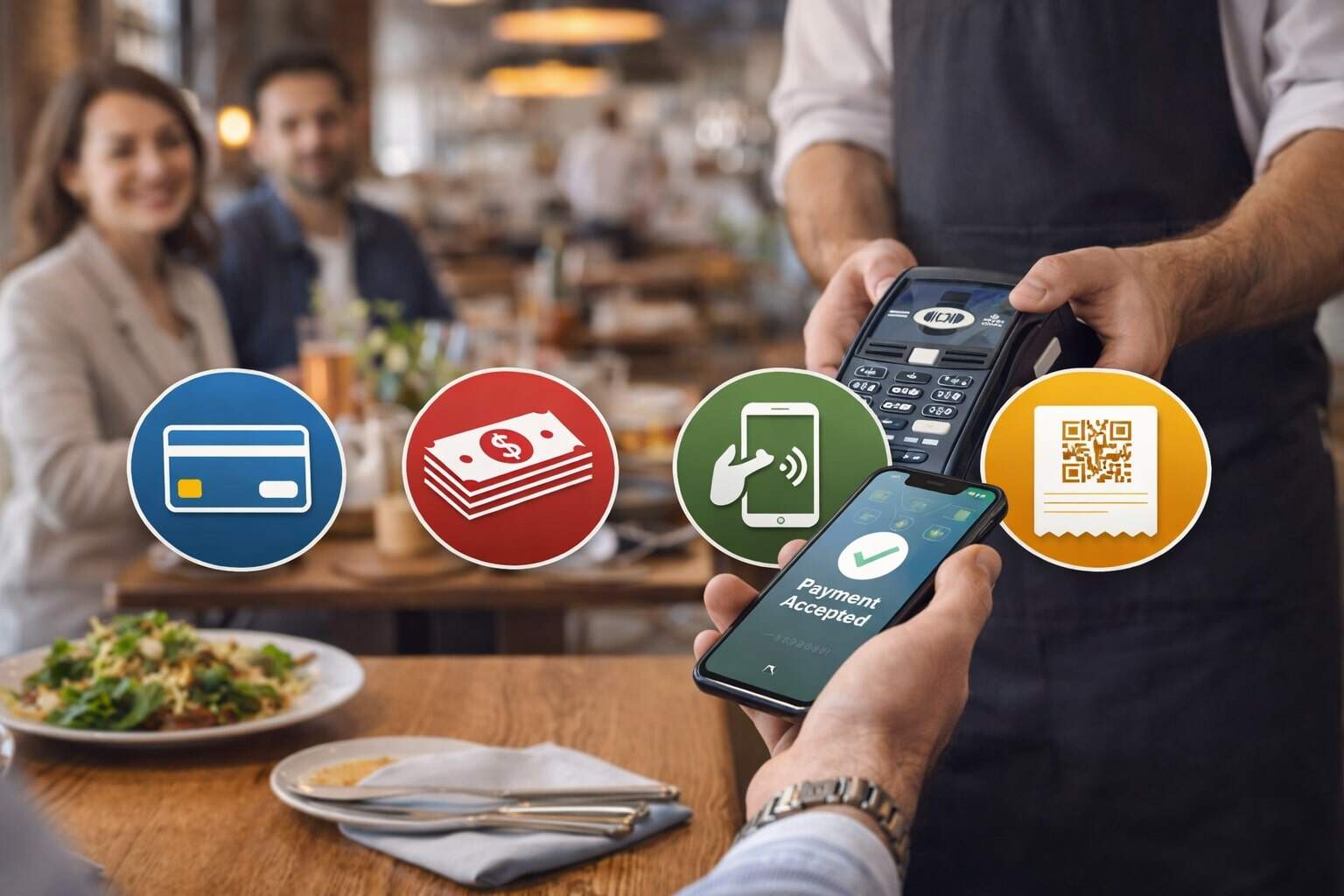
Restaurants win or lose guests in tiny moments: the host stand, the first bite, and—more than many owners realize—the payment experience. Today, restaurant payment methods are no longer “just swiping a card.” They’re a mix of in-person and digital options that affect checkout speed, tips, chargebacks, loyalty, delivery revenue, and even how often customers return.
This guide breaks down the most common restaurant payment methods, how each one works, what it costs, where it shines, where it can go wrong, and what’s coming next.
To keep this easy to read, you’ll see short paragraphs, clear examples, and practical takeaways you can apply whether you run a quick-service counter, a bar, a full-service dining room, or a multi-location brand.
You’ll also get compliance and fraud guidance that matters specifically for food service, where gratuities, split checks, and card-not-present orders add complexity.
Why restaurant payment methods matter more than ever
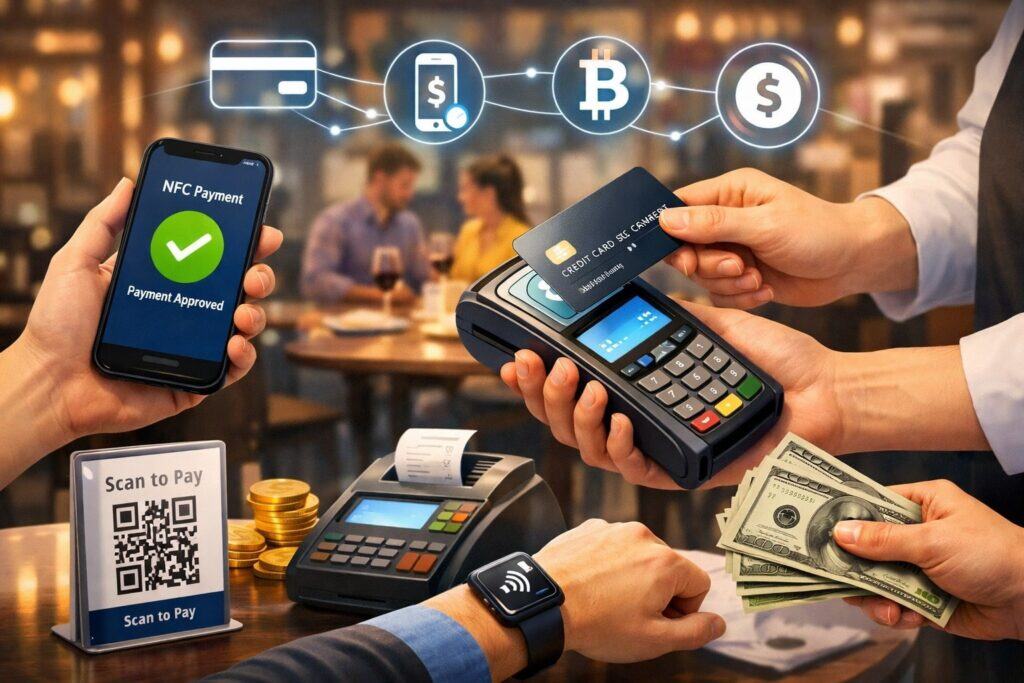
Choosing (and correctly setting up) restaurant payment methods impacts more than “how guests pay.” It influences table turns, order accuracy, tip capture, staff workflow, customer satisfaction, and total profit per ticket.
For example, a slow checkout at peak time can create a line at the register or keep a party seated longer than planned—both reduce throughput. On the other hand, a smooth tap-to-pay or pay-at-the-table setup can shave minutes off each closeout, improving the pace of service without making guests feel rushed.
Modern diners also expect choice. Some guests prefer contactless options like mobile wallets, while others still want cash. Delivery and online ordering guests often pay before they ever see a server.
Catering clients may want invoices, bank transfers, or stored cards for recurring events. If your restaurant payment methods don’t match these preferences, you lose orders, tips, and repeat visits.
There’s also a cost and risk angle. Each payment type carries different processing fees, fraud exposure, and dispute patterns. Card-not-present transactions—like online orders—tend to have higher fraud risk than an in-person chip or tap transaction. Meanwhile, gift cards bring great cash flow but require careful tracking, policies, and redemption planning.
Finally, compliance has become stricter. Restaurants handling card data must follow current security standards, and the updated PCI DSS v4.0 transition and “best practice” items became mandatory by March 31, 2025.
Card payments in restaurants: credit and debit
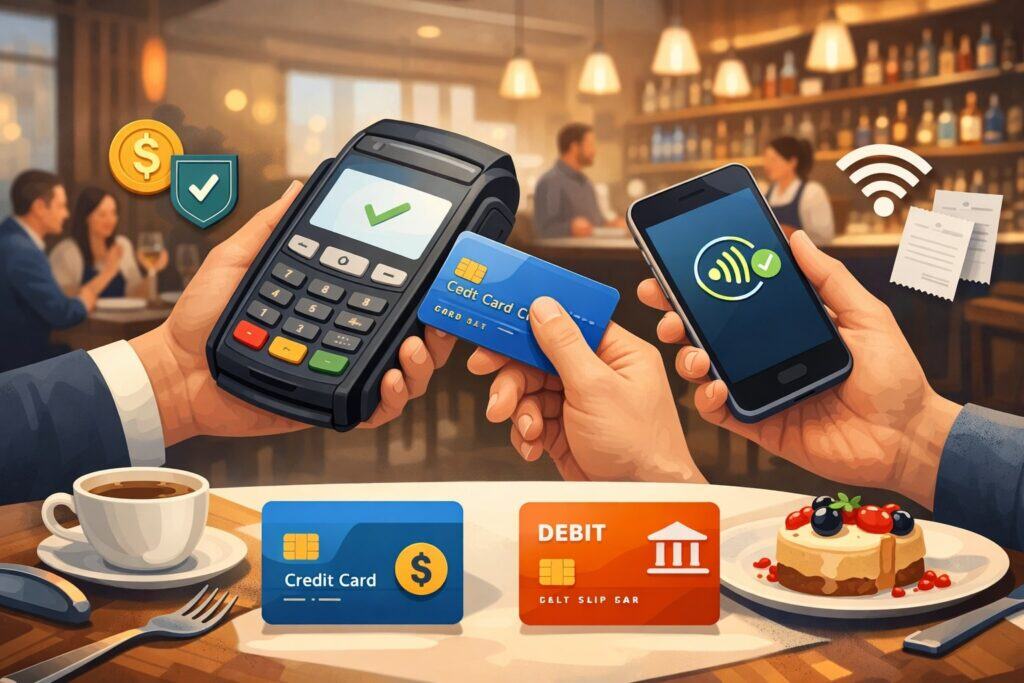
Credit and debit cards remain the backbone of most restaurant payment methods because they’re familiar, fast, and widely accepted. In a typical setup, the guest pays with a card, the transaction is routed through your payment processor, then through the card network, and finally to the issuing bank.
The approval comes back in seconds, and the restaurant receives funds after settlement (often the next business day, depending on funding terms).
Credit cards: how they work, where they fit, and what to watch
Credit cards are popular for dining because they support higher ticket sizes, easy tipping, and strong consumer protections. In full-service dining, credit cards are often used for larger checks where gratuity is added after the initial authorization.
Many restaurants authorize for the check amount (or a small buffer), then adjust the final captured total when the tip is added. This workflow makes credit cards central to tipping culture and smooth closeouts—especially when guests split checks or add tips on the receipt.
But credit cards also bring interchange and network-related costs that vary by card type and how the transaction is processed (tap/chip vs keyed). When a credit card is keyed in manually, it may qualify at a different rate tier than a chip or tap transaction because the risk profile changes.
That’s why training matters: staff should avoid “manual entry” unless necessary, and they should follow prompts that help transactions qualify as securely as possible. Credit cards also bring chargeback risk, especially for takeout, delivery, and “card on file” situations.
Common dispute reasons in restaurants include “I don’t recognize this charge,” “order not received,” “wrong amount,” and “I didn’t authorize a tip.” Good practices include itemized receipts, clear refund rules, consistent descriptor naming, and making sure tip entry is accurate and supported by signed receipts where required.
Future trend: expect more restaurants to adopt pay-at-the-table and handheld devices to reduce lost receipts and improve the “moment of payment.” This also reduces walkouts and speeds up table turns—especially during peak hours.
Debit cards: PIN vs signature, and why debit is different
Debit cards look similar to credit cards, but the funds typically come from a bank account rather than a credit line. In restaurants, debit can be run in a few ways: as PIN debit (guest enters a PIN) or as a “signature” debit transaction (processed on the card networks similarly to credit).
Many guests prefer debit because it helps them control spending, and many restaurants like debit because it can be fast and widely used for quick-service.
Debit transactions can have different cost structures, and they can behave differently when tips are involved. For example, if a debit transaction is processed with a tip adjustment later, the system needs to handle the final amount correctly without causing declines or customer confusion.
Some setups prefer to capture the total (including tip) in one step when possible, while others use authorization plus adjustment.
Operationally, debit cards shine in fast, high-volume settings (cafés, counter service, food trucks). But they can also cause friction if guests want to tip after the authorization and the device flow doesn’t match expectations.
The best approach is to use terminals and POS flows designed for restaurants, not retail, because restaurant-specific payment methods must support split checks, tip prompts, and batch settlement patterns.
Future trend: debit usage will continue rising alongside contactless adoption, with “tap debit” becoming a standard behavior for quick meals. As contactless experiences speed up, guests will expect debit to be as seamless as a wallet tap.
Contactless payments: tap-to-pay cards and mobile wallets
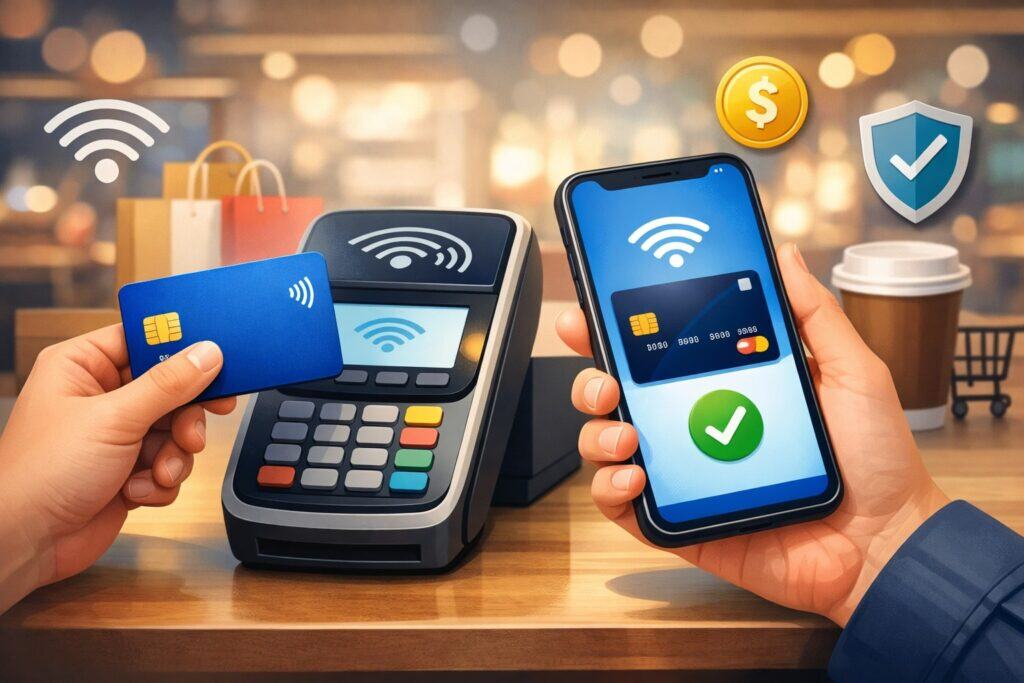
Contactless has become one of the most visible shifts in restaurant payment methods because it reduces checkout time and feels modern. Guests tap a contactless-enabled card or phone near the terminal; the transaction uses EMV contactless technology to generate dynamic data, which is more secure than old magnetic stripe swipes.
Tap-to-pay cards: speed and security benefits in busy service
Tap-to-pay cards are a strong fit for restaurants because they’re fast, reduce physical contact, and generally improve throughput. For quick-service and counter pickup, tap-to-pay can be the difference between a smooth line and a bottleneck. The guest taps, the transaction approves quickly, and the staff moves to the next order.
From a security standpoint, tapping is typically safer than magstripe because it uses dynamic cryptograms rather than static stripe data. That matters in environments like bars or fast counters where staff may not examine cards closely. Tap also reduces wear on terminals compared to inserting chips repeatedly.
Contactless isn’t only about speed; it can also improve tip capture when combined with properly designed prompts. For example, many counter-service models rely on tip prompts at checkout. A fast tap with a well-designed tip screen can increase tip rates without forcing awkward interactions.
Future trend: “tap-to-phone” acceptance is expanding, where a merchant device can accept taps without a dedicated terminal. Visa has highlighted strong growth in Tap to Phone adoption. This is especially relevant for pop-ups, food trucks, and event catering where portability matters.
Mobile wallets: Apple Pay, Google Pay, and the guest experience
Mobile wallets are among the most guest-friendly restaurant payment methods because they combine speed with a feeling of security. Guests tap their phone or watch and authenticate via biometrics.
The restaurant doesn’t see the guest’s full card number in the same way as a traditional card entry, which can reduce certain types of fraud and improve trust.
Wallet usage is particularly strong for:
- Fast casual and quick-service
- Takeout counters
- Bars and venues with high drink volume
- Modern full-service experiences using handhelds
Mobile wallets also support loyalty integration when paired with the right POS and customer engagement tools. While wallets themselves don’t automatically create loyalty accounts, the overall digital experience encourages guests to opt into SMS/email rewards, digital receipts, and re-order links.
Future trend: more acceptance options without extra hardware. Apple’s “Tap to Pay on iPhone” allows merchants to accept contactless payments using only an iPhone and a supported payment app, which can reduce hardware dependence for small operators and mobile concepts.
Cash payments: still essential, but operationally different
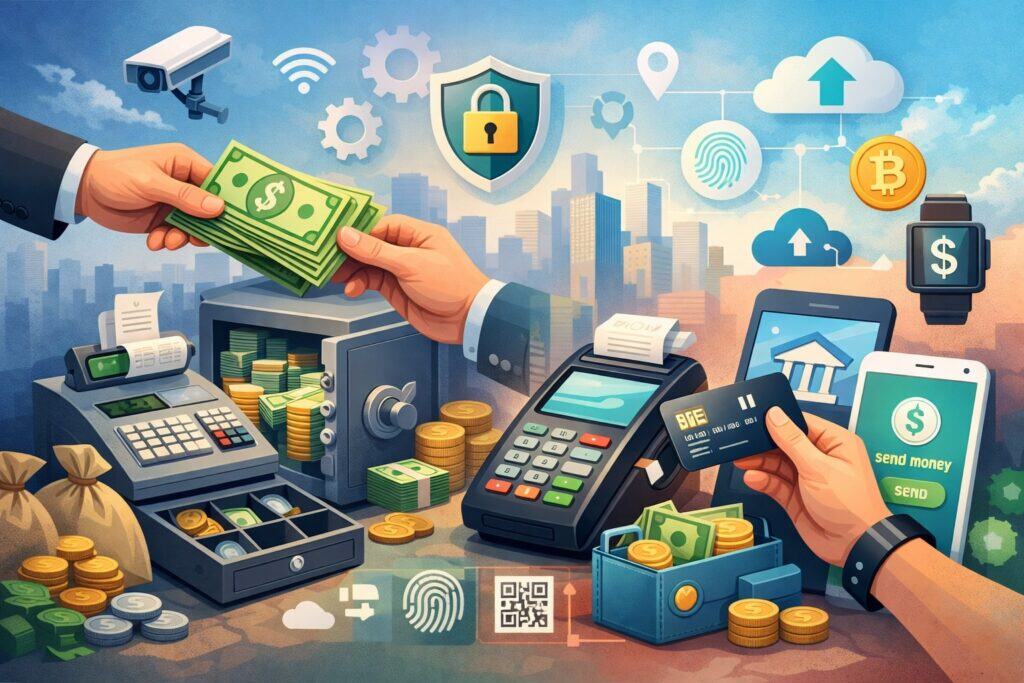
Even as digital options grow, cash remains one of the most common restaurant payment methods for many concepts, especially in neighborhoods where cash budgeting is normal, or in quick-service where speed matters. Cash has advantages: it’s immediate, it avoids processing fees, and it eliminates chargebacks.
But cash also creates operational work. You need secure cash handling procedures, clear drawer accountability, change management, safe drops, and end-of-day reconciliation. If you don’t build discipline here, cash leakage can quietly reduce profit.
Pros of cash: control, cost, and simplicity for guests
Cash can be a strategic tool. Some restaurants prefer cash for small-ticket items because processing fees can be meaningful at low ticket sizes. Cash can also reduce friction for guests who don’t want to use cards or who are managing spending.
Cash is also resilient when networks go down. If your internet is unreliable or you run a pop-up with weak connectivity, cash can keep service moving. In a crisis scenario—terminal outage, processor disruption, or a temporary power issue—cash keeps the restaurant open.
However, “cash-only” is a brand decision. It can limit impulse purchases, reduce average ticket size for some diners, and inconvenience guests who expect digital payment methods. Many restaurants choose a hybrid approach: accept cash but design the checkout process so digital payments still feel fastest.
Future trend: fewer purely cash-based operations, but continued cash usage in tips, small purchases, and neighborhood spots. Restaurants that keep cash should invest in tight controls, not just a drawer.
Cash challenges: labor, safety, accounting, and guest perception
Cash management adds labor: counting drawers, preparing deposits, reconciling shortages, and recording cash sales accurately. Cash also introduces safety risks—robbery, employee theft, and mistakes.
Restaurants with late-night hours should consider security protocols like minimal cash on hand, time-delay safes, and clear policies around drop frequency.
Accounting is another challenge. If cash sales aren’t recorded consistently, you can distort food cost percentages, tax reporting, and inventory planning. Many operators underestimate how much “small” cash errors become “big” annual losses.
Guest perception matters too. Some diners associate “cash-only” with inconvenience. Others love it because it feels straightforward and sometimes comes with a discount. If you encourage cash discounts, be consistent and transparent with signage and receipts so guests don’t feel surprised at checkout.
Future trend: cash will remain part of the payment mix, but restaurants will increasingly treat cash like a specialized workflow that requires training, technology controls, and audit habits—especially as digital reporting becomes more precise.
Restaurant payment methods for online ordering and delivery
The fastest-growing complexity in restaurant payment methods comes from off-premise sales: online ordering, delivery, catering portals, and third-party marketplace apps. These transactions often happen without a physical card present, which changes fraud risk and dispute patterns.
Card-not-present payments: why risk is higher and how to reduce disputes
When a guest pays online, the restaurant can’t rely on chip or tap security in the same way. This increases fraud exposure, which can lead to more chargebacks. In food service, disputes are often emotional and immediate: “My order was missing items,” “It was cold,” “I didn’t get it,” or “I didn’t authorize that tip.”
Practical ways to reduce risk:
- Use address verification and CVV checks where supported
- Require account logins or verified phone numbers for repeat ordering
- Use clear fulfillment tracking (timestamps, pickup confirmation, delivery handoff notes)
- Photograph large catering orders before they leave
- Make refund policies visible and consistent
Restaurants should also keep clean documentation. If a chargeback happens, you want easy access to order details, receipts, customer communication, and proof of fulfillment. A strong POS + online ordering integration reduces the “missing paperwork” problem that causes preventable losses.
Future trend: more “one-click reorder” and stored credentials for returning guests, plus stronger fraud screening at checkout. As instant payments and account-to-account options expand, restaurants may gain alternatives that reduce card dispute exposure for certain order types.
Third-party delivery platforms: payment flows and margin reality
Third-party delivery platforms often handle the payment, then pay the restaurant after taking commissions and fees. This is still part of the restaurant’s overall restaurant payment methods strategy because it affects cash flow, reporting, and guest ownership.
The upside: instant access to customers who browse the marketplace. The downside: reduced margins and weaker customer relationship. Payment reconciliation can also be tricky, because the restaurant may receive batched deposits that include multiple orders, adjustments, and promotions.
Restaurants often do best when they treat marketplace delivery as a customer acquisition channel, while pushing repeat guests toward first-party ordering where payment methods can be optimized for profitability. That might mean offering better loyalty rewards, lower prices, or exclusive menu items through your own site/app.
Future trend: more hybrid models where restaurants maintain marketplace listings but focus marketing on owned channels, using digital receipts and loyalty to migrate repeat buyers.
Gift cards and stored value: prepaid revenue with long-term upside
Gift cards are one of the most powerful restaurant payment methods because they bring prepaid cash flow, attract new guests, and encourage higher spending (many diners spend more than the gift card value). They also work as a loyalty tool when paired with promotions, holidays, and corporate gifting.
Physical and digital gift cards: setup, tracking, and redemption best practices
Physical gift cards remain popular at the register, especially during holidays. Digital gift cards (emailed or SMS) are growing fast because they’re easy to buy last-minute and can be integrated into online ordering.
Best practices:
- Use a system that tracks balances in real time
- Make gift card redemption smooth across in-store and online
- Train staff on partial redemptions, balance checks, and returns
- Prevent fraud by requiring secure issuance and monitoring unusually large purchases
From an operations standpoint, gift cards require careful accounting treatment because the sale is typically a liability until redeemed. Restaurants should also plan for what happens if a store closes, a concept changes, or you migrate POS systems—gift card portability matters.
Future trend: more “gift + loyalty” bundles where guests buy a gift card and get bonus value, plus deeper digital wallet storage so gift cards live inside a guest’s phone and are easier to redeem.
Gift card fraud: common schemes and how restaurants protect themselves
Gift cards can be targeted by scammers who try to drain balances, trick staff into issuing cards without payment, or exploit weak refund policies. Restaurants can reduce risk with:
- Role-based permissions (who can issue, refund, or adjust balances)
- Alerts for unusual gift card activity
- Requiring manager approval for large card issuance or refunds
- Clear refund rules for gift card purchases
Also, avoid manual workarounds. If staff write down gift card numbers or handle cards outside the system, you lose control and auditability. A good stored-value platform should give you reporting, audit trails, and easy balance lookup.
Future trend: tighter fraud monitoring and tokenized gift card storage, making it harder for criminals to reuse exposed card numbers.
QR code pay and pay-at-the-table: modern checkout for full-service dining
QR code payment and pay-at-the-table solutions are reshaping restaurant payment methods in dining rooms because they shorten the payment cycle. Instead of waiting for the check, then waiting for the card pickup, then waiting for the return, guests can pay when they’re ready—often without needing the server for the final step.
QR code payments: convenience, staffing impact, and guest choice
QR code pay typically works by placing a code on the table or receipt. The guest scans it, reviews the bill, selects a payment method (often card or wallet), tips, and receives a digital receipt.
Benefits:
- Faster table turns during busy periods
- Reduced “check waiting” frustration
- Helpful when staffing is tight
- Great for lunch rushes and high-volume dining rooms
Concerns:
- Some guests dislike paying on their phone
- Accessibility issues if guests don’t have smartphones
- Risk of QR code tampering if signage isn’t secured
The best implementation is “optional, not forced.” Keep traditional card acceptance available, and train staff to introduce QR pay as a convenience, not a replacement for service.
Handheld terminals and pay-at-the-table: better tips and fewer walkouts
Handheld payment devices are one of the most effective upgrades in restaurant payment methods for full-service. Servers bring the device to the table, present the bill, and process chip/tap payments instantly. Guests can tip on-screen, split checks easily, and get a receipt without delay.
This approach reduces:
- Card mishandling risk
- Time spent walking back and forth
- Payment errors from manual tip entry
- Walkouts and forgotten cards
It can also improve tip outcomes because guests see clear prompts and can tip immediately while the experience is fresh. For bars, handhelds help close tabs quickly and reduce end-of-night chaos.
Future trend: more software-only acceptance where phones become terminals. As “Tap to Pay on iPhone” and “Tap to Phone” style acceptance grows, more restaurants may rely less on dedicated hardware for certain use cases.
ACH, invoices, and account-to-account payments for catering and B2B
Not every restaurant payment method’s decision is about diners. Catering, events, and wholesale often need invoicing, deposits, and bank-based payments. This is where ACH and account-to-account options become relevant.
ACH transfers: when they make sense and what to manage
ACH is commonly used for catering deposits, recurring corporate lunches, and wholesale relationships. It can be cheaper than card acceptance for large invoices, and it’s familiar to business clients who prefer bank payments.
Things to manage:
- Payment timing (ACH isn’t always instant)
- Deposit schedules and late-payment policies
- Clear invoicing and reconciliation
- Authorization and documentation for recurring debits
For restaurants, ACH works best when paired with a clear contract: deposit amount, cancellation window, final headcount deadline, and refund terms. That reduces disputes and makes payments predictable.
Future trend: more restaurants will offer bank-based payment links for catering, especially as real-time payment networks mature and guests expect faster settlement.
Real-time payments: what’s changing with instant rails
Instant payment rails are expanding, and restaurants may see new options beyond cards over time—especially for B2B and catering. The FedNow Service launched in July 2023 and continues to expand features and adoption for instant payments between participating financial institutions.
For restaurants, the near-term impact is likely:
- Faster payouts for certain business payments
- New “request for payment” style options
- Improved cash flow for catering and corporate accounts
However, instant payments also require strong controls because once funds move, recovery can be harder than a card refund. Restaurants should treat instant payments like wire-level seriousness: verify payers, use clear invoices, and avoid taking instant payments from unknown sources without validation.
Future trend: as more banks support real-time rails, restaurants could adopt account-to-account payment options for catering that reduce fees and speed settlement—especially for large invoices.
Buy now, pay later and alternative payment methods
Some alternative restaurant payment methods are niche today, but they’re worth understanding because consumer behavior changes quickly.
BNPL: where it fits in dining (and where it doesn’t)
Buy now, pay later (BNPL) is more common in retail, but it can appear in food service for:
- Catering packages
- Large group reservations with prepaid menus
- Meal subscriptions or prepared food programs
BNPL can increase conversion on high-ticket experiences, but it also adds complexity: settlement timing, refund rules, and customer support responsibilities. Restaurants should be cautious about offering BNPL for normal dine-in tickets because it can confuse the payment moment and doesn’t match the “quick closeout” expectation.
Future trend: BNPL will likely remain a specialty tool for high-ticket hospitality experiences rather than everyday dining checks.
Cryptocurrency: mostly marketing today, but watch the tech direction
Crypto payments are still rare for typical dining transactions. Volatility, user adoption, and tax/reporting complexity make it impractical for most operators. Some restaurants accept crypto for branding reasons or in tech-heavy neighborhoods, but it’s not a mainstream restaurant payment methods choice.
Where crypto ideas may matter more is the underlying tech: faster settlement, tokenization concepts, and programmable payments. Even if diners don’t pay with crypto directly, some future payment infrastructure may borrow these ideas.
Fees, tipping, and policy choices that shape payment success
Even with the right restaurant payment methods, poor policies can create friction. Guests care about transparency. Staff care about reliability. Owners care about margins.
Service charges, surcharging, and cash discounts: what guests feel
Restaurants sometimes add fees to cover processing costs, employee benefits, or operational expenses. Whether this improves profitability depends on how it’s communicated and how guests react. Many diners strongly dislike surprise fees at checkout.
If you apply a surcharge or service fee, consistency and disclosure matter. Make it visible on menus, at checkout, and on receipts. Train staff to explain it calmly and confidently. Also be aware that rules can vary by location and card brand requirements, and changes can happen—so restaurants should review compliance regularly.
A common guest-friendly approach is a cash discount model: prices reflect card acceptance, and cash gets a small discount. Done transparently, it can feel fairer than a surprise surcharge.
Tipping flows: prompts, receipts, and tip accuracy
Tipping is central to restaurant payment methods in full-service and counter-service. The best systems:
- Support tip prompts for counter service
- Support tip adjustments for full-service
- Prevent tip-entry mistakes with clear screens
- Provide audit trails for tip changes
Tip disputes often happen when:
- Tips are entered incorrectly
- Receipts are missing signatures where required
- Guests don’t recognize the merchant name on statements
The fix is mostly process: clear receipts, consistent descriptor naming, staff training, and a POS flow that reduces manual entry.
Security and compliance for restaurant payment methods
Security isn’t optional. If you accept card payments, your restaurant must follow current card data security rules. Good security reduces fraud, reduces liability, and protects your reputation.
PCI DSS v4.0: what restaurants should know right now
PCI DSS applies to any business that stores, processes, or transmits cardholder data. The updated PCI DSS v4.0 became the active standard, and new requirements previously treated as “best practices” became mandatory by March 31, 2025.
For restaurants, the practical meaning is:
- Use validated payment devices and keep them updated
- Don’t store sensitive card data unless you have a compliant reason and controls
- Limit who can access systems
- Use strong passwords and multi-factor authentication where applicable
- Monitor for device tampering, especially in front-of-house areas
Most restaurants should aim to reduce scope by using point-to-point encryption (P2PE) and tokenization through reputable providers. The less card data you touch, the simpler compliance becomes.
Fraud prevention in restaurants: practical steps that work
Fraud looks different in restaurants than in retail. Common issues include:
- Stolen cards used for pickup orders
- Friendly fraud (“I didn’t get it”) on delivery
- Employee misuse of refunds or manual entries
- Chargebacks from unclear descriptors or tip confusion
Practical defenses:
- Require verification for high-risk orders (phone confirmation, ID checks for large pickups)
- Use clear order confirmation and delivery proof
- Keep refund rules consistent and documented
- Restrict refund permissions and track overrides
- Audit manual entries and unusual void patterns weekly
Future predictions: where restaurant payment methods are heading
Restaurants are moving toward payment experiences that are faster, more portable, and more embedded into ordering. Three themes stand out:
- Hardware-light acceptance: Tap-to-phone and “Tap to Pay on iPhone” style options reduce the need for dedicated terminals in some environments, especially mobile, pop-up, and line-busting scenarios.
- More instant settlement options: Real-time payment infrastructure continues expanding, and while cards will dominate dining for years, B2B and catering may increasingly adopt instant account-to-account tools where they lower costs and speed cash flow.
- Checkout becomes part of hospitality: Guests don’t want payment to interrupt the experience. QR pay, handhelds, and pay-at-the-table succeed when they feel optional, seamless, and aligned with service—not when they feel like the restaurant is “offloading” work onto the guest.
The restaurants that win with future restaurant payment methods will focus on choice, transparency, security, and speed—without losing the human hospitality that makes dining memorable.
FAQs
Q.1: What are the most common restaurant payment methods today?
Answer: The most common restaurant payment methods include credit cards, debit cards, contactless tap-to-pay cards, mobile wallets, cash, and gift cards. Many restaurants also accept online card payments for pickup and delivery, and some accept invoicing or ACH for catering.
Q.2: Which restaurant payment methods are best for quick-service restaurants?
Answer: Quick-service concepts typically perform best with fast restaurant payment methods like tap-to-pay, mobile wallets, and debit/credit cards with tip prompts. Cash is still important in many locations, but streamlined digital checkout usually improves line speed.
Q.3: Are contactless payments safe for restaurants?
Answer: Yes—contactless is generally safer than magstripe because it uses dynamic data. Tap-based restaurant payment methods also reduce card handling and can lower certain types of fraud compared with swiping.
Q.4: How can restaurants reduce chargebacks from online orders?
Answer: To reduce disputes on card-not-present restaurant payment methods, keep strong documentation: itemized receipts, order confirmations, fulfillment timestamps, and delivery/pickup proof. Use clear refund policies and consider verification steps for high-risk orders.
Q.5: Do restaurants need to comply with PCI DSS if they use a POS system?
Answer: Yes. If you accept card payments, PCI DSS applies. Using a reputable POS and processor can reduce your compliance scope, but you still need to follow operational controls. PCI DSS v4.0 deadlines and requirements apply broadly, with key changes fully effective by March 31, 2025.
Q.6: What payment method helps restaurants improve cash flow for catering?
Answer: For catering, many restaurants use deposits via card, ACH, or other bank-based restaurant payment methods. Bank payments can reduce processing fees on large invoices, and instant payment rails may increasingly support faster settlement over time.
Conclusion
The “best” restaurant payment methods aren’t a single option—they’re a well-designed mix that matches your concept, your guests, and your sales channels. Cards (credit and debit) remain essential, but contactless and mobile wallets are now expected.
Cash still matters, gift cards drive prepaid revenue, and online ordering requires extra attention to fraud and disputes. For catering and business clients, bank-based payments can improve margins and cash flow when managed properly.