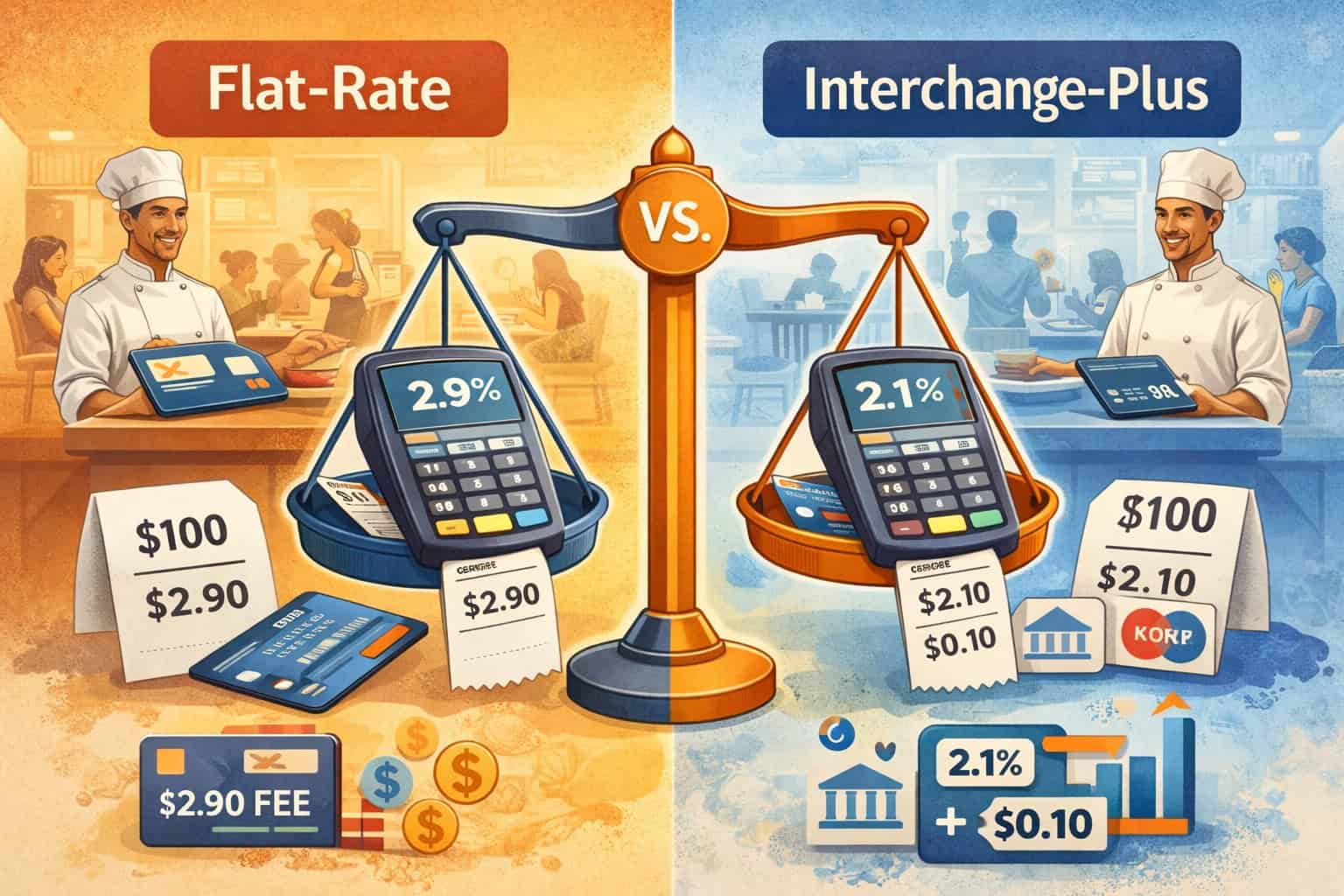
Restaurant credit card processing is one of those expenses that quietly grows as your sales grow—until it becomes impossible to ignore. The pricing model you choose (flat-rate pricing or interchange-plus pricing) can change your true processing cost more than most menu-price tweaks ever will.
That’s why the “flat-rate vs interchange-plus pricing for restaurants” decision isn’t just about saving a few basis points. It affects margins, cash flow, staff tip payouts, online ordering profitability, chargeback exposure, and how confidently you can forecast costs in busy and slow seasons.
Restaurants are also uniquely “complex merchants.” You have a mix of low-ticket and high-ticket orders, tips, partial refunds, bar tabs, delivery, catering invoices, and a growing share of digital wallet and online payments.
Each of those behaviors can push your effective rate up or down depending on whether you’re on flat-rate pricing or interchange-plus pricing. And when card networks adjust interchange programs, network fees, or rules (which happens regularly), the best pricing model for a restaurant can shift faster than many owners expect.
Mastercard publishes interchange program/rate bulletins on a schedule, and Visa publishes guidance on how surcharging works—both of which can impact restaurant payment strategy.
This guide breaks down flat-rate vs interchange-plus pricing for restaurants in plain language, with practical examples, the “gotchas” that matter on real statements, and future-facing predictions so you can choose a pricing model that fits your restaurant today—and still makes sense tomorrow.
Why Pricing Models Matter in Restaurant Credit Card Processing
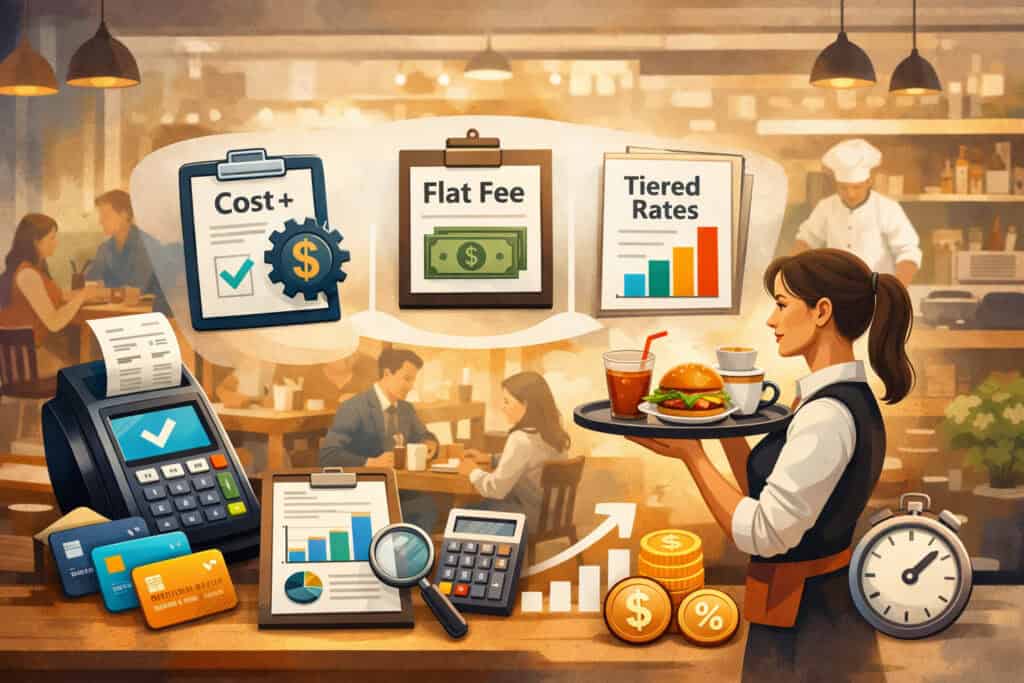
Restaurants don’t just “take payments”—they run a high-velocity payment environment. A typical day might include counter service at lunch, a rush of tap-to-pay at dinner, bar tabs that close late, tips added after authorization, online orders pushed through a gateway, and refunds for missing items.
Every one of those steps can influence your cost of acceptance. That’s why the pricing model itself matters as much as the rate you see in a proposal.
With flat-rate pricing, you get a simple advertised rate that bundles interchange, network assessments, and processor markup into one number. Simplicity is the appeal. But simplicity can hide whether you’re overpaying on lower-cost cards (like regulated debit) or underpaying (temporarily) on higher-cost rewards cards.
With interchange-plus pricing, your cost is unbundled: you pay the underlying interchange and network fees, plus a clearly stated processor markup. That transparency can be powerful for restaurants because you can actually diagnose why your effective rate changed—was it more online orders, more premium rewards cards, or a shift in debit vs credit?
The key idea in “flat-rate vs interchange-plus pricing for restaurants” is this: restaurants usually have enough transaction volume and enough payment-channel mix (in-store + online + delivery) that small differences compound quickly.
A 0.20% swing on $80,000 monthly card volume is $160/month—nearly $2,000/year—before you even factor in per-transaction fees, chargebacks, and monthly line items.
And because card network programs and rules evolve (including ongoing scrutiny of swipe fees and proposed settlements affecting card acceptance rules), a pricing model that’s “fine” today may become less favorable later.
How Flat-Rate Pricing Works in a Restaurant Setting
Flat-rate pricing charges a single, bundled rate (often plus a fixed per-transaction fee) regardless of what card the guest uses. In a flat-rate setup, your processor is effectively averaging card costs across your transactions.
When you run a $40 dine-in ticket, a $12 coffee order, or a $90 delivery order, your restaurant credit card processing fee is calculated using the same advertised formula—even though the underlying interchange for those payments can differ significantly based on card type, card brand, and how the transaction was accepted.
For restaurant owners, flat-rate pricing is attractive because it reduces decision fatigue. You don’t need to understand interchange tables.
You don’t need to decode statement line items. You can estimate fees quickly, which helps with pricing and budgeting. Flat-rate pricing is also often packaged with an easy onboarding flow, modern hardware options, and integrated tools for quick-service and small teams.
But flat-rate pricing for restaurants has tradeoffs. The bundled rate includes a built-in cushion for the provider. That cushion is how the processor protects itself when your guests pay with premium rewards cards or when your mix shifts toward online ordering, which can carry higher costs than card-present tap/insert transactions.
If your restaurant has a meaningful share of regulated debit, lower-cost transactions, or consistent card-present volume, flat-rate pricing can quietly become expensive because you pay the “average” even when your real underlying cost would have been lower.
In other words, in the “flat-rate vs interchange-plus pricing for restaurants” comparison, flat-rate pricing is often a convenience premium. Sometimes that premium is worth it. But you should know when you’re paying it—and what operational features you’re receiving in exchange.
Typical flat-rate structures restaurants see most often
Most flat-rate pricing plans combine (1) a percentage fee and (2) a per-transaction fee. Some providers also differentiate between card-present and card-not-present transactions, offering one flat-rate for in-store payments and a higher flat-rate for online, invoiced, or keyed-in payments.
That split matters for restaurants because online ordering, delivery, and catering payments are rarely “pure card-present,” even if you’re running a well-managed operation.
Restaurants also commonly see “blended flat-rate” offers that appear simple but add extra platform charges: POS software subscriptions, add-on fees for online ordering, “premium support,” or hardware leasing.
The result is that your effective restaurant credit card processing cost is not just the advertised rate—it’s the advertised rate plus fixed monthly costs that don’t scale down when sales slow.
A smart way to evaluate flat-rate pricing for restaurants is to treat it like a bundle: you’re paying for predictable processing plus product features (POS, reporting, integrations, loyalty, QR ordering, etc.).
If you truly use those features and they replace other software spend, flat-rate pricing may be a clean business decision. If you’re paying for features you don’t use, flat-rate pricing can become an expensive default.
When flat-rate pricing can look cheaper than it really is
Flat-rate pricing can look especially appealing when you’re comparing it to a confusing interchange-plus proposal. But the real comparison is “effective rate on your actual mix.” If your restaurant has a lot of small tickets, your per-transaction fee matters more than you think.
If you run many tip adjustments, you should confirm how the processor handles restaurant tip workflows and whether any transactions are downgraded or billed differently. If you do delivery and phone orders, confirm the card-not-present flat-rate (if different) and any gateway fees.
Flat-rate pricing can also look cheaper during promotional periods, introductory pricing, or when the provider’s platform subsidizes processing margin with other revenue. That can change later.
So in the flat-rate vs interchange-plus pricing for restaurants choice, you want to compare at least two scenarios: your current volume/mix and a “next year” version of your restaurant with more digital orders, more tap-to-pay, and potentially different card brand rules and interchange programs.
Mastercard interchange bulletins and network program updates are one reason restaurant costs can shift even when your menu doesn’t.
How Interchange-Plus Pricing Works for Restaurants

Interchange-plus pricing separates the “hard costs” from the processor’s margin. You pay the underlying interchange (set by card networks and issuers), plus network assessments, plus a fixed markup from your processor (often expressed as a percentage + per-transaction fee).
This is why interchange-plus pricing is frequently described as the most transparent pricing model in restaurant credit card processing.
In a restaurant context, interchange-plus pricing has a major advantage: it lets you see what’s driving your effective rate. If your effective rate goes up in a given month, interchange-plus statements can help you pinpoint why.
Did you run more online orders (card-not-present)? Did you see more premium rewards cards? Did your average ticket size change? Did your debit share drop?
That visibility is especially valuable for restaurants because payment mix changes with seasons, marketing campaigns, and platform shifts (delivery apps, online ordering, catering invoices).
Interchange-plus pricing also tends to reward operational best practices. For example, if your team consistently uses EMV insert/tap, batches daily, and avoids unnecessary manual entry, you’re more likely to qualify for lower-cost transaction categories when they apply.
While you can’t “game” interchange, you can reduce avoidable downgrades and reduce risk signals that lead to higher-cost processing in digital channels.
However, interchange-plus pricing for restaurants is not automatically cheaper. It’s cheaper when your processor markup is fair, your monthly fixed fees aren’t bloated, and your statement is clean (no hidden add-ons).
The key is making sure your “plus” is truly small—and that the provider isn’t making margin elsewhere through padded network fees, junk fees, or unnecessary subscriptions.
Interchange, assessments, and processor markup—what you’re really paying
A simple way to understand interchange-plus pricing is to treat it as three layers:
- Interchange: The base cost that generally goes to the card-issuing bank, determined by card type, acceptance method, and other factors.
- Network assessments and related fees: Charges from the card brands/networks tied to moving the transaction through the network.
- Processor markup (“the plus”): The payment provider’s revenue for processing, service, support, and risk handling.
Mastercard publishes interchange program and rate information in bulletins that show how varied interchange can be by program and card type, which is exactly why a bundled flat-rate can be misaligned with your restaurant’s real mix.
Why statement transparency matters for restaurants specifically
Restaurants can’t manage what they can’t see. When you’re running thin margins, you need clarity on cost drivers. Interchange-plus pricing gives you that clarity—if your processor’s statement is readable and honest.
Transparency matters even more now because the broader payments environment is under scrutiny and negotiation.
For example, proposed settlements and ongoing policy debates have focused on card network rules and the ability for merchants to manage acceptance costs (like greater flexibility to reject certain high-fee premium cards under a proposed Visa/Mastercard settlement).
That kind of shift would materially change how restaurants think about “flat-rate vs interchange-plus pricing for restaurants,” because cost control tools would improve for merchants who understand their mix.
Cost Drivers That Are Unique to Restaurants

Restaurants have payment patterns that other retail categories don’t. These patterns shape whether flat-rate pricing or interchange-plus pricing is the better fit. Understanding your restaurant’s payment anatomy is step one in making the flat-rate vs interchange-plus pricing for restaurants choice with confidence.
One major driver is ticket size variability. Quick-service restaurants often run many low-ticket transactions, which makes per-transaction fees more important. Full-service restaurants might have fewer transactions but higher tickets, which makes percentage rate more important.
Bars can swing dramatically—small tabs early, larger tabs late, and lots of tips. Then there’s the tip adjustment workflow. Restaurants often authorize first and finalize later with the tip. Your processor and POS must handle this cleanly to avoid added risk flags or operational mistakes that create higher-cost exceptions.
Another driver is batching and timing. If your system batches late or inconsistently, or if staff hold tabs for long periods, you can run into higher risk profiles and operational friction.
You also have refunds, voids, and partial refunds (common with missing items and guest recovery). Each can influence your net effective rate because you might pay fees on gross volume while refunds reduce your net sales.
Finally, restaurants are increasingly multi-channel. Card-present dine-in and takeout is usually lower risk than card-not-present delivery and online ordering. Online ordering growth is widely cited as a driver of payment behavior changes in restaurants, alongside contactless usage and mobile wallets.
Debit vs credit mix can change your math dramatically
Debit costs can differ significantly from credit, especially for certain regulated debit categories governed by Regulation II for covered issuers. The Federal Reserve explains Regulation II and how debit interchange fee standards work, and proposed updates to Regulation II have been discussed in recent years—meaning debit economics could shift.
For restaurants, this matters because a business with a high debit share might be a better candidate for interchange-plus pricing, since a flat-rate pricing plan often “averages up” and doesn’t fully reward lower-cost debit transactions.
Online ordering and delivery usually raise effective costs
Card-not-present transactions generally carry higher fraud risk, and risk influences cost categories. If your restaurant is growing delivery, pickup, catering invoices, or QR-based pay-at-table flows that route through a gateway, you’ll likely see your effective rate rise—especially under flat-rate pricing where the card-not-present rate is often higher.
Under interchange-plus pricing, you’ll see the mix shift clearly on your statement, and you can make operational moves: stronger fraud tools, better AVS/CVV usage where relevant, and channel-specific pricing decisions that protect margins.
Comparing Flat-Rate vs Interchange-Plus Pricing for Restaurants in Real Scenarios
The most helpful way to decide between flat-rate pricing and interchange-plus pricing is to compare scenarios that match how restaurants actually operate. The “best” model depends on your volume, your ticket size, your payment channels, and your tolerance for statement complexity.
For a new restaurant or a small café with unpredictable early volume, flat-rate pricing can be a reasonable starting point because it reduces complexity and provides a predictable cost baseline.
You can focus on staff training, guest experience, and consistent operations. The tradeoff is that if you scale quickly, you may outgrow the cost structure—especially if you have strong card-present volume and meaningful debit share.
For a busy quick-service restaurant, per-transaction fees matter a lot. If your average ticket is $10–$18 and you run hundreds of transactions per day, even a few cents difference per transaction adds up quickly.
In that case, interchange-plus pricing can be advantageous if the processor markup and per-item fees are fair and you keep your statement clean. Flat-rate pricing might still work if the provider’s per-item fee is low and the POS bundle saves you money elsewhere.
For a full-service restaurant with tips and higher average tickets, the percentage rate matters more than the per-item fee. Interchange-plus pricing often shines here because your higher ticket size can magnify the impact of paying a blended rate that’s “too high” for your real mix.
If your guests frequently use premium rewards cards, your underlying interchange can be higher, and the gap between flat-rate pricing and interchange-plus pricing may narrow. But if your processor markup is negotiated well, interchange-plus pricing can still win—especially as volume grows.
In the flat-rate vs interchange-plus pricing for restaurants decision, the most common “inflection point” is when you have stable monthly volume and enough transaction history to model your effective rate. Once you can model it, interchange-plus pricing typically gives you more control and a clearer path to optimization.
A realistic way to compare: effective rate + fixed fees + “channel mix”
A strong comparison isn’t just rate vs rate. It’s:
- Effective rate on your last 2–3 months of transactions
- Per-transaction costs vs average ticket size
- Monthly fixed fees (POS software, gateway, PCI, support)
- Channel mix (in-store vs online vs delivery)
- Operational friction (refunds, chargebacks, tip adjustments)
That framework stops you from choosing flat-rate pricing just because it “sounds simpler,” or choosing interchange-plus pricing just because it “sounds cheaper.” In restaurants, the right answer is the one that matches your mix and your operational reality.
Hidden Fees and Contract Terms Restaurants Must Watch
A restaurant can lose the savings of a better pricing model by missing the fine print. This is where many “flat-rate vs interchange-plus pricing for restaurants” decisions go wrong: owners compare the advertised rate but ignore statement-level fees, contract terms, and platform charges.
Common fixed costs include PCI-related fees, monthly minimums, statement fees, batch fees, gateway fees (especially for online ordering), and add-on charges for fraud tools.
Some processors also charge separate fees for chargeback handling, retrieval requests, and address verification. Even if those fees look small, they hit hardest during slower months, because they don’t scale down with volume.
Contract structure matters too. Watch for auto-renewal clauses, early termination fees, equipment lease agreements, and “non-cancellable” software subscriptions. A low interchange-plus markup is not a win if you’re locked into expensive hardware leasing or forced bundles you don’t need.
For restaurants with multiple locations, consistency matters. A provider might quote one location attractively and bury costs in “optional” features for the others. If you run multiple outlets, negotiate as a portfolio and standardize your statement format and reporting, so you can compare performance across stores.
Why “surcharging flexibility” and acceptance rules are part of the fee story
Restaurants often explore surcharging, cash discounting, or dual pricing to offset restaurant credit card processing costs. Card network rules define what’s permitted and what disclosures are required.
Visa’s merchant surcharging Q&A explains key concepts and limitations, and Mastercard publishes surcharge rules including caps (notably a maximum surcharge cap referenced in its guidance).
This matters because if you choose a pricing model assuming you’ll offset costs via surcharging—but you can’t implement it correctly or legally in your area—your financial plan breaks.
Also, proposed changes in card network rules (including those discussed in the context of the long-running interchange litigation and settlement proposals) could influence future flexibility for merchants.
Risk, Fraud, and Chargebacks: The Restaurant Reality
Restaurants are often viewed as lower risk than some e-commerce sectors, but the risk profile changes quickly when you add delivery, online ordering, and phone payments.
Chargebacks can rise due to “friendly fraud,” delivery disputes, stolen card usage, or confusing merchant descriptors. And when chargebacks rise, your overall processing relationship gets more expensive—either through explicit chargeback fees or through tougher underwriting and reserves.
In the flat-rate vs interchange-plus pricing for restaurants comparison, risk affects both models—but in different ways. Under flat-rate pricing, the provider has already built a margin into the rate, which can make them more tolerant of risk up to a point, but also less motivated to optimize your cost structure.
Under interchange-plus pricing, you see more of the moving parts, and you can often choose specific fraud tools and workflows that reduce card-not-present risk without blanket pricing increases.
Restaurants can also reduce disputes operationally: clear receipts, consistent merchant descriptors, strong customer service policies, and proper handling of tips and refunds. The “boring” basics—like accurate order confirmation for pickup and delivery—are often the cheapest fraud tools you can implement.
One more point: as contactless and wallet usage grows, your fraud profile can shift. Tap-to-pay tends to improve checkout speed and reduce some friction, but it also changes how you think about receipts, returns, and dispute evidence.
Payment trend discussions for 2025 emphasize expanding contactless adoption and tap-to-mobile solutions, which means restaurants should expect more digital payment behavior and continued growth in non-cash transactions.
Negotiation Playbook: How Restaurants Should Shop Pricing
Choosing between flat-rate pricing and interchange-plus pricing is only half the battle. The other half is negotiating the details that actually determine cost. Restaurants that negotiate well can make interchange-plus pricing highly competitive, and restaurants that negotiate poorly can end up paying “interchange-plus… plus a bunch of extras.”
Start by collecting the right data: your last 2–3 months of processing statements, transaction counts, average ticket size, and channel breakdown (in-store vs online). Then ask providers for proposals that match your reality: don’t let them quote a “card-present only” assumption if 30% of your volume is online ordering.
For interchange-plus pricing, focus on the processor markup and fixed fees. Ask for a simple markup (percentage + per-item) and request the removal of unnecessary monthly charges. For flat-rate pricing, ask for clear separation between the flat-rate and any platform fees, POS fees, or add-ons so you can calculate an honest effective cost.
Next, negotiate operational alignment: tip adjustment support, batch timing controls, multi-location reporting, online ordering gateway integration, and chargeback tooling. A restaurant is not a clothing store. Your processor should understand hospitality workflows.
Finally, negotiate flexibility. Month-to-month terms, transparent hardware pricing, and clear support SLAs matter. If a provider won’t put pricing and fees in writing in a clean way, that’s a signal that your “simple rate” is hiding complexity.
What to ask for when comparing flat-rate vs interchange-plus pricing for restaurants
Ask each provider:
- What is the total monthly fixed cost at my current volume?
- What is the effective rate estimate using my real mix?
- What fees apply to refunds, chargebacks, and gateway transactions?
- How do you handle tips, partial captures, and tab preauth?
- Can you provide an itemized fee schedule with no “miscellaneous” categories?
These questions keep the comparison grounded in real restaurant operations—not marketing.
Technology and Payment Trends: POS, Tap to Pay, Online Ordering, and Wallets
Restaurant technology has become a major driver of payment economics. Integrated POS systems simplify operations, but they can also “bundle” costs in ways that blur whether you’re truly on flat-rate pricing or interchange-plus pricing.
If your POS provider controls your processing relationship, you may be paying for convenience in a way that’s hard to measure without a careful statement review.
Tap-to-pay and digital wallets are also changing the payment experience. Faster checkout can increase throughput during rush periods, which is valuable. But it also shifts how you manage receipts, refunds, and customer expectations.
Industry predictions for 2025 highlight continued growth in contactless payments, mobile wallets, and “tap-to-mobile” adoption—meaning more restaurants will accept payments via phones and lightweight hardware setups.
From a pricing-model standpoint, more contactless and wallet payments don’t automatically mean higher or lower fees, but they can change your card mix and transaction routing.
The bigger driver is often channel growth: online ordering, delivery marketplaces, and catering invoices. Those flows can increase card-not-present volume, and card-not-present often costs more than card-present.
That’s why the best “flat-rate vs interchange-plus pricing for restaurants” decision is paired with a technology plan. If you’re moving aggressively into online ordering and delivery, interchange-plus pricing may give you better visibility and more levers to optimize.
If you’re a small single-location shop using a turnkey POS bundle, flat-rate pricing may be acceptable if the bundle replaces other software costs and keeps operations clean.
Future-proofing your payment stack without overpaying
Future-proofing means choosing tools that can adapt as rules and fees evolve. Card networks regularly update programs, and public debate around swipe fees continues. Mastercard interchange program bulletins and broader settlement discussions around card acceptance rules show that the landscape doesn’t stand still.
For restaurants, future-proofing also means owning your data: make sure you can export transaction reports, reconcile deposits cleanly, and identify channel-level profitability. The more you can see, the more you can manage—especially if you choose interchange-plus pricing.
Compliance and Rules: Surcharging, Cash Discount, and Dual Pricing
Many restaurants explore passing on some processing cost—especially as card usage grows and margins stay tight. But you have to do it carefully. Surcharging is not the same as cash discounting, and rules can vary by card brand and by local legal environment.
Visa defines a surcharge as an additional fee a merchant adds for using a particular form of payment and explains that merchants in most states may add a surcharge to credit card transactions subject to limitations and conditions. Mastercard also publishes merchant guidance that discusses surcharge rules and references a maximum surcharge cap.
In practice, restaurants must think about guest experience. A surprise fee at checkout can hurt repeat business more than it saves in processing.
That’s why some restaurants choose dual pricing (displaying cash and card price) or a clearly disclosed service fee model—where permitted—rather than a last-second surcharge. The right approach depends on your brand, your clientele, and your competitive environment.
This section matters for the flat-rate vs interchange-plus pricing for restaurants decision because cost-offset strategies can change which pricing model feels “best.” If you plan to offset fees, you may tolerate a slightly higher effective processing cost in exchange for operational simplicity.
If you plan to compete aggressively on pricing and keep fees invisible to guests, you’ll usually care more about optimizing your underlying effective rate—often pushing you toward interchange-plus pricing.
Where the rules may be heading
The broader payments environment is evolving. In addition to ongoing regulatory discussions (like proposed updates affecting debit interchange standards under Regulation II), merchant fee scrutiny continues through litigation and policy debate.
Restaurants should expect continued attention on transparency and merchant flexibility, which could expand cost-control options over time.
Future Predictions for Restaurant Processing Costs and Pricing Models
Restaurants should plan for a world where payment acceptance keeps changing—sometimes subtly, sometimes dramatically. The first prediction is simple: digital and contactless payments will keep growing, and restaurants will keep adding more payment channels (tap-to-pay, pay-at-table QR, online ordering, delivery).
Payment trend commentary for 2025 emphasizes ongoing contactless adoption and broader payment technology shifts, which typically increases the complexity of your payment mix.
Second, interchange and network fee dynamics will remain a moving target. Card networks update programs periodically, and bulletins like Mastercard’s interchange rate/program documentation illustrate how detailed and variable interchange can be.
Even if your restaurant runs the same operations, your effective rate can drift as consumer card preferences shift toward premium rewards products.
Third, merchant flexibility may improve, but slowly. A proposed Visa/Mastercard settlement announced in November 2025 has been reported to include changes related to acceptance rules (including the ability to reject certain high-tier cards) and modest fee reductions, though it still requires court approval and has critics.
If merchant acceptance flexibility expands, restaurants that understand their card mix (often those on interchange-plus pricing) may benefit more because they can make informed acceptance and pricing decisions. Flat-rate pricing could still be viable, but the advantage of transparency grows when rules create new levers.
Finally, expect more restaurants to run regular “effective rate audits.” The winning strategy won’t be picking a model once and never revisiting it. It will be choosing a model, measuring it quarterly, and renegotiating when your channel mix changes.
FAQs
Q.1: Is flat-rate pricing or interchange-plus pricing better for a small restaurant?
Answer: For a small restaurant, the “better” model depends on your priorities: simplicity vs optimization. Flat-rate pricing is usually easier to start with because you can predict costs without decoding statements.
If you’re a new café, food truck, or single-location quick-service concept, the time saved can be valuable. You’ll spend less energy on processing details and more on operational consistency, staff training, and guest experience. Flat-rate pricing also tends to pair well with turnkey POS bundles, which can reduce setup friction.
Interchange-plus pricing becomes more compelling when you have stable volume and enough transaction history to model your effective rate. If you’re consistently processing meaningful monthly card volume and you’re mostly card-present, interchange-plus pricing often gives you more transparency and a clearer path to savings—especially if your debit share is strong.
It also helps you understand exactly why costs move, such as when online ordering grows or premium rewards cards become more common.
The best approach for many small restaurants is to start simple but set a review point. Decide that you’ll reevaluate flat-rate vs interchange-plus pricing for restaurants once you hit a specific monthly volume or once your online ordering becomes a consistent percentage of sales.
That way, your pricing model evolves with your business instead of locking you into a convenience premium indefinitely.
Q.2: What’s the biggest mistake restaurants make when comparing flat-rate vs interchange-plus pricing?
Answer: The biggest mistake is comparing the headline rate instead of comparing the effective cost on your real mix. Restaurants often get pitched a clean flat-rate pricing number and a confusing interchange-plus pricing proposal, and they choose the one that “looks simpler.”
But restaurant credit card processing isn’t just a percentage—per-transaction fees, monthly fixed charges, gateway costs, refunds, and chargeback fees can change the outcome.
Another major mistake is ignoring channel mix. If you’re doing delivery, online ordering, catering invoices, or phone orders, you’re not a “pure card-present” restaurant anymore.
Flat-rate pricing often charges more for card-not-present transactions, and interchange-plus pricing will reflect higher underlying costs in those channels. If you don’t model that, you might choose a plan that looks good for dine-in but becomes painful as digital sales grow.
Restaurants also underestimate contract terms. A good interchange-plus markup can be ruined by expensive monthly fees, equipment leasing, or long-term commitments. Likewise, a fair flat-rate can turn costly once add-on POS fees stack up.
The fix is straightforward: demand a full fee schedule, calculate effective rate using recent statements, and compare at least two scenarios—today’s mix and next year’s likely mix.
Q.3: Do tips affect interchange-plus pricing or flat-rate pricing for restaurants?
Answer: Tips affect restaurant payment economics mainly through workflow: authorization vs final capture, and how your system handles adjustments. In full-service restaurants, it’s common to authorize a card for the base amount and then finalize later with a tip.
Your processor and POS must support this properly. If the workflow is clunky, staff might re-run transactions, key-enter when they shouldn’t, or delay batching—each of which can increase cost or create risk issues.
In flat-rate pricing, tips generally don’t change the pricing structure itself because you’re paying the same bundled rate on the final captured amount. But the operational mistakes around tipping can still increase issues like disputes or reconciliation errors, which add costs indirectly.
In interchange-plus pricing, tips still usually don’t “change” interchange in a simple way, but they can affect how transactions are categorized if the process is handled poorly (for example, if transactions get re-keyed or processed outside the intended flow).
That’s why restaurants should evaluate not only flat-rate vs interchange-plus pricing for restaurants, but also whether the provider truly supports restaurant-grade tip adjustment and reporting. A good provider will help you reduce operational errors, reconcile tips cleanly, and minimize disputes—often worth more than a tiny pricing difference.
Q.4: Can restaurants reduce processing costs without changing pricing models?
Answer: Yes—often significantly—because a meaningful portion of restaurant credit card processing cost is operational.
Even if you stay on flat-rate pricing, you can reduce “avoidable cost” by improving payment acceptance hygiene: encourage tap/insert over swipe, avoid manual key entry whenever possible, batch consistently, tighten refund procedures, and improve order confirmation for pickup/delivery to reduce disputes.
You can also optimize channel strategy. If third-party delivery platforms are eating margin, it may be worth steering repeat guests to first-party online ordering where you control fees and guest experience. Fraud and chargeback reduction can also lower soft costs: fewer disputes, less staff time, and fewer risk flags that make processors nervous.
If you’re on interchange-plus pricing, you gain extra levers because you can actually see what’s driving cost: card-not-present share, premium card share, debit routing effects, and network fee line items.
That visibility helps you make smarter operational and pricing decisions. Finally, you can negotiate better. Many restaurants can reduce processor markup and remove unnecessary monthly fees without changing providers, as long as they bring statements and volume history to the negotiation.
Q.5: Are surcharges or dual pricing a good idea for restaurants?
Answer: They can be, but they’re not “free money,” and they must be implemented carefully. Card brand rules and local laws matter.
Visa publishes merchant surcharging guidance explaining what a surcharge is and outlines limitations, and Mastercard provides surcharge rules including caps and disclosure requirements. If you don’t follow the rules, you can create compliance issues and guest complaints.
From a restaurant perspective, the bigger question is guest experience. A surprise fee at checkout can damage trust and reduce repeat visits, especially in competitive neighborhoods.
That’s why some restaurants prefer clearly disclosed dual pricing (cash price and card price displayed) or a transparent service fee approach—where allowed—rather than a last-second surcharge.
In the flat-rate vs interchange-plus pricing for restaurants decision, surcharging strategy can influence your choice. If you plan to offset costs, you might accept a simpler flat-rate pricing plan.
If you want to keep pricing clean and avoid checkout friction, you’ll likely focus more on optimizing the underlying processing cost—often making interchange-plus pricing more attractive. Either way, the decision should be intentional, disclosed clearly, and aligned with your brand.
Q.6: What changes might affect restaurant processing costs in the next few years?
Answer: Several forces could reshape restaurant processing economics. First, payment behavior is trending toward more contactless and mobile wallet usage, and industry commentary for 2025 suggests continued growth in these methods. More digital payments usually means more channels, more mix complexity, and more need for visibility.
Second, interchange and debit regulation discussions could continue. The Federal Reserve’s Regulation II framework shapes debit interchange standards for covered issuers, and proposed updates have been discussed in recent years. If debit economics change, restaurants with high debit share could see noticeable shifts.
Third, the long-running interchange fee dispute involving Visa and Mastercard has produced proposed settlements that reportedly include modest fee reductions and changes to acceptance rules, like more flexibility around card types (though court approval and outcomes matter).
If acceptance flexibility expands, restaurants may gain new cost-control tools—especially those that track card mix and effective rate closely.
The practical takeaway: restaurants should treat pricing model choice as a living decision. Monitor effective rate quarterly, track channel mix, and renegotiate when your business changes.
Conclusion
The flat-rate vs interchange-plus pricing for restaurants decision is really a decision about control versus convenience. Flat-rate pricing offers simplicity and predictability, often paired with turnkey tools that reduce operational friction.
Interchange-plus pricing offers transparency and optimization potential, especially once your restaurant has stable volume, a known channel mix, and the desire to manage costs proactively.
If your restaurant is early-stage, low-volume, or heavily focused on convenience, flat-rate pricing can be a clean choice—as long as you understand you may be paying a convenience premium.
If your restaurant is growing, multi-channel, or running meaningful monthly volume, interchange-plus pricing often becomes the smarter long-term strategy because you can see what drives cost and negotiate based on facts.
Whichever path you choose, the winning move is the same: measure your effective rate, not your advertised rate. Review fixed fees, channel mix, and statement line items.
And plan to revisit your model as your restaurant evolves—because payments, rules, and consumer behavior will keep evolving too, from contactless growth to potential rule changes around card acceptance and fee structures.