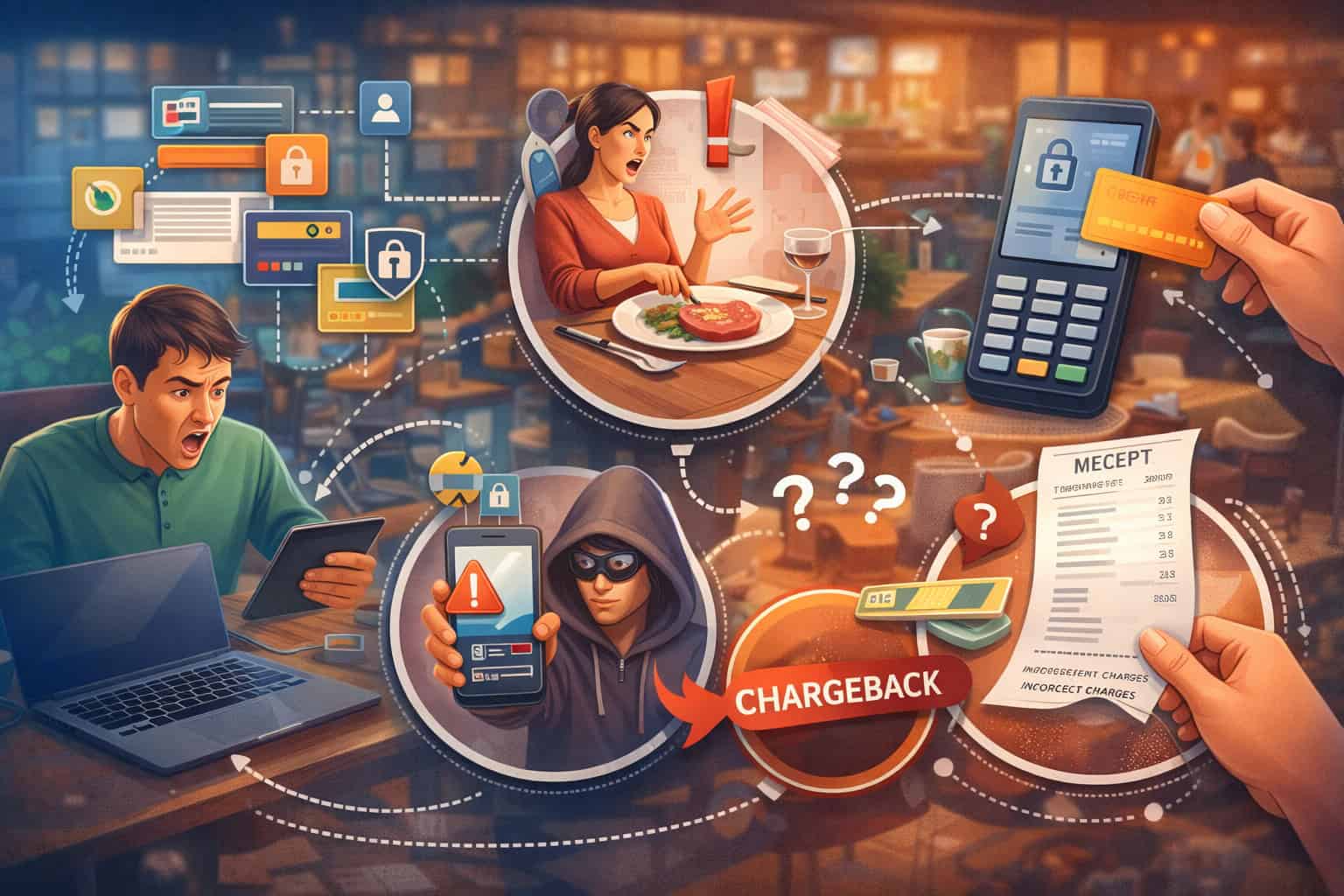
Chargebacks in restaurants happen when a guest disputes a card transaction and the issuing bank pulls the funds back from the restaurant—often with extra fees attached.
While some disputes are legitimate (like true fraud), many chargebacks in restaurants come from preventable issues: confusing receipts, “I don’t recognize this” claims, tip disputes, late-night walkouts that still get keyed-in, delivery complaints, duplicate charges, or staff skipping verification steps when the rush hits.
Restaurants are uniquely exposed because payments are fast, volumes are high, tips are added after the initial authorization, and service experiences are subjective.
Unlike retail where the customer leaves with a physical product, a restaurant guest can argue that the service was poor, the food was cold, or the delivery never arrived. Those complaints often turn into disputes instead of refunds—especially when guests can tap a few buttons in their banking app and file a claim.
This guide breaks down the real-world reasons chargebacks in restaurants occur, how to spot patterns, how to reduce them with practical steps, and what’s changing next in card dispute rules and technology.
You’ll also see risk hot spots like online ordering, delivery, bar tabs, and split checks—where chargebacks in restaurants are most likely to spike.
The Chargeback Process in Restaurants and Why It Feels Unfair
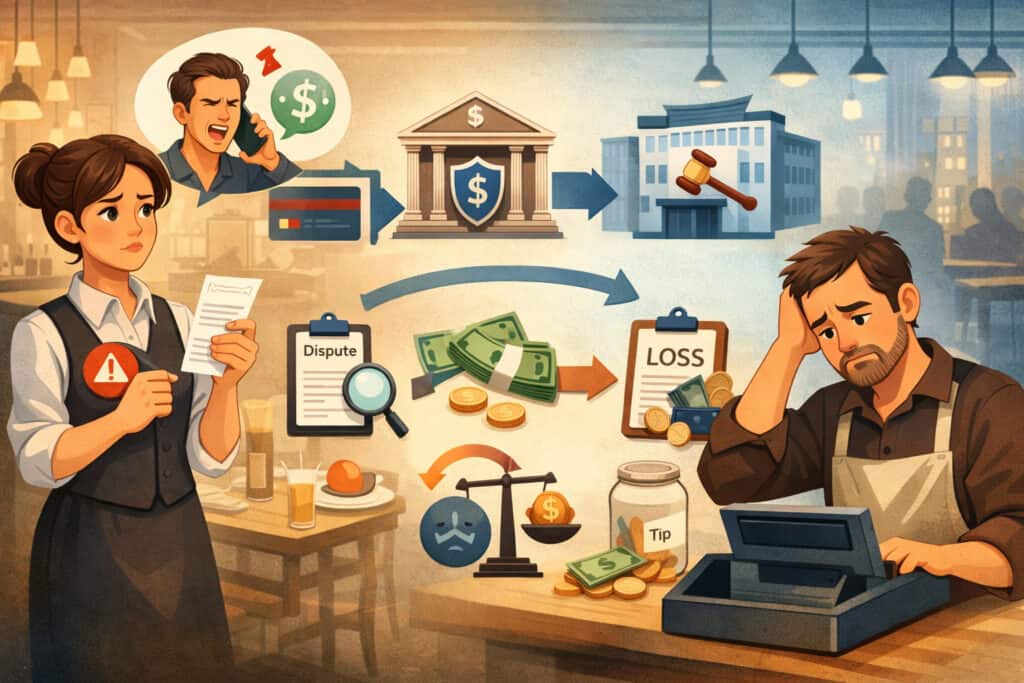
Chargebacks in restaurants can feel lopsided because the dispute process is designed to protect cardholders first. A guest contacts their bank, selects a dispute reason (fraud, not received, not as described, duplicate processing, canceled service, and so on), and the bank may issue a provisional credit quickly.
The restaurant then gets a notification through the processor and must respond with evidence within a strict deadline. If the restaurant misses the timeframe or submits weak documentation, the chargeback is usually lost by default.
Another reason chargebacks in restaurants sting is the cost stack. You lose the sale amount, pay a chargeback fee, and may also lose the food and labor costs that are already gone.
Too many chargebacks in restaurants can also trigger monitoring programs from card networks, which may lead to higher processing costs, rolling reserves, delayed funding, or account termination. Even when you “win,” you’ve spent staff time assembling evidence, pulling receipts, and writing responses.
Restaurants also deal with tip adjustments, incremental authorizations, and delayed captures—mechanics that are normal in food service but confusing to guests. A customer might see a pending amount, then a final amount, then think they were charged twice.
That misunderstanding alone is a major driver of chargebacks in restaurants. The key is to understand how banks interpret proof, what card networks expect as evidence, and how your day-to-day operations create dispute exposure—especially during peak hours.
Fraud-Driven Chargebacks in Restaurants
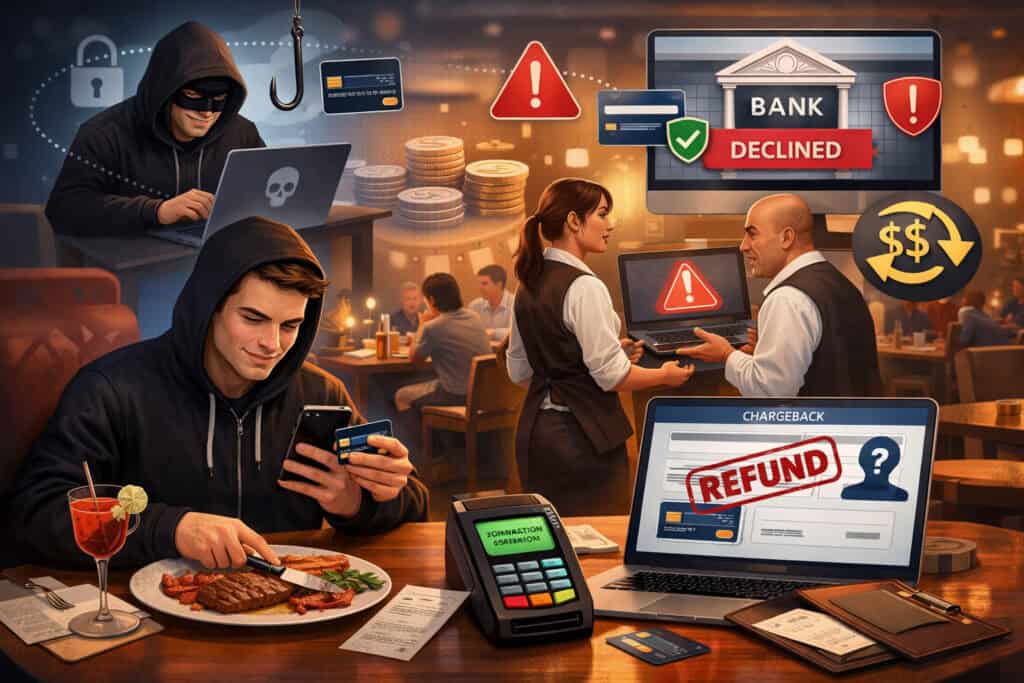
Fraud is a major bucket of chargebacks in restaurants, especially when card-not-present transactions (online orders, phone orders, app-based orders) are involved. In fraud disputes, the guest claims they didn’t authorize the charge.
Banks often lean toward the cardholder unless the restaurant can prove strong verification or liability is clearly assigned (for example, via modern authentication tools for online orders).
Fraud in restaurants isn’t always a masked stranger using a stolen card. Sometimes it’s “friendly fraud,” where a real customer makes the purchase and later disputes it.
That can happen after alcohol is involved, when family members share cards, or when someone regrets a large group bill. Because the meal is consumed, the restaurant can’t retrieve the “product,” and evidence can be harder to compile than a shipped retail order.
Fraud spikes in certain restaurant scenarios: late-night bars, quick-service locations near highways, high-ticket steakhouse tabs, and delivery zones with frequent “didn’t arrive” claims. It also increases when staff manually key in cards, accept screenshot “wallet” images, or skip checking IDs for chip fallback transactions.
If you want fewer chargebacks in restaurants, reducing fraud is about tightening verification without slowing down service—using the right tools and training, not just telling staff to “be careful.”
Card-Present Fraud: Counterfeit Cards, Stolen Cards, and Chip Fallback
Card-present fraud still drives chargebacks in restaurants when the payment flow is weak. Counterfeit cards are less successful with chip readers, but problems appear when the terminal allows magnetic stripe swipes too easily, when the chip fails and staff accept fallback swipes, or when a server runs a card away from the table and returns with a receipt that doesn’t match what the guest expected.
A stolen physical card used at a bar is another common source of chargebacks in restaurants—especially if no verification is performed and the guest later claims they never authorized the transaction.
The most dangerous pattern is repeated chip fallback. If a chip fails, networks expect the merchant to follow certain steps. When staff immediately swipe or key-in without proper prompts, the restaurant may lose fraud disputes. Tap-to-pay reduces risk, but only when it’s actually used and the terminal is configured correctly.
Another risk factor is storing open tabs without strong controls, then running a final charge after the customer leaves. If the customer argues the final amount is wrong, disputes can turn into chargebacks in restaurants even if the tab was legitimate.
To reduce this category, restaurants should enforce chip/tap as the default, limit fallback swipes, require manager approval for manual entries, and keep terminals updated. Simple operational discipline—like bringing portable terminals to the table—also improves trust and reduces “I didn’t do this” claims that become chargebacks in restaurants.
Card-Not-Present Fraud: Online Ordering, Phone Orders, and Delivery
Card-not-present orders are a leading engine of chargebacks in restaurants because the physical card isn’t verified at the point of sale. Fraudsters test stolen cards with small orders, then escalate to bigger ones.
Delivery and pickup systems also create “proof gaps”: the restaurant may have an order record, but not strong evidence that the legitimate cardholder authorized it or received it.
Phone orders are especially risky when staff accept card numbers without address verification or callback checks. Online orders can be exploited through bots, especially if the ordering page lacks rate limits, device fingerprinting, or fraud filters.
Chargebacks in restaurants increase when a restaurant is popular, has high delivery volume, or runs aggressive promotions—because those conditions attract both real customers and fraud attempts.
To fight card-not-present fraud, focus on layered checks: AVS (address verification where available), CVV collection, velocity controls (limits on repeated attempts), IP and device signals, and clear delivery confirmation.
For higher-risk orders, require stronger confirmation like a one-time passcode at pickup, signature at delivery, or a verified customer account. When you reduce card-not-present fraud, you reduce the most expensive type of chargebacks in restaurants because fraud disputes are harder to win without strong authentication and documentation.
Operational Errors That Trigger Chargebacks in Restaurants
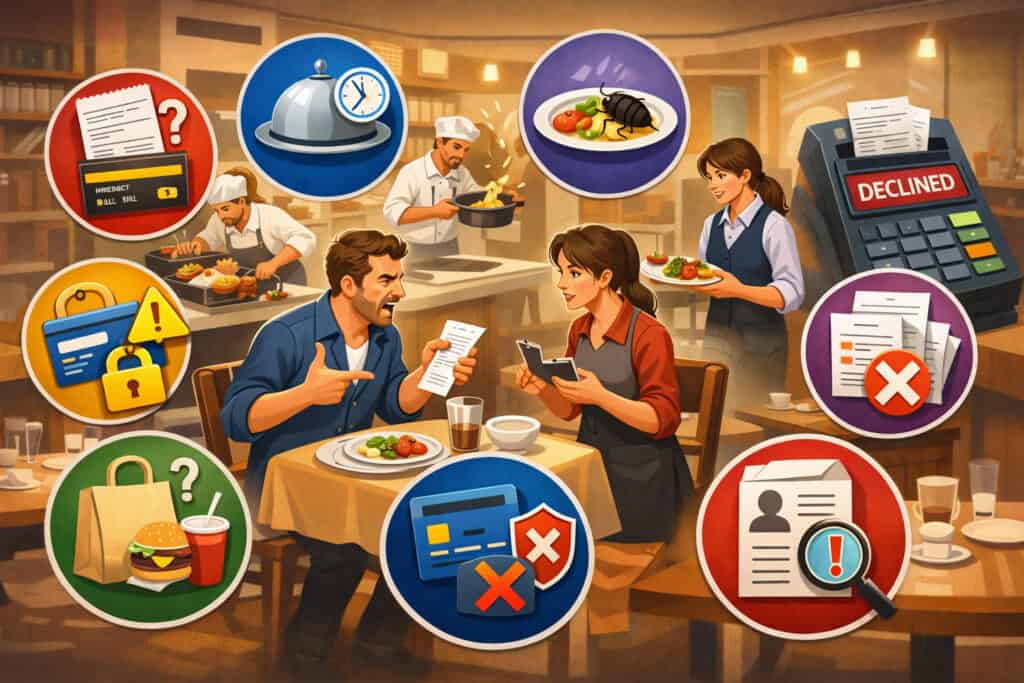
A surprisingly large portion of chargebacks in restaurants are not fraud—they’re mistakes. These are the easiest to prevent because they come from controllable processes: incorrect entry, duplicate charges, wrong check closures, tip entry errors, or mismatched receipts.
During busy shifts, small lapses scale quickly. One server double-taps a button, one bartender closes the wrong tab, or one manager batches incorrectly—and suddenly multiple guests dispute charges.
Operational chargebacks in restaurants often look like fraud to the guest because the amount is unfamiliar. The guest checks their bank app, sees two charges, panics, and disputes. Even if one charge is just a pending authorization that later drops, the dispute might already be filed.
That’s why restaurants should treat clarity as a payment security measure. Clear receipts, consistent descriptors, quick refunds, and strong reconciliation reduce confusion-driven chargebacks in restaurants.
Another operational issue is timing. Restaurants may authorize one amount, then capture later after tips are added. If batching is delayed, the final posting date can be days later.
Guests then forget the meal and file “no recognition” disputes, which become chargebacks in restaurants. Tight batch timing and accurate end-of-day procedures help prevent these “I don’t remember this” claims.
Duplicate Charges, Partial Reversals, and Authorization Confusion
Duplicate charges are one of the most common operational causes of chargebacks in restaurants. They can happen when a terminal times out and staff rerun the card, when a server mistakenly submits twice, or when a POS sync issue causes two captures.
Sometimes the restaurant sees only one completed sale, but the guest sees a pending authorization plus the final capture and assumes they were double charged. While authorizations often fall off automatically, guests don’t always wait.
Partial reversals can add confusion too. A guest may see multiple pending amounts for a single dining experience, especially with open tabs, incremental authorizations, or split checks. If staff cannot explain it clearly, the guest may dispute.
Banks frequently side with cardholders when the merchant’s documentation is messy, which is why these cases become chargebacks in restaurants even when the restaurant did not intend to overcharge.
Preventing this category is about clean workflows: train staff on what to do when a terminal errors, require checking transaction status before rerunning a card, and ensure your POS is configured to avoid duplicate submissions.
Also, use receipts and digital confirmations that show the final total clearly. When guests understand what they’re seeing, chargebacks in restaurants drop sharply.
Tip Adjustment Mistakes and Signature/Receipt Mismatches
Tip-related disputes are a unique driver of chargebacks in restaurants. A guest may claim the tip was altered, entered incorrectly, or added without consent. Sometimes the guest is right—numbers can be misread, handwriting is unclear, or staff make data entry mistakes.
Other times, the guest simply doesn’t recognize the final total because they only remember the pre-tip amount. Either way, tip confusion becomes chargebacks in restaurants because it’s easy for a guest to frame it as unauthorized.
Signature mismatches also matter. If a restaurant uses signatures (less common now, but still present in some environments), the signature on file may be illegible or missing.
If the receipt doesn’t match the amount captured—especially after a tip—banks may consider the merchant’s evidence weak. In many disputes, the quality of evidence determines outcomes more than the truth of what happened.
To reduce tip-driven chargebacks in restaurants, prioritize accurate tip entry, use digital tipping where possible, and implement end-of-shift review of high tips or unusual totals. Consider prompts that confirm the final amount on a customer-facing screen.
The less room there is for misunderstanding, the fewer disputes you face, and the easier it is to defend the chargebacks in restaurants that still occur.
Customer Experience Triggers That Turn Into Chargebacks
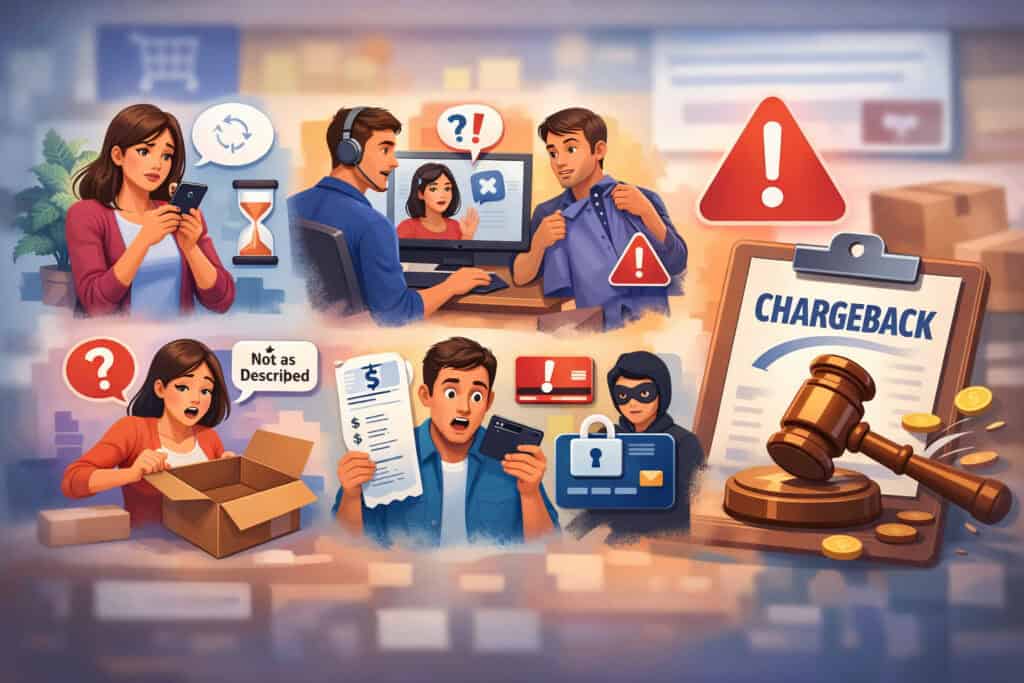
Not all chargebacks in restaurants are about payments. Many are about emotions: the guest felt ignored, the order was wrong, the wait was too long, or a delivery arrived late. When a restaurant doesn’t resolve complaints quickly, some guests skip the refund conversation and go straight to their bank. That turns a fixable issue into a chargeback, plus fees.
Customer experience disputes often show up under “not as described,” “services not rendered,” or “canceled.” In restaurants, these reasons can be subjective. A guest might claim food quality was unacceptable or that they never received the meal because it was left at the wrong door.
The bank doesn’t taste the food or watch the handoff; it relies on documentation. If your records don’t show what was ordered, how it was delivered, and how the complaint was handled, the restaurant may lose. That’s why customer experience management is a core strategy for reducing chargebacks in restaurants.
Restaurants with high takeout and delivery volume see this most. When the product leaves the building, the restaurant loses control over timing and condition. Packaging failures, missing items, and temperature issues are common.
The best defense is prevention: accurate order confirmation, careful packing procedures, delivery proof, and clear, friendly refund policies that encourage guests to contact you first instead of filing chargebacks in restaurants.
Order Errors, Missing Items, and Food Quality Complaints
Missing items are one of the fastest routes to chargebacks in restaurants, especially for delivery and pickup. A guest orders for a group, one entree is missing, and the guest disputes the entire order instead of requesting a partial refund.
In some cases, guests exaggerate claims because banks don’t always require strong proof from the cardholder, which fuels more chargebacks in restaurants over time.
Food quality complaints are tricky because they’re subjective. However, many disputes are rooted in preventable execution issues: unclear menu descriptions, inconsistent portion sizes, allergen mistakes, or poor packaging that causes spills.
When a guest believes they were misled or the meal was “not as described,” they feel justified disputing. That’s why the menu, photos, and upsell prompts must be accurate and consistent.
Reducing these disputes means building reliable order accuracy systems: kitchen checklists, expo verification, sealed bags with item counts, and receipts placed inside. For quality claims, document resolution attempts.
If a guest calls, note the time, the complaint, and the outcome (refund, remake, credit). That documentation can help when chargebacks in restaurants happen despite your best efforts.
Long Wait Times, No-Show Policies, and Reservation Deposits
As restaurants adopt reservation deposits and no-show fees, a new dispute category grows: customers disputing charges tied to cancellation rules. If the policy isn’t clearly disclosed at booking, guests may claim they never agreed.
Even if the restaurant policy is fair, poor communication turns into chargebacks in restaurants because banks look for evidence that terms were presented and accepted.
Long wait times can also spark disputes in pre-paid or deposit scenarios. If a guest feels the service was delayed beyond reason, they may argue the “service wasn’t rendered as expected.” This is especially common with special events, prix fixe menus, and holiday dining. Guests may be emotionally primed to dispute if the experience doesn’t match expectations.
To reduce this risk, make policies obvious: show them at booking, require an explicit confirmation checkbox, and include them in confirmation emails and receipts. When collecting deposits, describe the charge clearly so it doesn’t look like a random transaction later.
Transparent, well-documented policies don’t eliminate disputes, but they reduce chargebacks in restaurants by lowering the “I didn’t agree to this” argument that banks often consider.
POS, Payment Tech, and Data Issues That Increase Disputes
Technology can either reduce or amplify chargebacks in restaurants. When POS systems, gateways, and terminals don’t align, errors appear: mismatched totals, delayed captures, duplicate transactions, or incomplete data in receipts. Even small technical issues can lead to a pattern of disputes that looks like a risk problem to card networks.
One overlooked issue is the billing descriptor—the text that appears on the guest’s statement. If the descriptor is unclear, uses a legal entity name the customer doesn’t recognize, or lacks a location identifier, guests may file “unrecognized” disputes.
That’s a quiet but powerful driver of chargebacks in restaurants. A guest may remember dining at “Sunset Tacos,” but the statement shows “ABC Hospitality LLC.” Confusion becomes a dispute.
Another issue is poor logging. If the restaurant can’t produce a detailed receipt, order ticket, refund record, and any customer messages, it becomes difficult to defend. Strong data trails help reduce chargebacks in restaurants because you can respond quickly with clean, consistent evidence.
Billing Descriptors, Digital Receipts, and Guest Recognition
Billing descriptor optimization is one of the highest-ROI steps for reducing chargebacks in restaurants. The goal is simple: when the guest checks their statement, they instantly recognize the restaurant and location.
If you operate multiple locations or a parent company, include the brand name and a city or neighborhood reference where possible. Consistency matters—use the same recognizable name across platforms: POS, online ordering, and delivery channels.
Digital receipts also reduce confusion. If guests receive an emailed or texted receipt, they can reconcile the charge immediately. That reduces “no recognition” disputes that become chargebacks in restaurants days later. Digital receipts can also include itemization, tipping details, and refund instructions, steering guests toward direct resolution.
Guest recognition isn’t just about descriptors and receipts; it’s also about how staff communicate during payment. If tips, deposits, or split payments are involved, a quick explanation prevents misunderstanding. Clear communication reduces the chance that chargebacks in restaurants happen simply because a guest didn’t understand the final amount.
System Outages, Offline Mode, and Manual Keyed Transactions
When systems go down, restaurants often switch to offline mode or manual key entry to keep service moving. That’s understandable—but it increases risk. Offline transactions may capture later, confusing guests about timing.
Manual keyed transactions increase fraud exposure and reduce your ability to win disputes because verification is weaker.
During outages, staff may also create handwritten tickets or separate logs that don’t match POS records later. If a guest disputes, your evidence can look incomplete. That’s how operational chaos becomes chargebacks in restaurants even when the guest legitimately ate and paid.
To reduce this risk, create a documented outage playbook. It should include when to accept offline payments, how to record order details, how to obtain customer confirmation, and how to reconcile later.
Also set limits: for example, avoid keying in high-value transactions without manager approval. The more disciplined your “exception mode” is, the fewer chargebacks in restaurants you’ll face after the systems come back online.
High-Risk Scenarios: Bars, Tabs, Delivery, and Split Checks
Certain restaurant formats naturally produce more disputes. Bars and nightlife venues face intoxication-related disputes, walkouts, and tab confusion. Delivery-heavy restaurants face “not received” claims and address issues.
Busy brunch spots deal with large groups, split checks, and tip disputes. Knowing your high-risk scenario helps you apply targeted controls rather than generic advice.
Chargebacks in restaurants often spike in these environments because transaction context is messy: loud music, low lighting, rushed interactions, and multiple payment methods at one table. When guests are splitting bills, swapping cards, and adding tips, small errors become big disputes.
Another factor is third-party involvement. If a delivery marketplace is in the middle, the customer may dispute the restaurant charge, the marketplace charge, or both—depending on how the transaction is presented.
That can lead to duplicate disputes and confusion that increases chargebacks in restaurants. The best approach is to map your riskiest flows and build specific procedures for each one.
Open Tabs, Walkouts, and “Tab Closure” Disputes
Open tabs are a classic driver of chargebacks in restaurants, especially in bars. Guests may start a tab, order multiple rounds, then leave without formally closing. The bar closes it later with a standard gratuity or a tip estimate.
Guests then dispute the final amount, claiming it was unauthorized or incorrect. Even when the policy is posted, banks may side with the guest if evidence of agreement is weak.
Walkouts create another problem. Some venues try to charge a card on file if a guest leaves unexpectedly. If consent wasn’t clearly documented, that can become chargebacks in restaurants with a high loss rate. The key issue is authorization: did the guest knowingly authorize the method, the amount, and any automatic gratuity?
A safer approach includes clear disclosure, card-on-file consent, and customer-facing confirmation at tab start. Use pre-authorizations properly, keep itemized records, and capture signatures or digital acknowledgments when required by your workflow. The cleaner your tab process, the fewer chargebacks in restaurants you’ll see from late-night service.
Split Checks, Large Parties, and Gratuity Disputes
Large parties are high risk because totals are higher, multiple cards are involved, and service expectations are complex. Automatic gratuity can be a flashpoint.
Guests may claim they didn’t approve of it, didn’t see it on the menu, or were charged twice—once as gratuity and once as tip. Those misunderstandings frequently become chargebacks in restaurants, especially when receipts aren’t itemized clearly.
Split checks increase the chance of misapplied payments. A server might apply the wrong card to the wrong check, or accidentally charge one guest for another guest’s items. Even if corrected later, the guest may dispute the initial charge. And if the restaurant processes a refund but it takes time to post, guests may file disputes anyway.
To reduce this category, standardize large-party procedures: confirm party size and gratuity policy upfront, show gratuity clearly on the receipt, and use customer-facing devices that display the exact total before finalizing.
Encourage staff to repeat totals during the payment handoff. This reduces chargebacks in restaurants by preventing the “surprise” factor that pushes guests to dispute instead of asking for clarification.
Prevention Strategies That Actually Reduce Chargebacks in Restaurants
Reducing chargebacks in restaurants requires a combined approach: operational discipline, staff training, clear guest communication, and smart payment configuration. The goal isn’t just winning disputes—it’s avoiding them. Winning a chargeback can be difficult, and even a win costs time. Prevention is where profits are protected.
Start with the basics: clear receipts, clean descriptors, prompt refunds, and consistent policies. Many chargebacks in restaurants happen because the guest couldn’t reach anyone, didn’t know your refund rules, or got no response to a complaint.
Make contact easy and empower managers to resolve issues quickly. A fast refund is often cheaper than a chargeback fee plus lost product cost.
Next, tighten payment acceptance: chip and tap first, limit manual entry, and require manager approval for high-risk actions. For online ordering, apply fraud filters and confirmation steps for suspicious orders.
Finally, monitor your dispute reasons. The patterns tell you what’s broken—whether it’s a training issue, a tech issue, or a customer experience gap.
Staff Training, Checklists, and Manager Controls
Training is one of the most effective ways to reduce chargebacks in restaurants because most disputes start with human error.
Servers need simple rules they can follow under pressure: never rerun a card without checking status, always confirm the table and check number, and always review tips for legibility. Bartenders need a consistent tab policy and a clear process for closing tabs.
Checklists are powerful because they remove guesswork. Use a short end-of-shift checklist: reconcile open tabs, confirm voids and refunds are completed, verify high-ticket transactions, and close batches on time.
Manager controls also reduce risk. For example, require manager approval for manual keyed transactions, large refunds, or chip fallback acceptance.
When staff understand that chargebacks in restaurants are not just “a finance problem” but a daily workflow issue, behavior changes. It also helps to share examples. Show the team what a dispute looks like, what evidence is needed, and how a small mistake turns into a real cost. This makes training practical, not theoretical.
Customer Communication, Refund Routing, and Dispute Deflection
Dispute deflection means guiding guests to resolve issues directly with you instead of going to their bank. A simple “If there’s an issue, call us and we’ll fix it today” printed on receipts or included in digital receipts can reduce chargebacks in restaurants. So can fast response times on phone, email, and social channels.
Refund routing matters too. If you promise a refund but it takes a week to process, guests may dispute. Set expectations clearly: explain how long refunds usually take to appear on statements.
Also, make sure your team knows how to process partial refunds quickly for missing items or delivery problems, which are common triggers of chargebacks in restaurants.
Clear policies help, but they must be visible. Post them on online ordering pages, receipts, and confirmation messages. For delivery, include instructions for reporting issues immediately.
When guests feel heard and see a clear path to resolution, they’re less likely to file a dispute. That directly reduces chargebacks in restaurants without needing complex tools.
Responding to Chargebacks: Evidence, Timelines, and Win Rates
Even with strong prevention, some chargebacks in restaurants will happen. The key is to respond quickly and submit strong evidence. Evidence typically includes itemized receipts, signed or customer-confirmed receipts (when available), order details, timestamps, server notes, refund history, and any customer communications.
For delivery orders, proof of delivery is critical: address confirmation, delivery confirmation, photos, or signature/OTP confirmation where used.
Speed matters because dispute windows are strict. If you miss a deadline, you usually lose automatically. Organization matters too. If evidence is inconsistent—like different totals across documents—the bank may side with the cardholder. That’s why you need a repeatable response process.
It also helps to know which cases to fight. Some disputes are low-value and not worth the time. Others are patterns you must challenge to stop repeat abuse.
Restaurants should track chargebacks in restaurants by reason code, channel (in-store vs online), and location, then decide a policy for representation (challenging disputes) based on expected win rates and total cost.
Building a “Dispute Packet” That Banks Actually Accept
A good dispute packet tells a coherent story. It should include a clean itemized receipt, proof of authorization (chip/tap record when available), order ticket details, and any evidence the guest participated in the transaction.
If it’s a pickup order, include pickup time, name used, and any confirmation steps. If it’s delivery, include address match and delivery confirmation.
The packet should also address the dispute reason directly. For example, if the reason is “duplicate processing,” show that one charge was voided or reversed. If the reason is “no recognition,” emphasize the descriptor, date/time, and the items. If the dispute is about tip, include the tip line record and note your tip entry verification process.
Banks aren’t evaluating emotion; they’re evaluating documentation. The clearer your packet, the better your odds. Even when you lose, strong packets can reduce chargebacks in restaurants over time by signaling that your business challenges illegitimate disputes consistently.
When to Refund Instead of Fight and How to Avoid Repeat Abuse
Not every dispute is worth fighting. If you clearly made an error, refund quickly and learn from it. If the guest has a valid complaint and you can verify it, a refund is often cheaper than a chargeback. However, repeat abusers exist.
Some guests learn they can claim “not received” repeatedly. That behavior can cause recurring chargebacks in restaurants unless you adjust policies.
A practical approach is tiered decision-making. For low-ticket disputes, you may choose refunds to save labor. For high-ticket disputes, repeated claims, or suspicious patterns, you fight with evidence and consider blocking future orders.
Keep internal notes on repeat issues: addresses with frequent delivery claims, phone numbers associated with disputes, or accounts with multiple chargebacks in restaurants.
Also, fix the root cause. If disputes cluster around one shift or one terminal, investigate. If online disputes spike after a new menu photo update, you may have created expectation gaps. The smartest dispute strategy is one that reduces future chargebacks in restaurants, not just recovering a few transactions.
Future Trends and Predictions for Restaurant Chargebacks
Chargebacks in restaurants are evolving as payments become more digital and disputes become easier to file. The big trend is frictionless disputes: customers can start disputes in-app without calling anyone.
That convenience increases “impulse disputes,” where guests dispute before contacting the restaurant. At the same time, restaurants are adopting more digital payment methods—QR code pay-at-table, app-based ordering, and kiosks—which changes evidence types and dispute patterns.
Expect more focus on authentication and data quality. As fraud tools improve, liability may shift more cleanly when strong authentication is used. Restaurants that adopt better identity and order verification will reduce fraud-related chargebacks in restaurants.
Another growing trend is reservation deposits and experience-based dining fees, which will continue to create disputes unless terms are crystal clear.
AI-driven fraud attempts may rise too. Bots can test cards, create fake accounts, and place orders quickly. That will push restaurants toward smarter fraud filters and stronger controls. The winners will be restaurants that balance convenience with verification—adding friction only when risk is high.
QR Codes, Pay-at-Table, and Digital Identity Signals
Pay-at-table via QR codes can reduce certain disputes because customers see totals directly and can confirm before paying. It also reduces the “my card left my sight” concern.
However, QR payments can introduce new confusion if receipts aren’t delivered properly or if multiple payment links are active at once. Clear UX matters because confusion still becomes chargebacks in restaurants.
Digital identity signals will become more important for online ordering—device reputation, behavioral patterns, delivery address history, and account trust scores. Restaurants won’t need to become cybersecurity experts, but they will benefit from ordering platforms and gateways that provide these protections by default.
As digital flows become standard, evidence becomes more data-driven. That can improve win rates for chargebacks in restaurants because logs can show what happened more precisely than handwritten receipts—if your systems are configured correctly and store the right data.
Smarter Dispute Tools and “Pre-Chargeback” Interventions
Another likely direction is earlier intervention. Some ecosystems already support dispute alerts or early warning systems that notify merchants before a dispute becomes a formal chargeback. Wider adoption of these tools would reduce chargebacks in restaurants by letting you refund or resolve issues quickly, avoiding the fee and the negative dispute record.
Also expect better integrations between POS, ordering, and customer service logs. When everything is connected, you can pull evidence faster and respond within deadlines. Restaurants that invest in integrated systems will manage disputes more efficiently and reduce overall chargebacks in restaurants.
The future favors operational excellence. The restaurants that win are those that treat payments as part of hospitality: clear communication, accurate execution, and fast problem-solving. That approach prevents disputes before they turn into chargebacks in restaurants.
FAQs
Q.1: What are the most common causes of chargebacks in restaurants?
Answer: The most common causes of chargebacks in restaurants include fraud claims (especially for online orders), duplicate charges, tip disputes, unclear billing descriptors, missing items in delivery/pickup orders, and dissatisfaction that wasn’t resolved through a refund.
Confusion is a major factor—guests often dispute because they don’t recognize the charge or don’t understand why the final amount changed after tips.
Operational mistakes during busy shifts also play a big role, such as closing the wrong check, rerunning a card after a timeout, or entering a tip incorrectly. When restaurants improve receipt clarity, refund speed, and payment workflows, chargebacks in restaurants often decline significantly.
Q.2: How can restaurants reduce “I don’t recognize this charge” disputes?
Answer: To reduce chargebacks in restaurants tied to “no recognition,” focus on statement clarity and guest confirmation. Make sure your billing descriptor is recognizable and consistent with your brand name.
Provide itemized receipts and, when possible, digital receipts by text or email so guests can reconcile the purchase later. Train staff to explain deposits, gratuity, and tip adjustments.
Also close batches daily so posting dates don’t drift too far from the dining experience, which increases forgetfulness. These steps reduce chargebacks in restaurants by preventing confusion before it turns into a bank dispute.
Q.3: Are delivery and online orders more likely to cause chargebacks?
Answer: Yes—delivery and online orders generally produce more chargebacks in restaurants because they are card-not-present transactions and are easier for fraudsters to exploit. They also create disputes about non-receipt, missing items, and quality issues.
To reduce these chargebacks in restaurants, use layered verification (CVV, address checks where available, fraud filters), confirm pickup/delivery properly, and maintain strong order accuracy processes. Clear issue-reporting instructions and quick partial refunds for missing items also help keep customers from disputing the full order.
Q.4: What evidence helps win restaurant chargebacks?
Answer: Winning chargebacks in restaurants depends on the reason code, but strong evidence usually includes an itemized receipt, proof of authorization (chip/tap record where possible), timestamps, order details, refund records, and customer communication logs.
For delivery, proof of delivery is crucial—address confirmation, delivery time, photos, or signature/OTP confirmation if used. For tip disputes, clear tip line records and consistent tip entry procedures matter.
The key is submitting consistent, readable, and relevant documentation within deadlines, because banks heavily weigh evidence quality in chargebacks in restaurants.
Q.5: Should restaurants refund customers instead of fighting disputes?
Answer: Sometimes yes. If the restaurant made an error, a refund is often cheaper than a chargeback fee plus staff time. But for high-value disputes, repeated abuse, or clear legitimate sales, challenging can be worthwhile.
The smart approach is a policy that weighs the transaction value, likelihood of winning, and whether the pattern is increasing chargebacks in restaurants. Also consider proactive refunds when you receive early alerts, if available, to prevent a dispute from turning into a formal chargeback.
Conclusion
Chargebacks in restaurants rarely come from a single problem. They usually result from a mix of fraud risk, operational mistakes, customer experience breakdowns, and payment clarity issues like descriptors and tip adjustments.
The most profitable strategy is prevention: make charges easy to recognize, keep receipts clean and itemized, close batches on time, limit manual entry, and train staff to follow simple payment rules under pressure.
For delivery and online ordering, add layered verification and reliable proof-of-delivery processes, because card-not-present disputes are a major driver of chargebacks in restaurants.
When disputes still happen, respond fast with a clear evidence packet that addresses the dispute reason directly. Track patterns by channel and cause so you can fix root issues instead of treating disputes as random events.
Looking ahead, digital ordering, QR payments, and easier in-app disputes will keep chargebacks in restaurants a key operational challenge—but restaurants that combine better communication, stronger verification, and cleaner payment data will see fewer disputes and better outcomes over time.