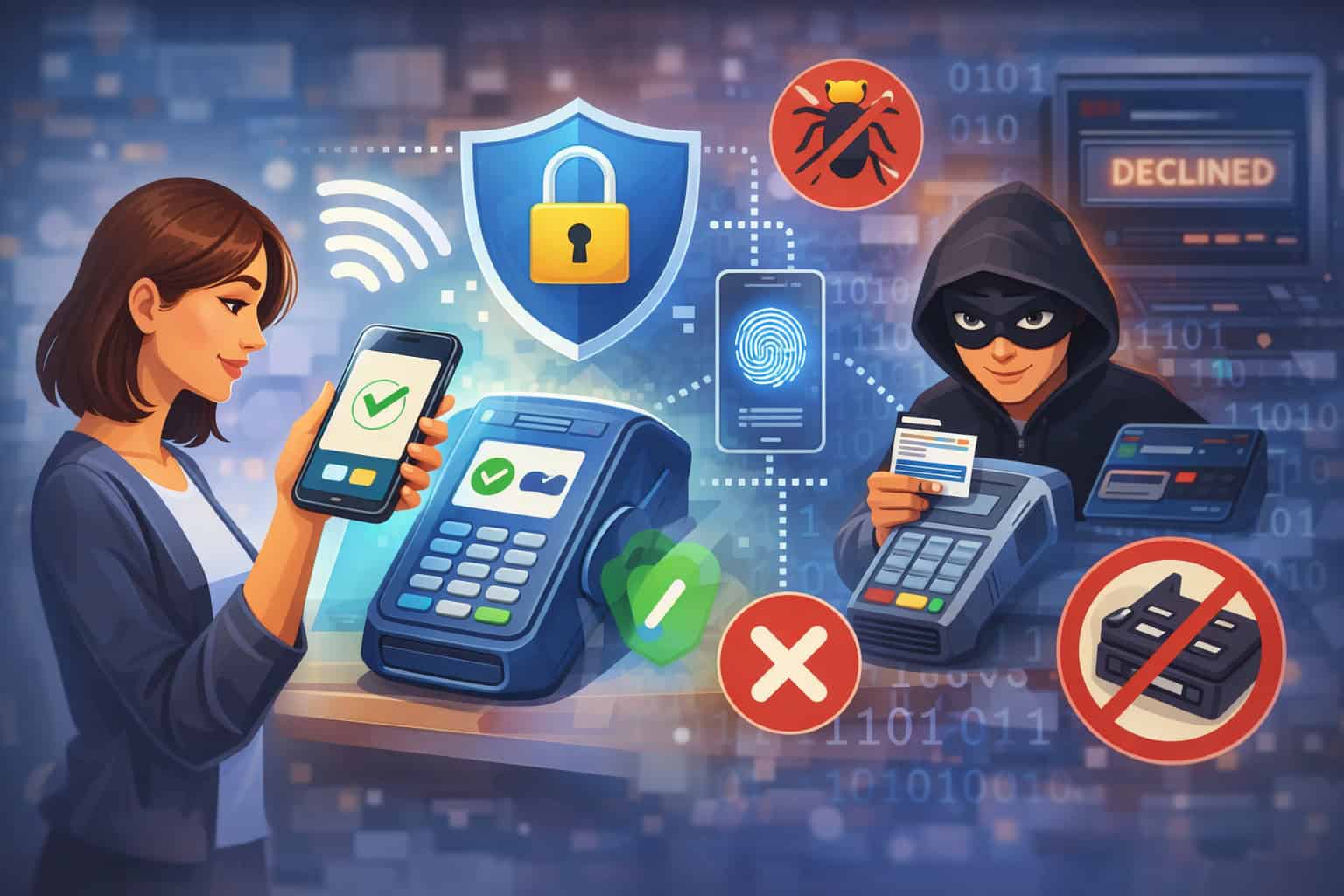
Contactless payments have moved from “nice-to-have” to a mainstream checkout expectation—especially for quick-service, retail, events, and service businesses. But speed is only half the story.
The bigger win is that contactless payments reduce fraud by changing what criminals can steal and how reusable that stolen data is. Traditional swipe transactions rely on static card data that can be copied and replayed.
Modern contactless payments—whether you tap a card, phone, or smartwatch—lean on EMV cryptography, dynamic transaction data, and (in mobile wallets) tokenization that replaces the real card number with a substitute credential.
Together, those layers shrink the payoff from skimming, make counterfeiting harder, and reduce the usefulness of payment data in the event of a breach.
Fraud doesn’t disappear, though. It shifts. When in-store fraud becomes tougher, attackers pressure weak spots like account takeover, social engineering, and card-not-present abuse.
That’s why the most useful way to understand contactless payments reducing fraud is to follow the entire chain: what happens at the terminal, what data leaves the device, what the networks and issuers validate, and where merchants still need strong operational controls.
This guide breaks down the mechanics, the practical merchant steps, and what’s likely coming next as wallets, biometrics, and tokenized credentials continue to expand. EMV contactless standards define how terminals and chips communicate for secure “tap” transactions, and the same ecosystem supports tokenized transactions across channels.
What Makes Contactless Payments Different From Swipe and Insert
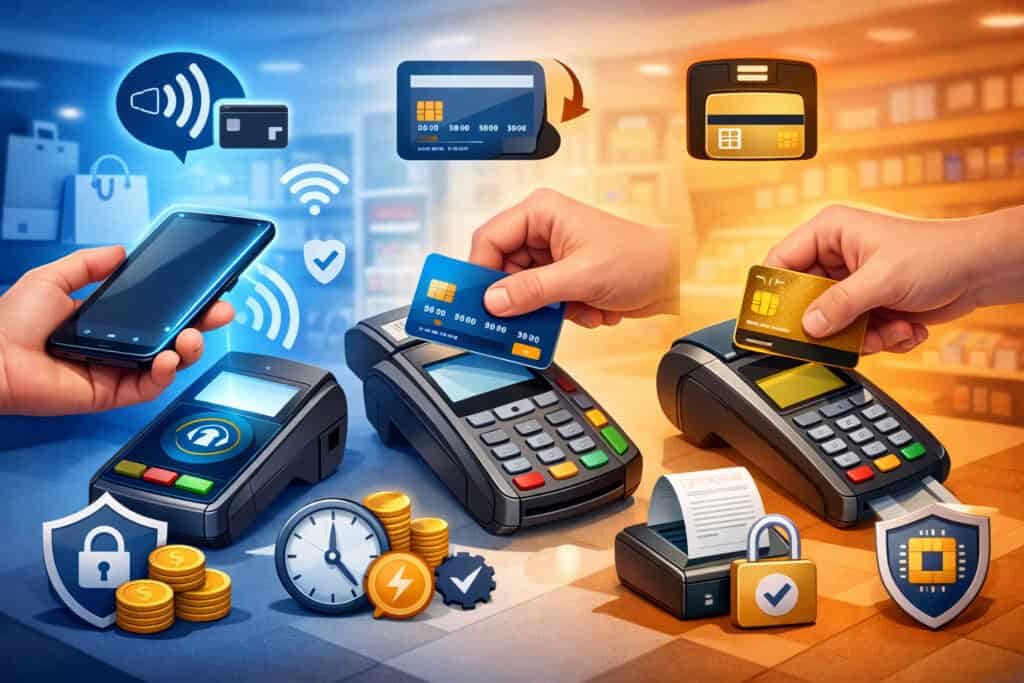
Contactless payments change the fraud equation because they are designed around “dynamic” validation rather than “static” card data. With older magnetic-stripe swipes, much of what the terminal reads can be copied and replayed.
That is why skimmers and cloned cards became so common. By contrast, contactless payments (tap) are typically EMV-based, meaning the payment credential participates in a cryptographic process that proves authenticity for that specific transaction.
EMV’s core concept is that the credential can generate a unique cryptogram tied to transaction details, which makes copying the data far less useful.
Another difference is the way contactless payments reduce exposure of sensitive information. With a physical contactless card, you still have a card number behind the scenes, but the transaction security relies on EMV methods.
With mobile wallets, the protection is often stronger because wallets use tokenization: the terminal and merchant do not receive the real card number (PAN). Instead, they receive a token (a substitute number) plus a transaction-specific cryptogram.
Apple’s platform documentation describes how a Device Account Number and a one-time cryptogram are used, with a transaction counter incrementing each time. That design makes replay attacks much harder because the “same” payment data won’t validate twice.
In practical terms, contactless payments reduce fraud in three ways that matter to everyday merchants: they lower the chance of counterfeit card success, reduce the value of data stolen from the merchant environment, and increase the reliability of fraud detection signals (because wallets and EMV rails provide richer authentication context).
But the degree of fraud reduction depends on how you accept payments—tap card vs tap phone vs keyed entry—and whether your operational settings encourage secure behavior or force insecure fallbacks.
NFC and EMV Contactless: The Security Basics Merchants Should Know
Most people associate contactless payments with NFC (near-field communication), but NFC is only the “short-range radio.” The fraud reduction comes from the EMV contactless rules layered on top. EMVCo publishes the specifications and approval processes for EMV contactless chips and terminals to ensure secure, interoperable transactions.
Here’s what matters: EMV contactless is built so the terminal and the card/device can exchange data and produce an authorization request that includes proof the credential is genuine. In EMV-style transactions, the chip can generate a unique cryptogram using dynamic inputs.
One explanation widely used in EMV education is that the cryptogram is created from dynamic data such as a randomly generated number from the terminal and the transaction amount, making each transaction different even if it’s the same card at the same merchant.
From a fraud perspective, that uniqueness blocks a large class of attacks where criminals capture payment data and then “replay” it elsewhere. If an attacker tries to clone a tap transaction the way they clone a swipe, the copied data typically fails validation because it can’t reproduce the correct cryptogram for the new transaction.
This is the foundational reason contactless payments reduce fraud in card-present environments—especially counterfeit fraud. It doesn’t eliminate all fraud (lost/stolen and social engineering remains), but it makes “copy card → spend anywhere” dramatically less effective.
Tokenization and Transaction Cryptograms: Why Mobile Wallet Taps Are Even Safer
When customers use a phone or smartwatch, contactless payments usually add another protective layer: network tokenization. In tokenization, the real card number is replaced with a token that’s usable only in a specific context (such as that device and that token domain).
EMVCo describes payment tokenization as replacing valuable card data with payment tokens to increase security for mobile and e-commerce transactions.
Apple’s security documentation explains that Apple Pay transactions include a Device Account Number plus a payment cryptogram (a one-time code) computed using a transaction counter and keys.
The counter increments each time, which is a simple but powerful anti-replay design. In Visa’s materials, network tokens are described as replacing sensitive card data and adding a unique cryptogram to each transaction for additional security.
Why does this reduce fraud? Because stolen merchant data becomes less valuable. If a breach yields tokens instead of real card numbers, the attacker can’t easily monetize that data outside the token’s permitted domain.
And if they intercept a tokenized transaction payload, the cryptogram is designed to be non-reusable. That’s why contactless payments—specifically wallet-based taps—are often considered among the safest consumer payment methods at the physical point of sale.
The Fraud Landscape: Where Criminals Win (and Lose) in Modern Card Payments
Fraud is not one problem. It’s a portfolio of tactics that shift with technology and incentives. When merchants upgraded from swipe to chip and tap, counterfeit fraud became harder, but other forms of fraud grew louder—especially remote fraud, account takeover, and disputes tied to “friendly fraud.”
Industry research on EMV migration in the United States highlights this complexity: while the overall goal was to mitigate card-present fraud (especially counterfeit), outcomes vary by segment and network type, and some categories saw different shifts than expected.
This matters when you evaluate how contactless payments reduce fraud. Contactless helps most in scenarios where the attacker’s plan depends on copying card data (skimming, cloning, replay).
It helps less where the attacker uses stolen credentials online, tricks a customer into authorizing a wallet provisioning, or exploits weak customer authentication.
So the “true” impact is: contactless reduces a major slice of in-person technical fraud, but it does not replace identity security, strong onboarding, and good dispute management.
A practical way to think about it is: the more a transaction can be cryptographically bound to a legitimate credential and legitimate user presence, the less profitable it is to steal payment data.
EMV cryptograms and wallet tokenization do exactly that. But if the attack is “convince someone to hand over an OTP” or “take over an account,” then the payment method at the terminal is only part of the defense.
Card-Present vs Card-Not-Present: Why Fraud Often Shifts Instead of Vanishing
When card-present acceptance becomes more secure, criminals often migrate to where the defenses are weaker. This is one reason many markets saw pressure shift toward card-not-present fraud as EMV adoption increased.
A Federal Reserve Bank of Kansas City research briefing discusses EMV migration effects and notes that patterns can vary—for example, with some debit segments not seeing counterfeit declines in the way people assumed and with different loss impacts across issuers, merchants, and cardholders.
So where does contactless fit? Contactless payments reduce fraud primarily in the card-present channel by lowering counterfeit success and reducing the value of captured data.
But if your business also sells online, you still need strong remote-payment controls—3DS where appropriate, velocity checks, device intelligence, and clear refund and dispute workflows. In other words: contactless payments are an in-store advantage, not a universal fraud cure.
For many merchants, the best combined strategy is: push the safest method at the register (tap), reduce reliance on fallback methods (swipe, manual entry), and make remote fraud controls stricter because attackers will test that surface once in-store becomes harder.
Friendly Fraud and Chargebacks: Where Contactless Helps—and Where It Doesn’t
Chargebacks and “friendly fraud” are a different beast. Even a perfectly secure tap transaction can be disputed by a cardholder claiming they didn’t authorize it, or by a customer unhappy with service.
Contactless payments can help a bit by strengthening evidence: wallet transactions may come with stronger authentication signals (device presence, token domain, sometimes biometric confirmation), and EMV transactions can support liability and representation frameworks.
But friendly fraud often hinges on policy, fulfillment, and communication—not cryptography. If your receipts are unclear, your cancellation policy is confusing, or your support is slow, you can still lose disputes even if the tap was legitimate.
The practical implication: use contactless payments to reduce technical fraud, but treat disputes as an operational discipline—clear descriptors, receipts, delivery proof, cancellation logs, and rapid response processes.
Contactless also affects customer behavior. Fast “tap and go” can reduce line friction, but if customers don’t get a receipt or don’t recognize the descriptor later, disputes can rise. So the fraud-reduction promise is highest when contactless is paired with strong customer communication and clean back-office practices.
How Contactless Payments Reduce Fraud at the Point of Sale
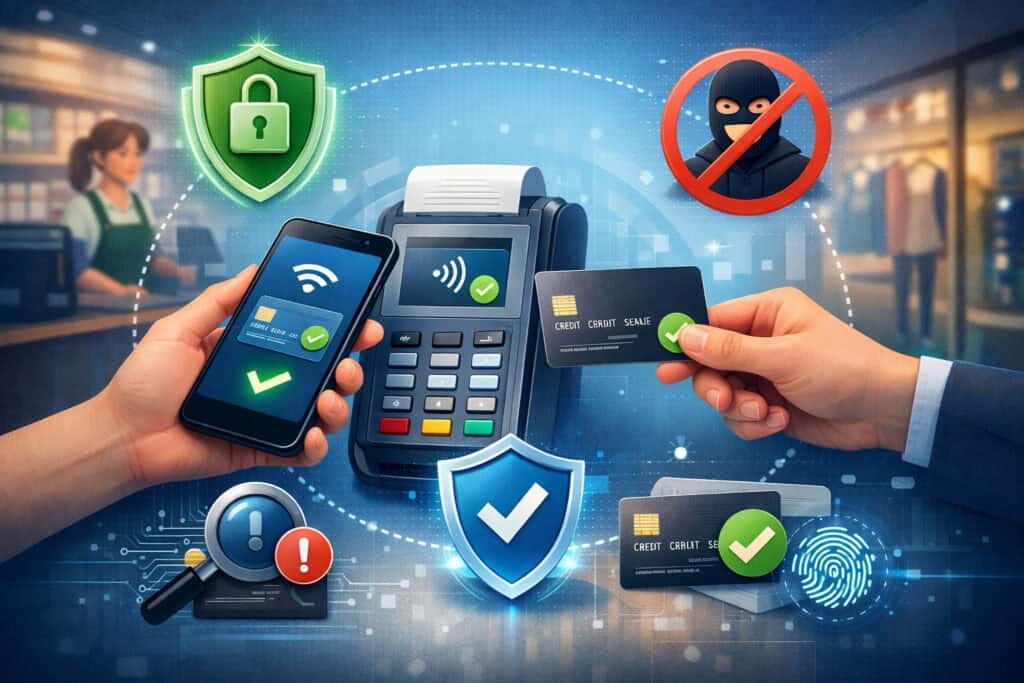
The strongest fraud reduction benefit of contactless payments shows up at the physical point of sale because that’s where older fraud tactics were most dependent on copying card data. The classic pattern was: skim a swipe, clone the card, then spend in-person.
EMV-based tap makes that much harder because transaction approval relies on dynamic cryptographic values that can’t be reused the same way.
The “dynamic” part is important. If a terminal and credential generate a one-time cryptogram tied to the transaction, a criminal can’t just record it and reuse it.
EMV education materials often emphasize that each EMV transaction produces a unique cryptogram derived from transaction inputs (including a terminal-provided random value and the transaction amount). That is exactly the design feature that breaks many replay and cloning schemes.
In mobile wallet contactless payments, tokenization further reduces fraud by preventing the merchant from receiving the real card number. EMVCo describes payment tokenization as a way to increase protection of payment data across mobile and e-commerce.
In a breach scenario, that difference can change what criminals can do with stolen data—especially when combined with P2PE and strong merchant security.
So, at the register, the fraud reduction story is simple: tap transactions are harder to counterfeit, harder to replay, and often leak less sensitive information. But merchants still need to configure terminals correctly and avoid insecure fallbacks, or attackers will push transactions into weaker rails.
Dynamic Data Blocks Skimming and Cloning (and Why Magstripe Fallback Still Matters)
Skimming thrives on static data. If the track data can be copied, it can be replayed. Contactless payments reduce fraud because the meaningful authentication data is dynamic and transaction-specific.
That’s why EMV-style cryptograms are repeatedly highlighted in EMV explanations: the chip generates a unique code per purchase that can’t simply be copied and reused.
However, criminals are practical: if they can’t win via tap, they try to force a fallback. That’s where magstripe fallback and “swipe if tap fails” habits become a security leak.
A Federal Reserve Bank of Atlanta blog post discussing persistent counterfeit risk points out that magstripes remain widely present, and any swipe can still potentially be skimmed and cloned to counterfeit.
For merchants, the takeaway is: contactless payments reduce fraud best when you reduce exposure to swipe. Encourage tap or chip. Maintain terminals so “tap failure” doesn’t become the norm. Watch for suspicious “terminal doesn’t work, can you swipe?” scenarios.
And don’t allow staff to routinely key in card numbers for convenience. Criminals love operational shortcuts more than they love technical sophistication.
Device Authentication, Biometrics, and “Proof of Presence” for Wallet Taps
Mobile wallet contactless payments typically require some form of device authentication—biometric (fingerprint/face) or passcode—before the payment credential is used. That user-presence step helps reduce fraud for lost/stolen scenarios compared with a physical card that can be tapped if found.
The technical side is also stronger: Apple documents that Apple Pay uses a Device Account Number and includes a one-time payment cryptogram computed with a transaction counter and keys.
From a fraud standpoint, this creates a layered defense:
- Something you have: the device with the secure payment credential.
- Something you are/know: biometric or device passcode.
- Something the network validates: token domain and cryptogram validity.
Even if an attacker films a tap at the register or intercepts transaction data, the cryptogram is meant to be one-time, and the Device Account Number is not the same as the real card number. That combination reduces the value of stolen data and reduces the chance that a stolen phone can be used without the owner’s authentication controls.
Merchants benefit indirectly: fewer counterfeit attempts succeed, and fewer transactions are initiated with easily cloned credentials. But you still need to handle exceptions carefully—especially manual-entry requests, suspicious refunds, and unusual device behavior.
Security Controls Behind the Scenes: What Networks and Issuers Validate
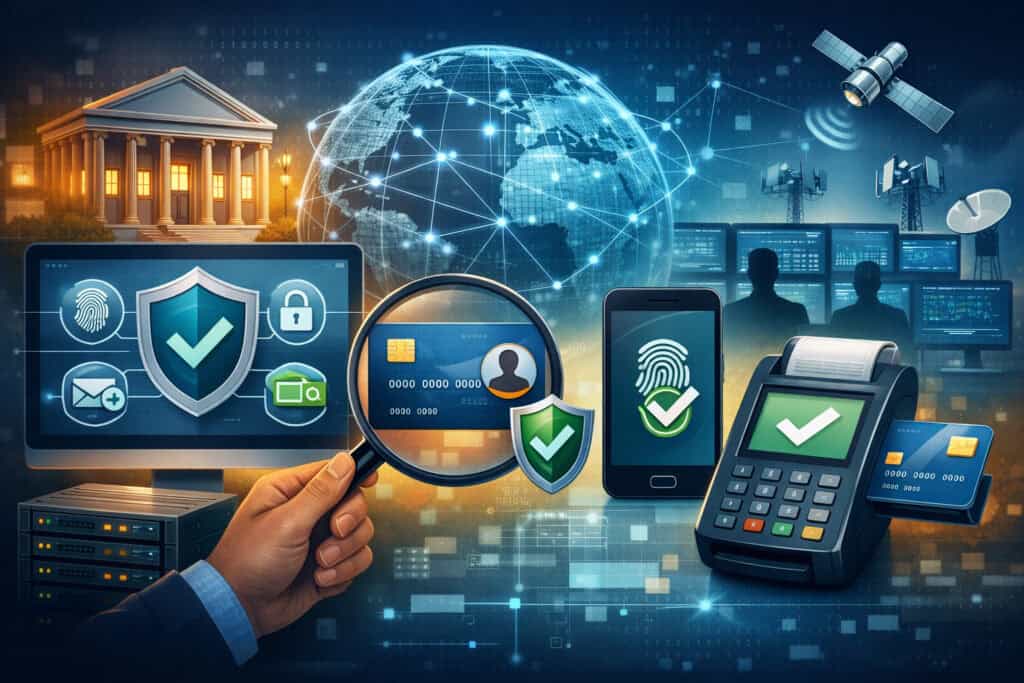
A contactless payment might feel instant, but a lot happens in a second. The network and issuer validate signals that don’t exist in a swipe world, and that extra context is one reason contactless payments reduce fraud.
In EMV transactions, the issuer can evaluate cryptograms and risk parameters. In tokenized wallet transactions, the issuer and network can validate the token, confirm its domain restrictions, and use cryptograms to prevent replay.
EMVCo’s role is to publish EMV contactless and tokenization frameworks that keep the ecosystem interoperable and security-focused. Visa and other networks describe tokenization as a way to mitigate fraud and improve authorization outcomes by replacing sensitive payment details with tokens.
The important point for merchants: fraud reduction is not only what the terminal does. It’s also what the issuer can verify. When you accept contactless payments through EMV and wallet rails, you give issuers stronger tools to approve good transactions and decline suspicious ones.
That can reduce false declines while still blocking fraud—especially when tokenization and device signals improve confidence.
Network Tokenization and Token Lifecycle Management
Tokenization is not just “replace the number.” It includes a lifecycle: provisioning, domain controls, suspension, re-issuance, and deactivation. EMVCo frames payment tokenization as replacing valuable card data with tokens to increase security for mobile and e-commerce transactions, while supporting compatibility across channels.
Visa materials emphasize that tokenization turns sensitive payment details into randomized values called tokens and is used to mitigate fraud and support new customer experiences.
A key fraud benefit is containment: if a token is compromised, it may be limited to a device, merchant type, or channel domain. That reduces how widely criminals can monetize stolen credentials.
For merchants, tokenization can also reduce the blast radius of a breach when combined with good architecture. If your environment stores tokens rather than PANs, attackers have less usable data.
The PCI Security Standards Council also provides guidance on tokenization and how it may affect PCI DSS scope, reinforcing that tokenization can change what data is considered sensitive and how environments should be evaluated.
The practical message: accept wallet-based contactless payments where possible, and structure your systems to avoid storing raw card data. That’s how contactless payments reduce fraud not only at checkout, but also in “after the sale” risk like database compromises.
Real-Time Risk Scoring: How Better Signals Reduce Fraud and False Declines
Fraud detection works best when it has strong signals. Contactless payments can provide more trustworthy context than a swipe because EMV and wallet transactions include richer authentication artifacts (cryptograms, token attributes, device-related indicators).
Networks and issuers can combine those signals with real-time behavior models, merchant category data, and customer history.
This doesn’t mean every tap is automatically safe. Lost/stolen and coercion scenarios exist, and scammers can still manipulate consumers. But cryptographic assurance raises the cost of certain fraud types. It’s easier to block suspicious patterns when the underlying credential is harder to counterfeit.
Another subtle advantage is authorization quality. Networks often position tokenization as helping improve authorization rates (not just reduce fraud) because tokens can be more current (e.g., updated credentials) and allow cleaner risk decisions.
For merchants, that can mean fewer “good customer” declines while still keeping fraud controls tight—especially in quick-service and high-frequency categories.
So while the terminal experience is “tap,” the fraud reduction is a system outcome: more reliable authentication data leads to better decisions at the issuer, which can reduce fraud and reduce friction simultaneously.
Merchant Best Practices to Maximize Fraud Reduction From Contactless Payments
Contactless payments reduce fraud the most when merchants treat them as the default and remove incentives for insecure fallbacks. That means using EMV-capable terminals, keeping them updated, monitoring for hardware tampering, and configuring acceptance rules carefully.
It also means protecting the payment environment so that even if attackers target your network, they cannot extract usable data.
Two standard families matter here. First, EMV rules at the acceptance point. Second, PCI security standards for protecting payment data flows and merchant environments.
The PCI Security Standards Council explains that point-to-point encryption (P2PE) cryptographically protects account data from the point of interaction to the secure point of decryption, making stolen data unreadable if intercepted.
This is a major complement to contactless payments, because even tokenized transactions can be abused if attackers can manipulate terminals or steal other sensitive elements.
Also note: PCI DSS requirements evolve. PCI SSC’s guidance indicates PCI DSS v4.0 became the active standard after v3.2.1 retirement, with “new requirements” transitioning from best practices to required by March 31, 2025.
If you handle payment data directly, staying aligned with current PCI expectations is part of preventing the types of breaches that turn into large fraud waves.
Use EMV-Capable Terminals, P2PE, and Strong PCI Hygiene
Start with the terminal. Use EMV-capable devices that properly support contactless payments and keep firmware updated. Physically secure terminals to reduce tampering. Treat unexpected “tap stopped working” issues as security events, not only IT issues. Attackers like to degrade you to swipe.
Then protect the data path. PCI SSC describes P2PE as cryptographically protecting account data from where the card is accepted to the secure point of decryption, keeping data unreadable if stolen in transit or from intermediate systems.
When combined with contactless payments—especially tokenized wallets—this can significantly reduce the value of data exposed during a breach.
Finally, manage your PCI scope intelligently. Tokenization guidance from PCI SSC exists specifically because tokenization changes how environments may be evaluated and what remains in scope.
Even if you outsource most of the payments, you still need disciplined access control, patching, vendor management, and incident response. Contactless payments reduce fraud, but poor infrastructure can reintroduce fraud at scale.
If you want the simplest “high impact” playbook: tap-first checkout + P2PE + no card data storage + tight refund controls. That combination removes the most common monetization routes for fraudsters.
Train Staff, Tune Acceptance Rules, and Reduce “Fallback” Abuse
Operational controls are where many merchants lose the fraud benefit. Staff often want to “just get the sale done,” which can mean manual entry, accepting swipe when chip/tap fails, or overriding warnings. Fraudsters exploit that human behavior.
Train staff to recognize red flags: customers insisting on swipe, multiple declined taps followed by “can you key it in,” requests to split transactions unusually, or pressure tactics during busy periods. Make it easy for staff to do the safe thing by ensuring terminals work reliably and receipt flows are smooth.
Also review your acceptance configuration. Set sensible floor limits and verification rules where applicable, but be mindful that wallet transactions can be authenticated differently than plastic card taps. Focus on preventing risky scenarios: repeated fallback, suspicious refunds, and unusual after-close settlement edits.
Finally, watch for “refund fraud.” Contactless payments reduce fraud at purchase, but criminals can still exploit refund workflows. Require matching original payment methods for refunds when possible, verify IDs for high-value returns, and restrict refund privileges. Fraud reduction isn’t just how you take money—it’s how you give it back.
Consumer Best Practices and Common Misconceptions About Contactless Fraud
Consumers often ask: “Can someone steal money just by standing near me with a scanner?” The practical risk is usually overstated. The more realistic threats are different: lost/stolen cards used quickly, account takeover that leads to unauthorized wallet provisioning, and social engineering scams that trick people into approving actions.
Contactless payments reduce fraud for consumers mainly because they reduce the usefulness of stolen payment data and increase authentication strength—especially with mobile wallets.
Apple’s security documentation emphasizes that Apple Pay uses a Device Account Number and a transaction-specific cryptogram, computed with a transaction counter and keys, which means transaction data is not meant to be reusable.
But consumers can still create risk by disabling device security, sharing one-time codes, or ignoring alerts. The best consumer advice is: use device passcodes and biometrics, enable notifications, and treat provisioning codes like passwords. Contactless is a strong payment method—if the identity layer is protected.
Privacy, Tracking, and Turning NFC Off: What Actually Changes Risk
Turning NFC off can reduce accidental “tap” risk, but it doesn’t solve the big fraud threats. The bigger issue is account security and device security.
If your phone is protected with a strong passcode and biometrics, the chance of unauthorized wallet use drops significantly. If your phone is unlocked and your wallet is easily accessible, contactless becomes less protective.
Consumers also worry about privacy: does tapping share more data? With tokenized wallets, the merchant typically receives a token instead of a real card number, which can reduce exposure of actual card details.
EMV payment tokenization is explicitly positioned as a way to increase protection of payment data while maintaining compatibility across channels.
That doesn’t mean tracking disappears—merchants can still link purchases via loyalty programs, receipts, and device-level analytics. But from a payments perspective, tokenization tends to reduce the spread of the real card number.
So the best privacy-and-fraud posture is not “avoid contactless,” it’s “use contactless with strong device security and cautious sharing of verification codes.”
When Contactless Can Still Be Risky: Lost Phones, Social Engineering, and Provisioning Attacks
Contactless payments reduce fraud, but scammers adapt. One growing risk pattern across the industry is fraud that happens before the tap—during card provisioning into a wallet.
If a criminal can trick someone into sharing a bank verification code or can take over an account, they may add the card to a device they control. Once provisioned, they can use contactless payments quickly.
That’s not a failure of NFC. It’s an identity and authentication problem. The tap is still cryptographically strong; the weak step is “who is allowed to create a valid token on a new device?”
Networks and platforms support strong methods, but real-world implementations can vary. This is why banks and issuers increasingly push stronger authentication and better device binding.
For consumers: treat provisioning codes as secrets, use carrier protections against SIM swap, turn on bank alerts, and report device loss immediately. For merchants: be aware that tokenized fraud may look “clean” at the terminal, so your best defense is upstream—issuer risk systems, velocity monitoring, and good refund controls.
Industry Trends and Future Predictions for Contactless Fraud Prevention
Contactless payments are evolving from “tap a card” to “tokenized identity at checkout.” The next phase will likely combine device-based credentials, stronger consumer authentication (including passkeys), and tighter domain controls on tokens.
Tokenization is repeatedly framed by networks as foundational to future-proofing payments, with fraud mitigation and improved authorization as core benefits.
At the same time, fraudsters will keep moving toward account takeover, synthetic identity, and scam-driven authorization fraud—because those attacks bypass cryptographic protections by getting the victim to approve actions.
That’s the central prediction: technical counterfeit fraud keeps getting harder, while identity-driven fraud becomes the bigger battleground.
Merchants should plan accordingly. If you’re upgrading acceptance, prioritize modern terminals, wallet acceptance, and encryption.
If you’re improving fraud operations, prioritize customer verification for high-risk refunds, stronger onboarding for stored credentials, and tighter controls on manual entry. Contactless payments reduce fraud—especially counterfeit—but your business risk profile will be shaped by how attackers adapt.
Passkeys, FIDO, and Wallet-Based Identity Signals (What Could Change by 2027)
Passkeys and FIDO-based authentication are likely to reduce reliance on one-time codes and passwords, which are frequent weak points in account takeover and provisioning scams. As wallets and issuers adopt stronger device-bound authentication, unauthorized wallet provisioning should become harder.
That will amplify the fraud-reduction advantage of contactless payments because the attacker won’t be able to “legitimately” obtain a token as easily.
The likely practical outcome is more “high confidence” transactions: token + device binding + strong user authentication + cryptogram. For merchants, that can mean fewer chargebacks tied to unauthorized use and fewer false declines, because issuers will have stronger evidence of user presence.
You don’t need to implement passkeys yourself to benefit. But you should stay compatible with wallet-based payments and modern checkout flows, because the ecosystem is moving toward credentials that are harder to phish and harder to replay.
Tap-to-Pay on Phone and SoftPOS: Opportunity and New Risk Controls
“Tap-to-pay on phone” (softPOS) lets merchants accept contactless payments using a smartphone rather than a dedicated terminal. Adoption is likely to grow in field services, events, micro-merchants, and pop-ups because it lowers hardware friction.
The fraud prediction here is mixed: contactless payments reduce fraud at the credential level, but softPOS expands the security perimeter (more devices, more OS variability, more operational risk). Merchants adopting softPOS should expect stricter compliance expectations, device integrity checks, and stronger monitoring.
If you use softPOS, treat phones like payment terminals: lock them down, limit admin access, keep OS updates current, enforce MDM policies, and separate business and personal use. The fraud-reduction advantage of contactless still holds, but only if the acceptance device itself is trustworthy.
FAQs
Q.1: Are contactless payments safer than chip insert payments?
Answer: In many everyday scenarios, contactless payments are at least as safe as chip insert payments, and mobile wallet contactless payments can be safer due to tokenization.
Both chip insert and tap use EMV cryptographic principles designed to prevent easy cloning and replay. EMV transaction concepts emphasize unique cryptograms derived from dynamic transaction data, which helps prevent counterfeit fraud.
Mobile wallet taps often add tokenization, meaning the merchant does not receive the real card number. EMVCo positions payment tokenization as increasing security for mobile and e-commerce transactions by replacing valuable card data with payment tokens.
Apple’s documentation adds detail: Apple Pay uses a Device Account Number and a one-time payment cryptogram computed with a transaction counter, making transaction data non-reusable in the intended design.
So, if you compare “tap phone” vs “insert card,” the phone tap commonly has the edge because it combines EMV-style transaction security with tokenization and device authentication. But insert is still a strong method compared to swipe, and merchants should support both while reducing swipe fallback.
Q.2: Can criminals steal money by scanning my contactless card in public?
Answer: The “public scanning” fear is popular, but most real-world fraud doesn’t work that way. The more profitable fraud paths are still account takeover, stolen credentials used remotely, and operational scams.
The biggest reason casual scanning is less attractive is that modern transactions rely on cryptographic validation and network controls; attackers need a way to monetize data at scale.
Also, wallet-based contactless payments do not transmit the real card number to the merchant; they transmit a token plus cryptographic data. EMV payment tokenization is designed to protect payment data, and platforms like Apple Pay include a one-time cryptogram per transaction.
A more realistic consumer risk is lost/stolen physical cards used quickly at low-friction merchants, or stolen phones where device security is weak. Good habits—device passcode, biometric lock, transaction alerts—reduce those risks far more than worrying about a stranger with a “scanner.”
Q.3: Do contactless payments reduce fraud for small businesses, or only big retailers?
Answer: Contactless payments can reduce fraud for small businesses because counterfeit and skimming attacks often target smaller merchants precisely due to weaker controls.
If you move from swipe-heavy acceptance to tap-first acceptance, you reduce exposure to static track data that skimmers monetize. That is one reason the persistence of magstripe swipe capability is discussed as a continued counterfeit risk—swipes can still be skimmed and cloned.
Small businesses often get the most benefit by combining contactless acceptance with simplified security architecture—using validated payment providers, avoiding card data storage, and adopting P2PE where possible.
PCI SSC describes P2PE as protecting account data from the point of acceptance to secure decryption, making stolen data unreadable if intercepted.
So yes—small businesses benefit, often immediately, because many small merchant fraud losses come from avoidable “swipe and key-enter” patterns and from weak terminal security.
Q.4: If contactless payments reduce fraud, why do I still hear about digital wallet scams?
Answer: Because the weakest link often isn’t the tap—it’s identity. Many wallet scams involve tricking someone into approving card provisioning, stealing verification codes, or taking over an account.
Once a criminal successfully provides a token to their device, subsequent contactless payments may look legitimate to merchants because the token and cryptogram validate correctly.
That doesn’t mean contactless payments don’t reduce fraud. It means fraud shifted to earlier steps. Tokenization is still a powerful protection for transaction data.
EMVCo describes payment tokenization as a way to increase protection of payment data, and networks describe tokens plus cryptograms as key security features.
The fix is stronger onboarding and authentication: better device binding, stronger verification than SMS codes, faster fraud detection on provisioning events, and consumer education about never sharing verification codes.
Merchants still benefit from contactless’s counterfeit reduction, but the ecosystem must keep raising the bar on identity security to reduce these newer scam paths.
Q.5: What should merchants do first to get the fraud-reduction benefits of contactless?
Answer: The fastest wins usually come from three changes:
- Make tap the default: ensure your terminals support EMV contactless and are configured correctly.
- Reduce swipe fallback: fix terminal issues quickly and train staff not to push transactions into swipe/manual entry unless truly necessary.
- Protect the payment environment: adopt P2PE and avoid storing card data.
P2PE is explicitly designed to make account data unreadable from the point of acceptance to the secure decryption environment, reducing the value of stolen data in a breach.
Also, keep your compliance program current—PCI DSS v4.0 is the active standard, with new requirements moving from best practices to required by March 31, 2025, according to PCI SSC guidance.
When those basics are in place, contactless payments reduce fraud reliably because you’ve removed the easiest criminal paths: skim swipes, force fallbacks, steal usable card data, or exploit lax refund practices.
Conclusion
Contactless payments reduce fraud because they modernize the trust model at checkout. Instead of relying on static card data that criminals can copy, contactless payments use EMV-style dynamic transaction security—and, in the case of mobile wallets, tokenization that replaces real card numbers with substitute credentials plus one-time cryptograms.
EMVCo’s contactless and tokenization frameworks exist specifically to support secure, interoperable transactions across devices and channels.
Apple’s security documentation underscores the practical reality: wallet payments include a Device Account Number and a transaction-specific cryptogram computed with a counter and keys, meaning the data is designed not to be reusable.
But fraud reduction isn’t automatic. The best results come when merchants tap the default, reduce swipe fallback, protect the payment environment with encryption (like P2PE), and run disciplined operational controls—especially around refunds and manual entry.
PCI SSC describes P2PE as protecting account data from acceptance to secure decryption so stolen data is unreadable, which pairs naturally with contactless’s reduced data value.
Looking ahead, the biggest fraud battles will likely move even further toward identity: account takeover, social engineering, and scam-driven “authorized” fraud. The technical rails of contactless payments will keep getting stronger, but merchants and consumers will need stronger authentication and better operational controls to keep pace.
If you treat contactless payments as one part of a layered fraud strategy—not the whole strategy—you’ll get the speed customers want and the risk reduction your business needs.