By breadpointofsale January 18, 2026
Cash discount programs for restaurants have moved from “niche cost-saver” to a mainstream strategy for protecting margins when card acceptance costs rise.
A well-built cash discount program for restaurants can reduce effective processing expenses without surprising guests—but only if it’s communicated clearly, configured correctly in the POS, and aligned with card network rules and state-level requirements.
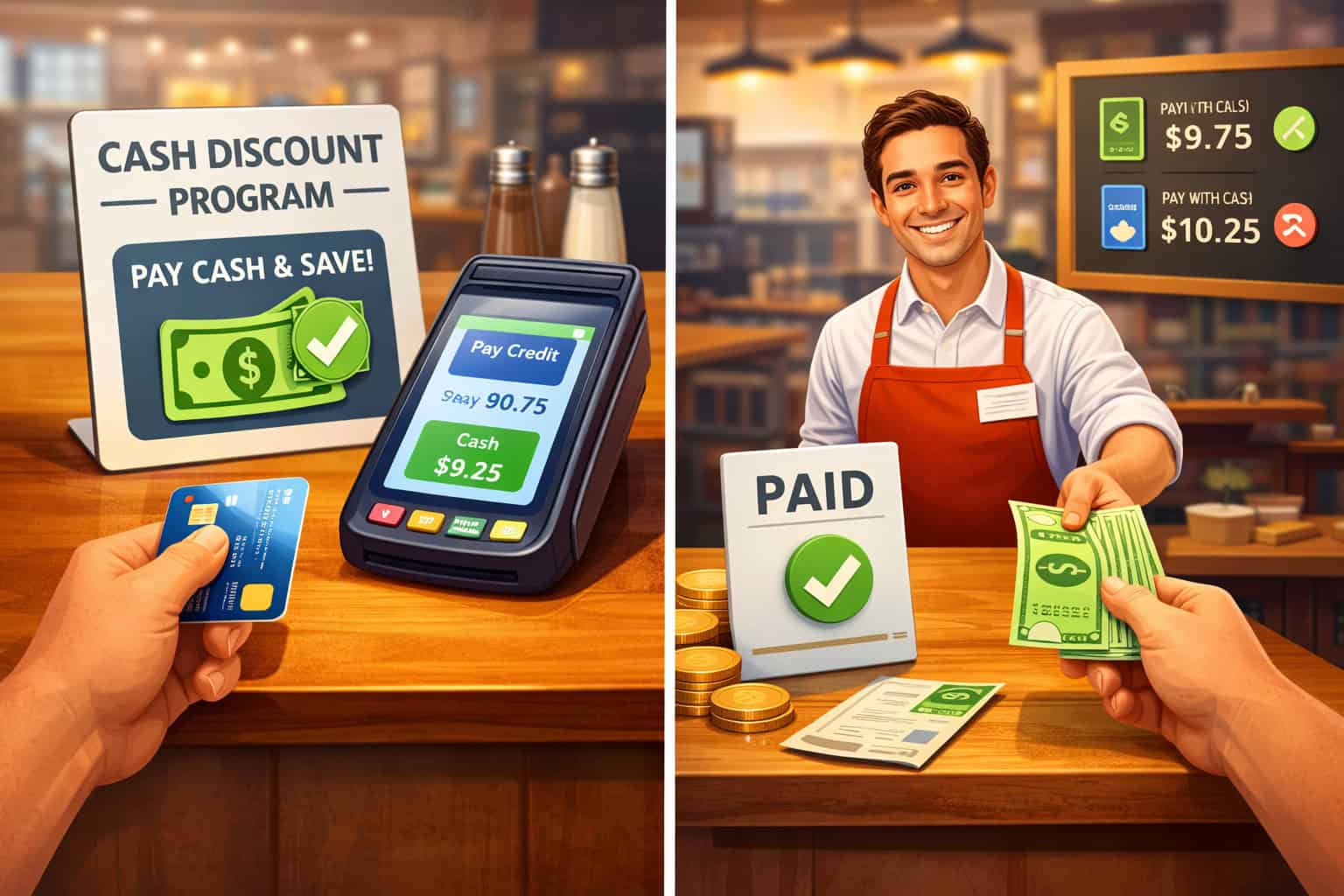
At its core, a cash discount program for restaurants works by setting menu prices as the “card price” (sometimes called the non-cash price), then offering guests a discount when they pay with cash (and sometimes certain debit methods, depending on the program design).
Visa explicitly treats a cash discount as a type of “discount offer” (not a surcharge) and explains that a compliant price presentation is essential—either showing only the card price, or showing both card and cash prices side-by-side.
What makes restaurants different from many other merchants is the mix of quick-service speed, tipping workflows, online ordering, delivery, bar tabs, and split checks. That complexity is exactly why cash discount programs for restaurants should be designed as an operational system—not just a fee setting in your terminal.
If you’re thinking about launching (or fixing) a cash discount program for restaurants, this guide walks you through the “why,” “how,” compliance guardrails, customer experience, POS setup, and what’s likely coming next.
What a Cash Discount Program for Restaurants Really Is (And What It Isn’t)
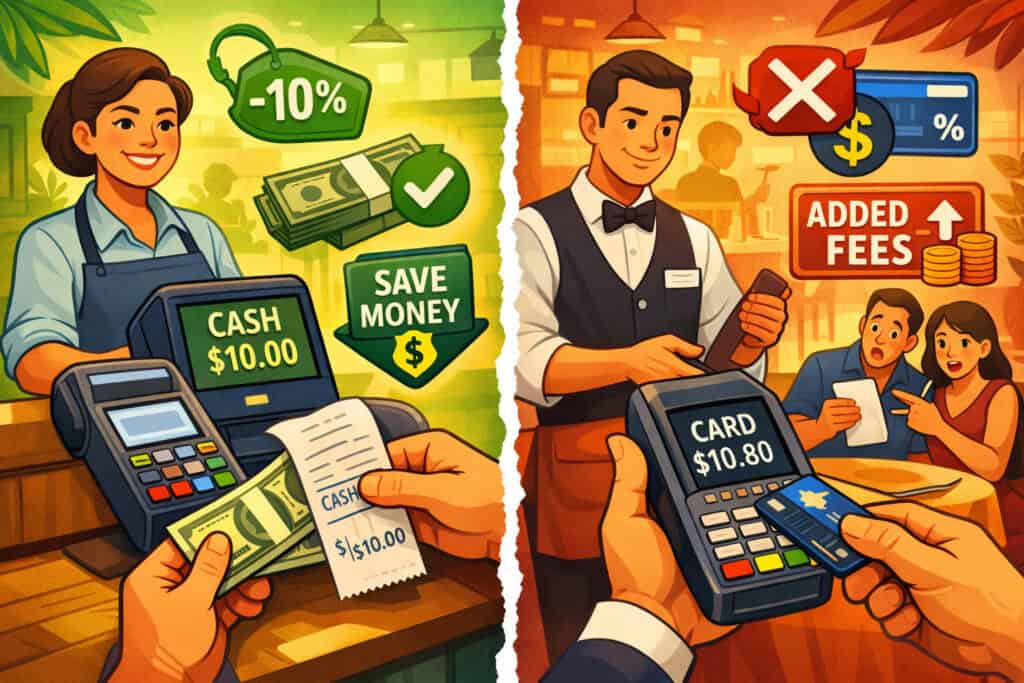
A cash discount program for restaurants is a pricing strategy where the restaurant offers a discount to guests who pay with cash, while the posted or quoted prices reflect the non-cash (card) price.
The guest who pays cash receives the discount at checkout (or sees the cash price listed alongside the card price in a dual-price format). The idea is simple: you’re rewarding the lower-cost tender rather than “penalizing” card use.
This distinction matters because a cash discount program for restaurants is often confused with a credit card surcharge. A surcharge adds a separate fee on top of the advertised price when a customer uses a credit card.
A cash discount program for restaurants, by contrast, frames the benefit in the opposite direction: the listed price is the card price, and cash gets a discount. Visa’s guidance highlights that the correct display of prices is part of doing cash discounts properly.
Restaurants also need to understand that guest perception can blur these lines. Even if your cash discount program for restaurants is technically compliant, guests may still feel like they’re “paying extra” with a card if the messaging is sloppy.
That’s why the best programs make disclosure effortless: signage at entry, signage at the point of sale, and messaging on menus and receipts. POS providers and payments platforms commonly emphasize posting clear signage before offering the discount.
If your team thinks, “We’ll just add 3% to card payments,” you’re no longer describing a cash discount program for restaurants—you’re describing a surcharge model. The operational and legal considerations are not identical, and treating them as interchangeable is where restaurants run into angry guests, chargebacks, and compliance risk.
Why Cash Discount Programs for Restaurants Are Growing So Fast
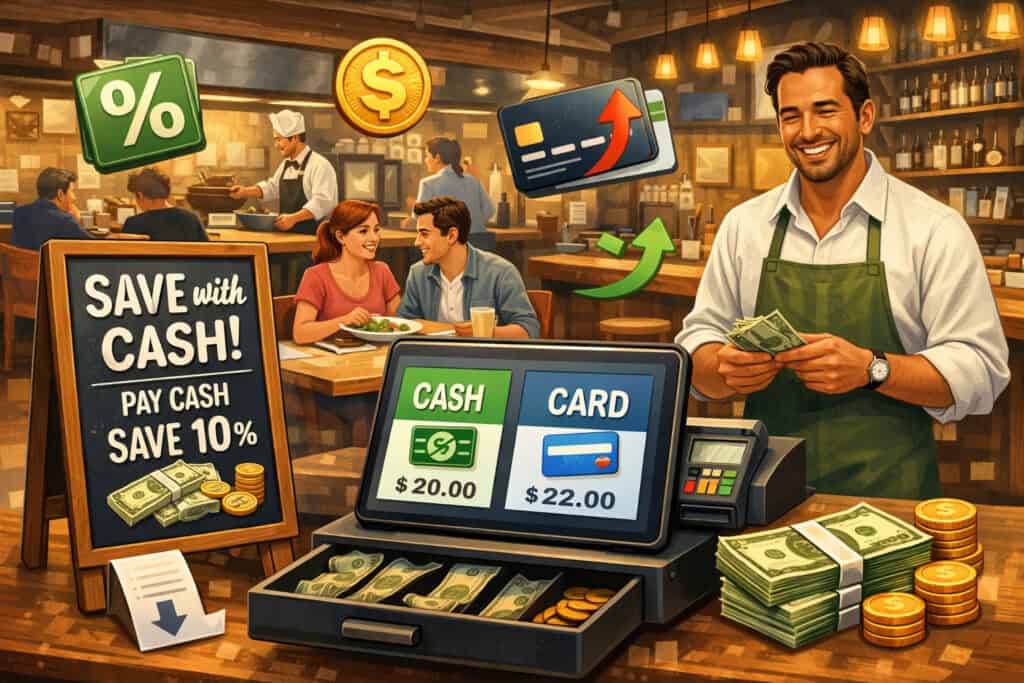
Restaurants operate on tight margins, and card acceptance has become one of the most painful “silent” costs. Processing expense isn’t just the percentage rate—there are transaction fees, assessments, and often higher costs on rewards cards.
When your average ticket is modest (think quick service, lunch spots, coffee, fast-casual), the per-transaction fees can sting even more.
A cash discount program for restaurants can be attractive because it’s immediately measurable. You can compare card volume and cash volume, monitor the discount total, and track net processing costs.
For multi-location operators, it can also create pricing consistency: instead of guessing how much to “bake in” for fees, you standardize a policy.
There’s also a behavioral element. Some restaurants see a bump in cash usage—especially in neighborhoods where cash remains common, in bars, or in grab-and-go concepts. Even a small shift in tender mix can reduce overall fees.
And when your cash discount program for restaurants is paired with better cash controls (smart safes, tighter drawer reconciliation, deposit scheduling), the operational burden of cash can be reduced.
But growth doesn’t mean it’s risk-free. The more common cash discount programs for restaurants become, the more likely regulators, card networks, POS platforms, and review sites scrutinize them. The restaurants that win long-term will be the ones that treat this as a guest-friendly pricing model, not a “gotcha.”
Cash Discount vs. Surcharge vs. Dual Pricing: The Practical Differences in a Restaurant
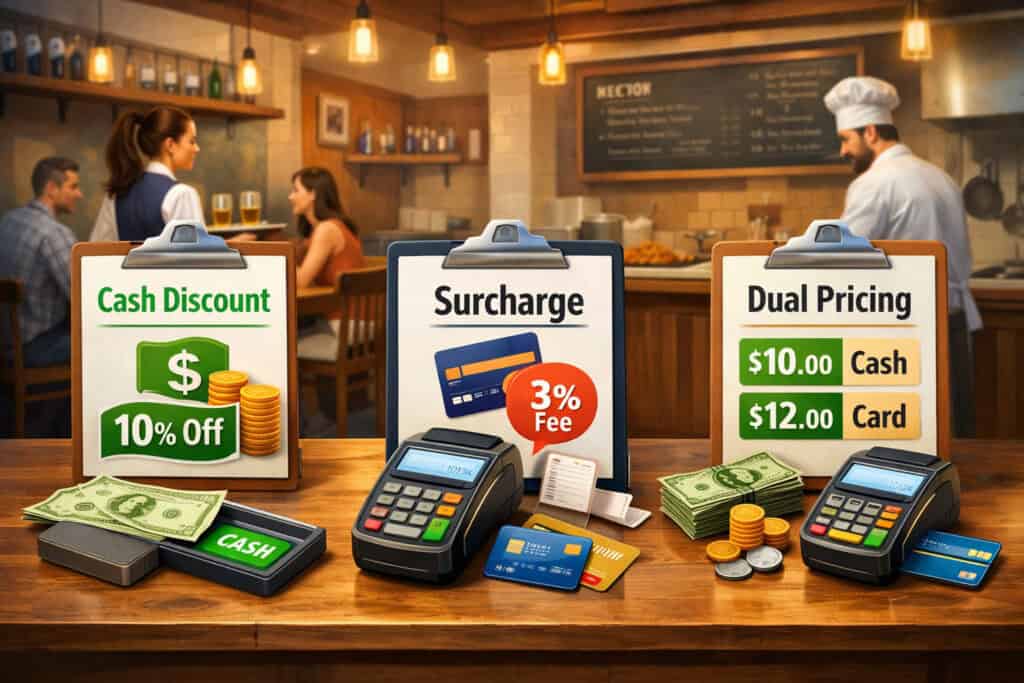
Restaurant operators often hear three terms in the same conversation: cash discount, surcharge, and dual pricing. You can’t run a strong cash discount program for restaurants without knowing how these behave at the menu, at checkout, and on receipts.
Cash discount (restaurant-friendly framing)
In a cash discount program for restaurants, the restaurant posts or quotes the card price and offers a discount for cash. When the guest pays cash, the receipt shows the discount applied. Visa describes cash discounting as a form of discount offer, and stresses that pricing display must be handled correctly.
Surcharge (fee added for credit)
A surcharge is typically an added amount when a guest pays with credit. Surcharging comes with more restrictions and is heavily shaped by card network rules and state-level rules. General guidance sources frequently note that surcharges are treated differently from cash discounts and can be restricted in certain places.
Dual pricing (two prices shown)
Dual pricing is often used as a display method for a cash discount program for restaurants: you show a cash price and a card price side-by-side. This can reduce confusion because guests see the difference up front rather than discovering it at payment time. Visa’s Q&A allows price presentation approaches that include listing both prices side-by-side per item.
For restaurants, dual pricing can be the most guest-friendly version of a cash discount program for restaurants, especially where menus are easy to update (digital menus, menu boards, QR menus). The tradeoff is operational: you must keep those prices accurate everywhere they appear—online menus, delivery menus, in-store menus, catering PDFs, and more.
Compliance Foundations: Card Network Rules and Why Restaurants Get Fined

Cash discount programs for restaurants are strongly shaped by card network expectations because card acceptance is governed by network rules through your processor and acquiring bank. The practical reality is that if your program looks like an undisclosed surcharge, you can trigger complaints and enforcement.
Visa’s merchant guidance distinguishes “cash discount” from surcharging and explains that compliant cash discounting depends on how prices are displayed and how the final bill is presented. The same overall concept appears across industry compliance materials: don’t surprise guests, and ensure your disclosures are clear.
Mastercard also publishes a comprehensive rules manual for the ecosystem, which is periodically updated and is ultimately what processors and acquirers expect merchants to follow.
While restaurants don’t typically read the full manual, your payment provider should be able to explain how your cash discount program for restaurants maps to those requirements.
The most common compliance failures in restaurants include:
- Not disclosing the cash discount program for restaurants at entry and at the point of interaction
- Inconsistent menu pricing across dine-in vs. online vs. bar vs. catering
- Receipts that don’t clearly show the discount or price basis
- Staff verbally explaining it in a way that sounds like a penalty (“we charge extra for cards”)
If you implement a cash discount program for restaurants, your real compliance tool is consistency. The guest should see the policy before ordering, understand the benefit, and see the math clearly on the receipt.
Signage and Disclosure: The Make-or-Break Factor for Guest Trust
If you want a cash discount program for restaurants that doesn’t backfire, signage and disclosure are not optional—they’re the program. Clear disclosure reduces disputes, prevents bad reviews, and helps align with payment network expectations.
Many POS and payments platforms explicitly instruct restaurants to post signage at the point of entry, at the point of sale, and on menus explaining that prices shown are non-cash prices and that a cash discount is available.
That multi-touch disclosure matters because restaurants have many guest journeys: dine-in guests, bar guests, takeout guests, and online order guests.
A strong disclosure approach for cash discount programs for restaurants includes:
- Entrance signage: A simple statement that a cash discount is available and that posted prices reflect non-cash pricing.
- Menu disclosure: A line on the menu footer (printed) and a banner or note (digital/QR).
- Register and terminal signage: A reminder at the moment of payment.
- Receipt disclosure: A line item that shows the discount applied and the resulting total.
The tone matters. Avoid language that sounds like punishment. Guests respond better to “cash discount” than “credit card fee,” even if the math feels similar. Your staff should also be trained to explain it in one sentence without editorializing:
“We offer a cash discount—our posted prices reflect card pricing, and you’ll receive the discount when paying with cash.”
Restaurants that skip these steps often experience the same backlash described in broader industry commentary: even when the intent is cost recovery, customers react to surprises.
POS and Receipt Setup: How to Configure a Clean Cash Discount Workflow
A cash discount program for restaurants lives or dies in your POS configuration. If your POS can’t apply discounts accurately across split checks, tabs, tips, and partial payments, you’ll create nightly reconciliation headaches and customer disputes.
A reliable setup usually includes:
- A cash discount rule that triggers only on cash tender (and, if designed, on specific debit tenders)
- Itemization on the receipt that clearly shows the posted total and the cash discount applied
- Controls so servers can’t accidentally apply the discount to card payments
- Reporting that tracks total discount amount, cash volume, and net processing costs
In practice, you have two common structures for cash discount programs for restaurants:
Approach A: “Non-cash price only” + discount at payment
You list only the non-cash (card) price. When a guest pays cash, the POS applies the cash discount. This is operationally simpler for menus, but it requires strong disclosure so guests don’t feel blindsided.
Approach B: Dual pricing display
You show both cash and non-cash prices. This is more transparent but requires more menu maintenance—especially if you change prices seasonally or run frequent specials.
Many compliance-oriented writeups emphasize that receipts should clearly show the credit/non-cash price basis and the discount (or show the two prices in a dual pricing model). In restaurants, receipts also interact with tipping. If the tip is calculated on the discounted cash total, you may see smaller tip amounts.
Some restaurants solve this by training staff to present suggested tip amounts thoughtfully or by ensuring tip prompts are based on pre-discount subtotals (where permitted by the POS and consistent with your policy).
Your goal is not just compliance. The goal is a checkout experience that feels normal.
Menu Pricing Strategy: How to Set the Discount Without Confusing Guests
A cash discount program for restaurants shouldn’t feel like a math problem. If your discount is too high, guests feel manipulated. If it’s too low, it may not be worth the complexity.
Most restaurants aim for a discount roughly aligned with typical card acceptance cost, but your effective cost varies by ticket size, card mix, and pricing model. That’s why you should base the discount on your actual effective rate rather than guessing. Review the last 2–3 months of processing statements and calculate:
- Total fees / total card sales
- Average ticket size for card payments
- Per-transaction fees impact (especially for low-ticket concepts)
Then design the cash discount program for restaurants with the guest experience in mind:
- Round discounts so totals look clean (avoid awkward pennies on menu boards)
- Consider a slightly smaller discount if it materially improves guest sentiment
- Keep your policy consistent across dine-in and takeout, or clearly explain differences
Also consider how your pricing appears online. If your online menu shows one price but the guest sees something else in-store, your cash discount program for restaurants will create friction.
Align your website menu, Google menu links, QR menu, and printed menus. Consistency is an SEO and reputation play as much as it is a payment strategy.
Operational Realities: Cash Handling, Security, and Nightly Reconciliation
The hidden cost of cash discount programs for restaurants is that they can increase cash volume—and cash has operational risks. If you encourage more cash, you need to tighten processes so you don’t trade processing savings for shrinkage, theft, or bank deposit headaches.
Start with the basics:
- Clear cash drawer policies and shift-level accountability
- More frequent drawer drops during high-volume times
- Standardized comps/voids policy so discounts aren’t abused
- A reconciliation routine that separates “discount applied” from “cash expected”
For multi-terminal environments (bar + host stand + server handhelds), the POS must consistently apply the cash discount program for restaurants across all order flows. If one terminal is misconfigured, you’ll see mismatched receipts and accounting errors.
If you do delivery or curbside, decide whether the cash discount program for restaurants applies there as well. Delivery drivers handling cash introduces another layer of risk. Some restaurants exclude delivery from cash discounting for that reason, but then you must disclose that exception clearly.
The operational win is when you pair your program with controls: smart safes, armored pickup schedules, and strong reporting. Otherwise, cash savings can be eaten by mistakes.
Taxes, Tips, and Service Charges: How a Cash Discount Interacts With Restaurant-Specific Fees
Restaurants often ask: “Does a cash discount program for restaurants change how we calculate tax or tips?” The answer depends on your local requirements and your POS configuration, so you should confirm with your tax professional. But there are consistent operational principles.
Sales tax is typically calculated on the taxable amount after discounts, but tax rules vary by jurisdiction and discount type. If your POS handles tax correctly for discounts generally, the cash discount program for restaurants should follow the same pattern. The key is that the discount should be recorded properly as a discount, not as an untracked reduction.
Tips are sensitive. A guest may tip based on what they see. If the discount reduces the visible subtotal, tips may fall. Some restaurants address this by:
- Showing suggested tip options based on pre-discount subtotals (if supported)
- Training staff to present the policy neutrally
- Using a dual pricing menu so guests aren’t surprised at the register
Service charges and “kitchen appreciation” fees are a separate conversation. Notably, industry reporting and restaurant associations have discussed how the FTC’s unfair or deceptive fees rule did not end up covering restaurant fees in the final scope, which was seen as a win for the industry.
Even so, restaurants should treat fee disclosure seriously because undisclosed fees are a fast path to complaints, disputes, and reputational harm.
A clean approach is: keep the cash discount program for restaurants simple, disclose it everywhere, and ensure the receipt is crystal clear.
State-Level Rules and Local Restrictions: What Restaurants Should Watch For
Cash discount programs for restaurants are broadly understood as permitted in many places, but restaurants still need to watch state-level rules that may affect how pricing is displayed, especially if the program drifts toward surcharge behavior.
Industry guidance commonly notes that cash discounts are treated differently than surcharges and that surcharges can be subject to state-specific restrictions. If you operate in multiple states—or if you do catering across state lines—build your policy to satisfy the most restrictive environment you operate in.
Here’s the practical, restaurant-friendly takeaway:
- If you want the lowest friction, make your cash discount program for restaurants look and feel like a discount, not a fee.
- Use dual pricing where feasible to reduce ambiguity.
- Keep disclosures consistent across menus, websites, and receipts.
Because state rules can change and enforcement can vary, your safest move is to align your program with clear disclosure and with the card network approach described in Visa’s guidance.
If you’re unsure about a specific state, confirm with counsel—especially for concepts that market heavily online, where advertised price transparency issues are more likely to trigger complaints.
Guest Experience: How to Avoid Bad Reviews While Running a Cash Discount Program
The difference between a restaurant cash discount program that works and one that explodes on social media is usually not the percentage—it’s the guest experience.
The best guest experience principles are:
- No surprises: Guests should see the policy before they order.
- Simple language: “Cash discount available” is easier than “non-cash adjustment.”
- Fast checkout: The program should apply automatically based on tender.
- Staff confidence: Your team should explain it in one sentence without debate.
A cash discount program for restaurants can actually be positioned as guest-friendly: “We keep our prices competitive and offer a discount for cash.” That framing feels better than “we charge a fee for cards,” even when the economic effect is similar.
Also watch how your program impacts regulars. Regular guests often become your loudest critics if they feel the rules changed without explanation. Consider a short “heads up” campaign:
- A small table tent for two weeks
- A pinned post on your social channels
- A short message on your online ordering page
This protects your reviews and reduces staff stress.
Choosing the Right Provider and Program Model for Restaurants
Not all processors implement cash discount programs for restaurants the same way. Some programs are effectively surcharges in disguise, with sloppy receipt language and poor disclosure guidance. Others are built around true discount logic and strong POS compatibility.
When evaluating a provider for a cash discount program for restaurants, look for:
- POS-native support (not a bolt-on that breaks tips and tabs)
- Clear receipt formatting that shows the discount properly
- Support for dual pricing if you want maximum transparency
- Reporting that tracks discount totals and net processing cost
- Training materials for staff scripts and signage placement
Also ask how the provider handles chargebacks and disputes tied to the cash discount program for restaurants. If a customer disputes a transaction claiming “unexpected fee,” your documentation—menu note, signage, receipt line items—becomes your defense.
Your provider should also keep up with network guidance changes. Mastercard and Visa rules evolve over time, and while you don’t need to memorize the manuals, you do need a partner who tracks updates.
Marketing and SEO: How to Explain Cash Discounting Without Scaring Customers
Restaurants rarely think of a cash discount program for restaurants as a marketing topic, but it can influence your online reputation, search listings, and menu conversions.
A practical approach:
- Add a brief FAQ to your website: “Do you offer a cash discount?”
- Include the policy on your online ordering page
- Ensure third-party menu listings match your displayed pricing approach
- Use consistent language across Google Business Profile Q&A (when you respond)
If you’re worried about ranking and conversions, avoid jargon. “Cash discount” and “pay with cash and save” are clearer than “non-cash adjustment.” If you use dual pricing, make sure screenshots and menu images reflect it accurately—menu photos are frequently uploaded by customers, and inconsistent menus create confusion.
Also, remember that “keyword clarity” matters for search. People often search things like:
- “restaurant cash discount”
- “cash discount program for restaurants”
- “credit card fee restaurant” (even if that’s not what you’re doing)
You can capture that intent by educating: explain that your restaurant offers a cash discount program for restaurants (a discount for cash), and that prices posted reflect card pricing.
Mistakes to Avoid When Launching Cash Discount Programs for Restaurants
Most failures happen in predictable ways. If you avoid these, your cash discount program for restaurants is far more likely to stick.
Mistake 1: Rolling it out overnight with no disclosure
Guests feel tricked. Staff gets yelled at. Reviews drop. Fix it by using multi-touch signage and menu messaging.
Mistake 2: Inconsistent pricing across channels
If your dine-in menu, QR menu, and website menu don’t match, guests will complain. Make a menu inventory list and update every surface.
Mistake 3: Misconfigured receipts
If your receipt doesn’t clearly show the cash discount program for restaurants in action, disputes become more likely.
Mistake 4: Staff explanations that sound like punishment
Train a one-sentence script. Don’t let it turn into a debate.
Mistake 5: Treating it like “set it and forget it”
Recheck your effective rate quarterly and adjust your discount if needed. Processing costs change; your program should evolve.
Future Predictions: Where Cash Discount Programs for Restaurants Are Heading
Cash discount programs for restaurants are likely to keep evolving in three ways: transparency, automation, and regulation pressure.
1) More transparency expectations
Even when a rule isn’t aimed at restaurants, the broader consumer trend is clear: people want upfront pricing clarity. Industry reporting has already highlighted debates around fee transparency and restaurant exemptions in specific regulatory contexts. The direction of travel is toward clearer disclosure norms—whether driven by law, platforms, or consumer behavior.
2) POS-driven “smart pricing”
POS systems are getting better at tender-based pricing logic—automatic dual pricing displays, better receipt formatting, and channel consistency across kiosk, online ordering, and handheld devices. That means cash discount programs for restaurants will feel more “native” and feel less like a bolt-on fee.
3) More scrutiny of programs that look like disguised surcharges
Restaurants that run a “cash discount program” but communicate it like a fee are more likely to attract complaints. The winners will be restaurants that keep the discount framing honest, use clear signage, and show pricing clearly as Visa guidance expects.
In short: cash discount programs for restaurants aren’t going away, but the sloppy versions will get squeezed out by guest expectations and compliance pressure.
FAQs
Q.1: Are cash discount programs for restaurants the same as adding a credit card fee?
Answer: No. A cash discount program for restaurants is structured as a discount for cash with posted prices reflecting non-cash pricing. A credit card fee (surcharge) is typically an added fee when paying with credit. Visa describes cash discounting as a discount offer and emphasizes correct price display.
Q.2: Do we need signage for a cash discount program for restaurants?
Answer: Yes—signage and disclosure are essential. Many POS/payment providers recommend posting signage at entry, at the point of sale, and on menus explaining the program and that posted prices are non-cash prices.
Q.3: Should we show dual pricing on the menu?
Answer: Dual pricing can reduce guest confusion because it shows cash and non-cash prices side-by-side. Visa’s guidance allows price presentation methods that include listing both prices side-by-side per item.
Q.4: Will a cash discount program for restaurants reduce tips?
Answer: It can, depending on how your POS calculates suggested tips and what subtotal guests use mentally. Monitor tip percentage after launch and adjust your checkout prompts or staff training if needed.
Q.5: Can we apply the discount to debit cards too?
Answer: Some restaurants do, but program design varies. Debit rules and network expectations differ from credit, so configure your POS carefully and ensure disclosures match what you actually do.
Q.6: Do cash discount programs for restaurants work for online ordering?
Answer: They can, but online ordering adds risk because guests see prices earlier and expect consistency. If your online menu shows different prices than in-store, complaints rise. Keep channel pricing aligned and disclose clearly at checkout.
Q.7: What’s the safest way to roll out a cash discount program for restaurants?
Answer: Use a two-week transition: add signage, update menus, train staff, and monitor complaints. Keep the program simple, and make sure receipts clearly show the discount line item.
Conclusion
Cash discount programs for restaurants can protect margins, stabilize pricing strategy, and reduce effective processing cost—but only when they’re executed with transparency and operational discipline.
The best cash discount program for restaurants is not a “fee switch.” It’s a system: pricing design, disclosure, POS configuration, staff scripting, channel consistency, and ongoing monitoring.
If you take one thing from this guide, it’s this: avoid surprises. Follow the disclosure and pricing-display expectations described in Visa’s guidance, post clear signage and menu notes, and ensure receipts show the discount cleanly.
Do that, and your cash discount program for restaurants can feel like a fair option rather than a hidden charge—keeping your guests happy while your margins breathe again.