By breadpointofsale December 10, 2025
Credit card processing for restaurant owners has become just as important as menu design, staffing, and location. Diners expect to tap, swipe, or pay with their phones in seconds. If your payment experience is slow, confusing, or expensive, it eats directly into your profit margins and your online reviews.
In this guide, we’ll break down how credit card processing for restaurant owners works today, what it really costs, how to choose the right processor and POS, and how to future-proof your restaurant for new payment trends.
Why Credit Card Processing for Restaurant Owners Matters More Than Ever
Over the last few years, restaurant guests have shifted heavily to cards, mobile wallets, and contactless payments.
For many full-service and quick-service restaurants, more than 70–80% of transactions now run through credit and debit cards, digital wallets, or QR-code payment flows. That means credit card processing for restaurant owners is no longer optional; it is a core utility like electricity or internet.
Contactless and mobile wallet usage has grown fast. Studies show diners increasingly prefer tap-to-pay, mobile wallets, and QR code payments because they are faster and feel more hygienic and secure.
In quick service environments, QR-based payments have surged several hundred percent since 2020, while more than half of diners actively look for contactless options when paying.
This shift has two big consequences. First, bad payment experiences (slow terminals, declined cards due to poor connectivity, or confusing tip screens) directly reduce table turns and frustrate guests.
Second, credit card processing fees are now a major line item in restaurant P&Ls. Swipe fees on cards average roughly 1.5–3% per transaction, and some busy bars and restaurants report paying six-figure sums each year in processing costs alone.
Because of this, credit card processing for restaurant owners is a strategic decision. The right setup improves checkout speed, supports easy tipping, integrates with online ordering, and keeps fees under control. The wrong setup traps you in long contracts, unpredictable pricing, and constant chargeback headaches.
How Credit Card Processing for Restaurant Owners Works Behind the Scenes
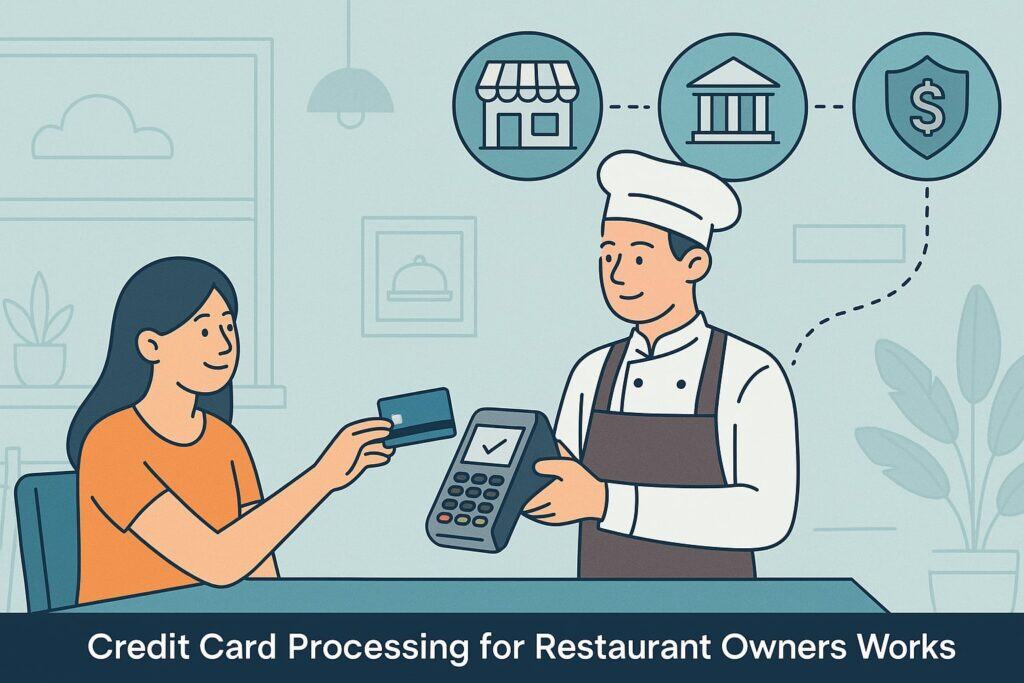
Even though it looks instant to your guests, credit card processing for restaurant owners involves several players: the cardholder, your restaurant, your payment gateway, your processor, the card network, and the customer’s bank. Understanding this flow helps you evaluate processors and troubleshoot issues.
The Transaction Journey in Restaurant Credit Card Processing
When a guest inserts, taps, or swipes a card at your point-of-sale terminal, your POS sends an authorization request through your payment gateway to your payment processor. The processor routes that request over the relevant card network (like Visa, Mastercard, American Express, or Discover) to the card-issuing bank.
The issuing bank then decides whether to approve or decline the transaction based on available credit, fraud checks, and card status. It sends a response back through the network and processor, and your terminal shows “approved” or “declined” to staff and guest. This all happens in a few seconds.
At the end of a shift or day, your restaurant “batches” or “settles” transactions. The processor submits that batch to the card networks, and the issuing banks send funds (minus interchange fees) to your acquiring bank.
The processor then deducts its markup and other fees and deposits the remaining amount into your business bank account.
For restaurant owners, the key takeaway is that every step—authorization, batching, settlement, and funding—has timing and costs attached.
Delayed batching can slow deposits; poor connectivity can cause more declines; and certain transaction types (like keyed-in numbers or card-not-present orders) are priced differently because they carry higher fraud risk.
Card-Present vs. Card-Not-Present in Restaurants
Credit card processing for restaurant owners now spans both card-present and card-not-present channels. Card-present covers in-person payments at the table, bar, counter, or kiosk using EMV chip, tap, or swipe. Card-not-present includes phone orders, online ordering, delivery app integrations, and stored cards in your loyalty or house account systems.
Card-not-present processing typically has higher interchange and processing rates because it’s easier for fraudsters to use stolen card numbers without the physical card. That’s why you’ll often see a cost difference between in-person and online fees for the same card brand.
For restaurants, this means you should configure your tech stack to route as many payments as possible through secure, tokenized, card-present or “card-present-like” flows (for example, a guest scanning a QR code to pay at the table with a wallet that supports strong customer authentication).
Blurring the line between on-premise dining and digital convenience gives you the best of both worlds: better guest experience and more efficient credit card processing for restaurant owners.
Understanding Fees in Credit Card Processing for Restaurant Owners
One of the hardest parts of credit card processing for restaurant owners is decoding the fee structure. You might see a simple flat rate on your statement, but underneath are several layers of cost: interchange, assessments, and processor markup.
Interchange, Assessments, and Processor Markup
Interchange fees are set by the card networks and paid to the card-issuing banks. These fees vary by card type (debit vs. credit, rewards vs. non-rewards), transaction method (chip, tap, swipe, online), and merchant category (restaurants are a specific category). Interchange rates are updated regularly—often twice per year—and are non-negotiable for individual merchants.
Assessment fees (or network fees) are smaller charges paid directly to the card networks for using their systems. These are also non-negotiable and are usually based on a percentage of volume.
On top of these “base costs,” your payment processor adds a markup. There are three common pricing models:
- Interchange-plus: You pay actual interchange plus a transparent markup (for example, +0.20% + 10¢ per transaction).
- Flat rate: You pay one simple blended rate (for example, 2.6% + 10¢) regardless of card type.
- Tiered pricing: Transactions are grouped into “qualified,” “mid-qualified,” and “non-qualified” tiers with different rates, often making your true cost hard to predict.
Credit card processing for restaurant owners typically benefits from interchange-plus or blended structures designed specifically for food and beverage businesses, where ticket sizes, tipping, and high volume matter more than occasional big ticket purchases.
Average Processing Costs for Restaurants in 2025
Recent data shows that average in-person credit card processing fees by network (not including processor markup) tend to fall in these ranges:
- Visa: around 1.79% + a small per-transaction fee.
- Mastercard: around 1.93% + a per-transaction fee.
- Discover and American Express: often somewhat higher, especially for premium cards and online transactions.
When you add processor markup, many restaurants end up paying total effective rates between 2–4% on card volumes, depending on the mix of card types, online orders, and negotiated terms. For high-volume restaurants, even a 0.1–0.2% difference in effective rate can translate to thousands of dollars per year.
This is why regularly reviewing statements, understanding your true “effective rate,” and negotiating better terms is critical. Credit card processing for restaurant owners should be treated like a major vendor contract, not a background utility you never revisit.
Choosing the Right Processor and POS System for Your Restaurant

Picking a processor and POS is one of the biggest technology decisions in credit card processing for restaurant owners. Your choice affects not only fees but also staff workflows, reporting, menu management, loyalty, and online ordering.
Key Criteria When Evaluating Restaurant Credit Card Processors
When you evaluate providers, look at more than just the headline rate. Important factors include:
- Pricing transparency: Interchange-plus with clearly disclosed markups is usually easier to audit than tiered pricing.
- Restaurant-specific support: Can they handle bar tabs, tip adjustments, split checks, and service charges correctly every time?
- Contract terms: Avoid long auto-renewing contracts with heavy early-termination fees or non-cancelable equipment leases.
- Funding speed: Many processors now offer next-day or even same-day funding for restaurant batches, which can help with cash flow.
- Chargeback tools: Good portals and alerts help you respond rapidly to cardholder disputes.
- Integration ecosystem: Your credit card processing for restaurant owners should integrate with online ordering, delivery platforms, accounting software, and loyalty programs to avoid manual data entry.
Also consider whether the provider is processor-agnostic or proprietary. Some restaurant POS companies act as both POS and processor; others let you choose a separate processor. A bundled solution can be simpler, while an open system can give you more bargaining power over rates.
Matching POS Features to Your Restaurant Concept
Your POS is the front-end of credit card processing for restaurant owners. For quick service, you may prioritize drive-thru, counter service speed, self-service kiosks, and QR ordering. For full-service restaurants, you may want table-side ordering, handheld pay-at-the-table devices, coursing, and check splitting.
Look for features like:
- Customizable tip prompts and automatic service charges.
- Easy split-check and split-item flows for large parties.
- Table mapping and coursing that sync with kitchen display systems.
- Integrated gift card, loyalty, and marketing tools.
- Omnichannel support (dine-in, curbside, pickup, delivery).
When credit card processing for restaurant owners is tightly integrated into the POS, servers don’t need to re-key amounts, managers can see real-time sales dashboards, and owners can analyze card mix, tip percentages, and menu performance from a single system. This integration is often worth more than saving a tiny fraction of a percent in fees.
Setting Up Credit Card Processing for Restaurant Owners Step by Step
Once you choose a processor and POS, implementation becomes the next hurdle. A smooth setup reduces downtime and speeds up your path to reliable credit card processing for restaurant owners.
From Application to First Live Transaction
The journey typically starts with a merchant account application. You’ll provide legal business information, ownership details, banking information, estimated processing volumes, average ticket size, and menu type (quick service, full service, bar, etc.). Underwriting teams use this to assess risk and approve your merchant account.
Once approved, the processor or POS vendor ships or installs your terminals, PIN pads, and any handheld devices. You’ll configure tax rules, menu items, modifiers, and tip flows. Make sure your merchant category code (MCC) correctly reflects that you are a restaurant or bar; this impacts interchange classification and sometimes eligibility for specific programs.
Next, you’ll do test transactions using real cards to confirm that approvals, voids, refunds, and tip adjustments work as expected. You’ll also test online ordering and delivery app integrations if they route payments through your merchant account.
Before going fully live, choose a batching schedule (for example, automatic batch close at 2 a.m. after last seating) and verify deposit timing. Clear internal training for servers and bartenders is crucial so they know how to handle declined cards, partial approvals, pre-authorization for bar tabs, and adding tips after the fact.
Training Staff and Setting Operational Policies
Credit card processing for restaurant owners is only as strong as the staff using the system. Invest time in teaching servers how to:
- Start and manage bar tabs securely.
- Verify signatures or ID where appropriate.
- Enter tips correctly on pre-auth or post-auth tickets.
- Handle split checks smoothly without mistakes.
- Recognize suspicious card behavior or potential fraud.
Establish internal policies for when to ask for another form of payment, how to handle tips on large parties, and who can issue refunds or voids. Clear policies reduce disputes and chargebacks later.
Also consider posting visible signage if you use surcharging or cash discount programs. Card network rules require clear, prominent disclosure of surcharges at both entry and point of sale, and surcharges are capped by network rules, often around 3–4% of the transaction.
Restaurant-Specific Features in Credit Card Processing You Should Demand
Restaurants are not like retail stores. You deal with tips, bar tabs, servers sharing terminals, and orders that might start at a bar and end at a table. Credit card processing for restaurant owners has unique needs that generic processors don’t always handle well.
Tipping, Bar Tabs, and Service Charges
Tipping is central to restaurant culture, and your system must handle it accurately. When you authorize a card for a bar tab or table, you typically place a pre-authorization for the ticket amount plus a buffer.
At the end of the meal, servers adjust the ticket with the tip and close the check. Your processor must support post-auth tip adjustments without causing downgrades (higher interchange) or increased risk of disputes.
For large parties or special events, many restaurants now use automatic gratuity or service charges instead of or in addition to tips. Your POS and processor need to treat automatic gratuities correctly on receipts and in reporting, and you’ll want to work closely with your accountant on payroll and tax implications.
Credit card processing for restaurant owners should also support pooled tips, tip-out reporting, and accurate allocation across servers, bartenders, and support staff. The right tools reduce manual spreadsheets and payroll headaches.
QR Codes, Tableside, and Mobile Wallet Payments
Guests increasingly expect to pay without handing over their card. Modern restaurant payment trends include QR code “scan to pay” at the table, handheld devices that bring EMV and tap-to-pay to the guest, and mobile wallet acceptance (Apple Pay, Google Pay, and others). Contactless options have become a powerful driver of guest satisfaction and repeat visits.
When evaluating credit card processing for restaurant owners, look for:
- EMV chip and NFC contactless support on all in-house devices.
- QR-code pay flows that integrate directly with your POS, so checks close automatically.
- Support for tap-to-pay on smartphones or tablets (for example, Tap to Pay on iPhone) so staff can accept cards anywhere in the restaurant without extra hardware.
These tools not only speed up checkout but also help turn tables faster and reduce lines at the bar or counter.
Security, PCI DSS v4.0.1, and Compliance for Restaurant Owners
Security and compliance are core to credit card processing for restaurant owners. A single data breach or pattern of non-compliance can lead to fines, forced audits, and reputational damage.
PCI DSS v4.0.1 and What It Means for Restaurants
The Payment Card Industry Data Security Standard (PCI DSS) sets rules for how businesses must secure cardholder data. The standard was significantly updated in version 4.0, and as of March 31, 2024, older version 3.2.1 was fully retired. PCI DSS v4.0 and v4.0.1 are now the active standards, with new requirements becoming mandatory by March 31, 2025.
For restaurants, this means you must:
- Use PCI-validated payment applications and terminals.
- Segment your network so POS traffic is separated from guest Wi-Fi.
- Enforce strong passwords and multi-factor authentication for remote access.
- Keep systems patched and up-to-date.
- Perform regular vulnerability scans and, where required, penetration tests.
Many small restaurants qualify for simpler PCI self-assessment questionnaires if they use fully outsourced, tokenized payment solutions that never store full card numbers onsite.
When you evaluate credit card processing for restaurant owners, ask vendors how their architecture reduces your PCI scope and what tools they provide to help you complete annual compliance tasks.
Tokenization, Encryption, and Fraud Controls
Strong security in credit card processing for restaurant owners relies on point-to-point encryption (P2PE) and tokenization. P2PE encrypts card data at the moment of contact with the terminal so that any intercepted data is useless.
Tokenization replaces card numbers with tokens in your systems, so recurring charges, saved cards, and loyalty profiles don’t expose real card data.
Modern processors also apply AI-driven fraud detection to spot unusual patterns, such as repeated high-value attempts on the same card, mismatched location data, or abnormal spending patterns.
For restaurants with a significant online ordering or delivery channel, these tools can dramatically reduce card-not-present fraud and related chargebacks.
Staying ahead of security requirements and leveraging your processor’s tools keeps your guests’ data safe and protects your restaurant from costly incidents.
Strategies to Reduce Costs and Boost Profit with Credit Card Processing
Because card payments represent such a large share of revenue, optimizing credit card processing for restaurant owners can have an outsized impact on profit. Small changes in pricing, routing, and operations add up.
Optimizing Pricing Models, Statements, and Interchange
First, analyze your merchant statements to find your effective rate—your total processing fees divided by total card volume over a month. Then:
- Compare your effective rate with industry averages. Effective rates above the low-to-mid 3% range may be a sign that your pricing or setup needs review.
- Ask your processor for a detailed breakdown of interchange, assessments, and markup.
- Consider switching from tiered to interchange-plus pricing, especially if you have many premium and rewards cards.
You can also help your restaurant qualify for better interchange categories by correctly configuring your merchant category, ensuring full EMV support, batching promptly, and including all required data in transactions.
Staying up-to-date with current interchange tables and card brand programs for restaurants, including any small-ticket or quick-service optimizations, can also lower costs.
Surcharging, Cash Discounting, and Legal Considerations
Some restaurants explore surcharging or cash discount programs to offset processing fees. Surcharging means adding a fee when guests pay by credit card; cash discounting means offering a lower price for cash or equivalent payments.
Card networks allow surcharging under strict rules: surcharges must be clearly disclosed before checkout and on receipts, and they are capped (often up to 3–4%). Certain card products or locations may have additional limitations.
Network guidance emphasizes transparency, and businesses must also comply with state and local laws that can restrict or regulate surcharging.
Before implementing any such program, restaurant owners should:
- Review card network rules and recent updates.
- Consult with their processor about compliant implementation.
- Seek legal or tax advice for their specific jurisdiction.
Credit card processing for restaurant owners should balance fairness to guests, competitiveness in the local market, and profitability for the business.
Handling Chargebacks, Disputes, and Fraud in Restaurants
Chargebacks are an unavoidable part of credit card processing for restaurant owners. They happen when a cardholder disputes a transaction with their bank, and if the bank sides with the cardholder, the funds are reversed from your restaurant.
Common Restaurant Chargeback Scenarios and How to Prevent Them
Typical restaurant-related chargebacks include:
- “I didn’t authorize this transaction.”
- “I was charged twice.”
- “The final amount was higher than I signed for.”
- “I never received the order” (especially for delivery or online orders).
To reduce these issues, credit card processing for restaurant owners should incorporate:
- Clear itemized receipts showing food, beverages, tips, and service charges.
- Signed merchant copies or digital acceptance logs, especially for large parties.
- Accurate pre-auth and tip adjustment processes that avoid surprising increases.
- Reliable delivery confirmation methods for off-premise orders.
Staff training also matters. Servers should confirm the check total before running the card, highlight any automatic gratuity or service charge, and handle split checks carefully to avoid accidental duplicates.
Responding to Chargebacks and Learning from Data
When you receive a chargeback, act quickly. Your processor’s portal normally provides the reason code, deadline, and a way to upload supporting documents (signed receipts, order tickets, delivery confirmations, or internal notes).
Recent legal and regulatory scrutiny of chargeback practices—especially around fraud liability for merchants that didn’t upgrade to chip-enabled POS—has led to settlements and rule changes among major card networks.
These developments underscore the importance of staying current with EMV, PCI, and network requirements so you’re not unfairly exposed to avoidable chargeback risk.
Over time, analyze your chargeback data. You may discover patterns tied to certain order channels, times of day, or staff members. Use those insights to refine your credit card processing for restaurant owners, tighten policies, adjust online ordering flows, or modify tip and service charge practices.
Future Trends in Credit Card Processing for Restaurant Owners
Payment technology is evolving quickly, and restaurants that adapt early often gain a competitive edge. The future of credit card processing for restaurant owners is shaped by mobile, AI, and regulation.
Mobile, Contactless, and Biometric Payments
Restaurant payment trends point strongly toward mobile and contactless experiences: tap-to-pay cards, mobile wallets, QR codes, and even biometric authentication.
Restaurant-focused sources highlight that contactless payments are now a standard expectation, not a novelty, and mobile ordering plus loyalty are hallmarks of top-performing restaurants.
We can expect:
- Wider adoption of Tap to Pay on regular smartphones and tablets, allowing staff to accept contactless credit cards and digital wallets anywhere in the venue.
- Increased use of biometrics (face or fingerprint) for guest authentication in mobile apps and loyalty programs.
- More QR-based hybrid experiences where guests can order, re-order, and pay from their phones while still interacting with servers for hospitality.
All of these trends reinforce that flexible, contactless-friendly credit card processing for restaurant owners will be essential going forward.
Regulation, Interchange Reform, and Network Rule Changes
Swipe fees and card network rules are under growing political and legal scrutiny. Card networks have already faced large settlements and proposed settlements over interchange fees and chargeback rules, including potential caps on certain fee levels and changes to “honor all cards” requirements that could allow merchants to decline particularly high-cost premium rewards cards.
In the coming years, restaurant owners should expect:
- Possible legislative or regulatory changes impacting interchange calculations, fee caps, or how fees are disclosed.
- Continued evolution of surcharging and cash discount rules, especially as some countries move to curb or ban excessive surcharges.
- Ongoing updates to PCI DSS requirements and security expectations, especially as card data moves into cloud-based and mobile environments.
Keeping close contact with your processor, industry associations, and trusted advisors will help you adapt your credit card processing for restaurant owners as the rules evolve.
Frequently Asked Questions
Q.1: How can I tell if I’m overpaying for restaurant credit card processing?
Answer: Start by calculating your effective rate: divide your total processing fees on a statement by your total card volume for the same period and express it as a percentage. If your effective rate is well above 3%–3.5%, it’s worth a deeper review.
Next, examine whether your pricing model is tiered, flat, or interchange-plus. Tiered pricing, especially when described with “qualified” and “non-qualified” categories, often hides higher markups and inconsistent costs.
Interchange-plus pricing is typically more transparent for credit card processing for restaurant owners because you can see actual interchange and the processor’s markup separately.
You should also compare your statements over several months. Look for sudden spikes in effective rate, new junk fees (like “regulatory fee” or “service fee” without clear explanation), and any “non-EMV” or “downgraded” categories that may indicate technical configuration problems.
If you see these, ask your processor for an audit and consider getting a competing quote. Even small reductions in effective rate can have a major impact over a year of card volume.
Q.2: Is it better to use my POS provider’s built-in processing or a separate processor?
Answer: Both approaches can work, and the best choice depends on your priorities. When your POS provider also handles your processing, you get an all-in-one solution: one support team, tightly integrated features, and fewer moving parts. This can simplify credit card processing for restaurant owners, especially for operators with limited IT resources.
However, a single-vendor bundle may reduce your negotiating leverage on processing fees and contract terms. If the provider locks you into long agreements, it can be harder to shop rates later.
By contrast, using a POS that is “processor-agnostic” lets you choose among multiple processors and switch more easily if pricing or service becomes an issue.
When evaluating options, compare the total cost of ownership instead of just headline rates. Factor in software subscription fees, hardware costs, processing rates, add-on module pricing, and any early termination fees.
Ask vendors to model fees based on your actual ticket size and volume so you can see the real impact on your credit card processing for restaurant owners.
Q.3: Are surcharges and cash discount programs worth it for restaurants?
Answer: Surcharges and cash discount programs can offset some or all of your processing costs, but they also carry legal, regulatory, and customer-experience considerations.
Card networks allow merchants in many jurisdictions to add a surcharge to credit card transactions, but only under specific conditions: clear, prominent disclosure; caps on percentage; and compliance with network rules and local laws.
Some guests may react negatively to visible surcharges, especially in environments where tipping is already expected. You need to consider your local competition, your brand positioning, and your average ticket size.
In some markets, cash discounts or dual-pricing (listing both cash and card prices) may be more acceptable than an explicit fee.
If you decide to implement these strategies, work closely with your processor to ensure your program is configured correctly in your POS and on receipts, and seek qualified legal advice about local regulations.
Done well, surcharging can help manage the expenses of credit card processing for restaurant owners; done poorly, it can create compliance risks and damage guest loyalty.
Q.4: How do I make credit card processing faster and smoother for guests?
Answer: Speed and simplicity are crucial. To streamline credit card processing for restaurant owners and improve the guest experience:
- Deploy contactless-enabled terminals and handheld devices so guests can tap their cards or phones at the table, counter, or curbside pickup.
- Enable QR “scan to pay” options on receipts or table tents, allowing guests to view and pay their checks without waiting for a server.
- Configure clear, intuitive tip prompts with common percentages and a custom option.
- Integrate your online ordering and delivery app payments into your POS so staff aren’t juggling multiple tablets and devices.
From an operational perspective, ensure strong Wi-Fi or wired connections for all payment devices, set automatic batch times, and provide training so staff can solve basic payment issues quickly.
When your payment experience is fast and frictionless, guests focus on food and service—not on your terminals.
Q.5: What should small or new restaurants do first when setting up card processing?
Answer: If you’re opening a new restaurant, start by mapping out your service model: full-service, quick-service, bar-centric, food truck, or hybrid. Then look for POS and processing partners with proven experience in that specific segment.
Focus on vendors that:
- Offer clear, transparent pricing and are willing to explain every fee.
- Provide hardware that supports EMV, contactless, and mobile wallets.
- Include robust onboarding, menu programming assistance, and staff training resources.
- Integrate with the accounting, payroll, and online ordering tools you already plan to use.
Begin with simple, reliable credit card processing for restaurant owners rather than chasing every advanced feature at once. You can always add loyalty, gift cards, and advanced analytics later. Building a solid foundation with secure, compliant, and well-supported processing will set your restaurant up for growth.
Conclusion
Credit card processing for restaurant owners has evolved from a back-office utility into a strategic lever. The rise of cards, mobile wallets, contactless payments, and online ordering means that your payments stack touches almost every part of the guest journey, from how quickly checks are closed to how easily guests can reorder and how predictable your cash flow and margins are.
By understanding how card processing works, decoding fee structures, choosing restaurant-focused partners, complying with PCI DSS v4.0.1 requirements, and staying ahead of emerging trends like Tap to Pay and QR-based dining, you can turn payment acceptance into a competitive advantage rather than just a cost of doing business.
As regulations evolve and card networks adjust interchange and surcharge rules, restaurant owners who actively manage their payment stack—reviewing statements, renegotiating pricing, hardening security, and optimizing guest experiences—will have a clear edge.
Treat credit card processing for restaurant owners as a powerful tool in your operational and financial strategy, and it will repay that attention in smoother service, happier guests, and healthier margins year after year.