
By breadpointofsale January 18, 2026
Debit vs credit card fees in restaurants can feel confusing because the “fee” you see on a statement is actually a bundle of moving parts: interchange (paid to the cardholder’s bank), network assessments (paid to the card network), and processor/merchant services markup (paid to your provider).
Once you unpack those parts, debit vs credit card fees in restaurants become much easier to control—often without changing your POS, raising menu prices, or upsetting guests.
Restaurants are a special case. Margins are tight, ticket sizes vary wildly, and tips, refunds, and card-not-present orders (online ordering, delivery, catering) add complexity. That’s why debit vs credit card fees in restaurants is not just a finance topic—it’s an operations topic that impacts staffing, menu engineering, marketing promos, and guest experience.
This guide breaks down debit vs credit card fees in restaurants in plain language, shows what drives costs up or down, and gives realistic strategies you can apply in quick-service, fast-casual, full-service, bars, and multi-location groups.
It also includes forward-looking predictions for where debit vs credit card fees in restaurants is heading next, based on current network rules and ongoing industry pressure around “swipe fees.”
One thing is consistent: restaurants that understand debit vs credit card fees in restaurants can usually lower effective rates without sacrificing acceptance or speed.
Understanding the Real “Card Fee” in a Restaurant Transaction
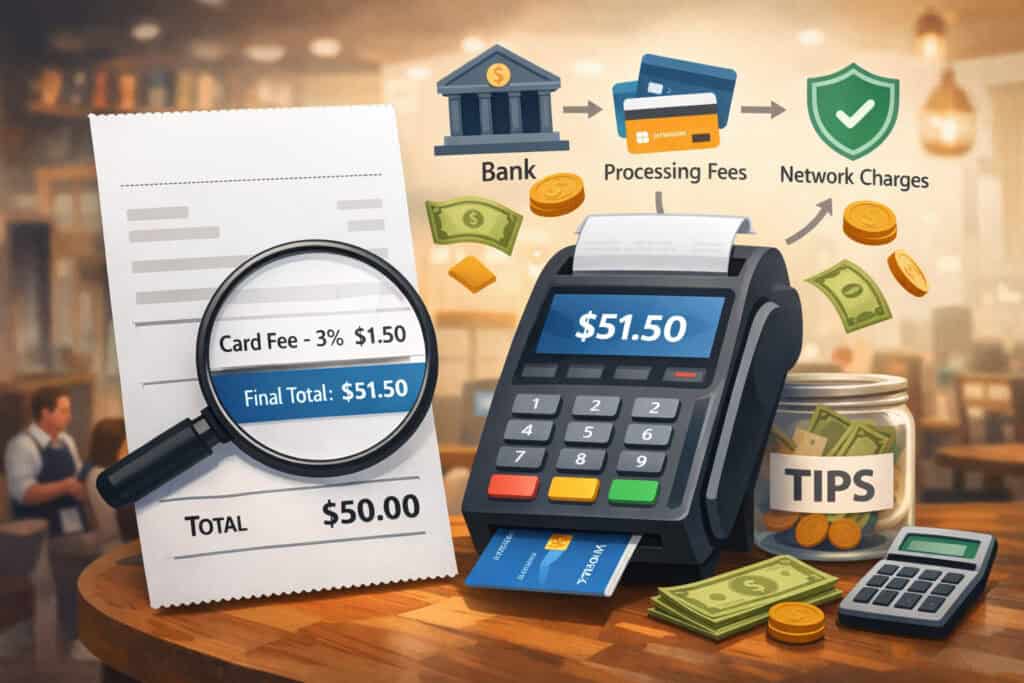
Debit vs credit card fees in restaurants starts with understanding what the fee actually includes. Most restaurants don’t pay a single flat “card fee” that’s the same across every transaction. Instead, the final cost is shaped by three layers, and each layer behaves differently for debit vs credit card fees in restaurants.
First is interchange, typically the largest component. Interchange is set by card networks and paid to the cardholder’s issuing bank.
For debit transactions from large issuers, interchange is regulated under Regulation II (often discussed as the Durbin rule), which caps certain debit interchange at 21 cents + 0.05% of the transaction, with a potential additional 1 cent adjustment tied to fraud-prevention standards. This is a huge reason debit vs credit card fees in restaurants often favor debit on higher ticket sizes.
Second is network assessments and dues, charged by networks for moving transactions across their rails. These vary by network and transaction type (present vs not-present, debit vs credit, and sometimes by authorization method).
Third is your processor markup (and sometimes additional pass-throughs like gateway or POS add-ons). This is the piece you can negotiate most directly, which is why debit vs credit card fees in restaurants are never only about interchange tables.
For restaurants, there’s also the “restaurant reality layer”: tips, incremental authorizations, batch timing, and refunds. These don’t just create operational quirks; they can change qualification and raise effective cost. If you want to win at debit vs credit card fees in restaurants, you have to manage both the pricing model and the workflow.
Debit vs credit card fees in restaurants also vary by acceptance method. Tap-to-pay, chip, swipe, online, and “keyed-in” orders can land in very different interchange categories.
Card-present with strong security signals tends to price better than card-not-present. This is why moving more transactions to secure card-present flows can improve debit vs credit card fees in restaurants even if your provider stays the same.
Debit Card Fees in Restaurants: Why Debit Often Costs Less (and When It Doesn’t)
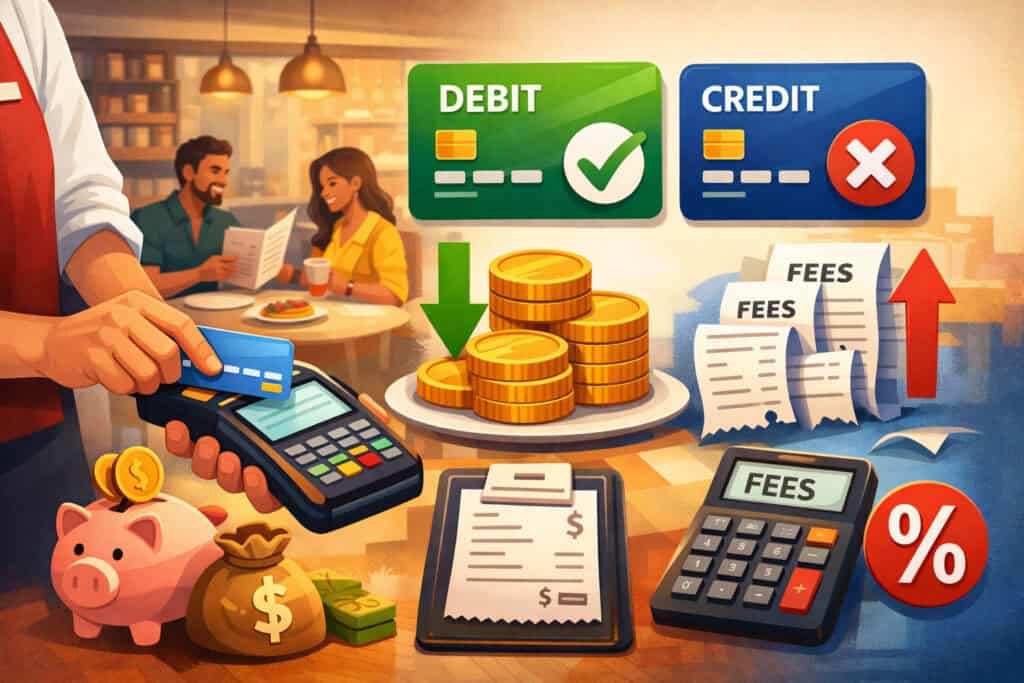
Debit vs credit card fees in restaurants often lean toward debit because many regulated debit transactions are capped, which limits how high the interchange portion can go. The practical impact is simple: as your ticket size increases, a capped debit fee can become relatively cheaper than a percentage-based credit interchange.
The Regulation II cap is widely cited as 21 cents + 0.05%, plus a possible 1 cent fraud adjustment for eligible issuers. In restaurant terms, that means a $40 debit ticket might have a regulated interchange component that’s closer to a small fixed amount than a large percentage.
If you run a bar with higher average tickets, catering, or busy full-service dinners, debit vs credit card fees in restaurants can shift dramatically in favor of debit—assuming the debit transaction is routed and processed in the most cost-efficient way.
But debit is not always automatically “cheap.” There are three common reasons debit vs credit card fees in restaurants doesn’t save as much as expected:
- Unregulated debit: Smaller issuers can charge higher debit interchange than the regulated cap. So debit vs credit card fees in restaurants depend on your guest mix and which banks issued the cards.
- PIN vs signature / routing choices: Debit can route differently depending on how it’s accepted (PIN debit vs “signature debit” or contactless). Routing rules and network options matter, and restaurants sometimes default into less favorable routing due to POS configuration or processor preferences.
Regulation II also includes routing provisions designed to prevent restrictions that override a merchant’s ability to choose routing in certain cases. - Card-not-present debit: Online ordering debit may price differently than in-store debit. If your digital ordering share is growing, debit vs credit card fees in restaurants become as much about fraud signals and authentication as it is about “debit vs credit.”
A restaurant that wants predictable savings from debit vs credit card fees in restaurants should make sure its POS supports debit routing options, uses modern terminals, and has clean tip/adjustment procedures that avoid downgrades or exception pricing.
Debit can be a cost advantage, but only when the configuration and workflow allow it to stay in the best categories.
Credit Card Fees in Restaurants: Why Credit Is Usually Higher (and What Drives the Spread)

Debit vs credit card fees in restaurants tend to show higher costs on credit because credit interchange is commonly percentage-based and can climb further with rewards programs, premium cards, and card-not-present orders.
In practice, restaurants often see a wider spread between “basic” credit cards and premium rewards cards than between debit types.
Industry summaries frequently quote broad credit processing ranges for merchants. For example, compiled estimates often put typical merchant costs in a range roughly around 1.10% to 3.15% depending on card type and setup, and some groups cite averages around 2.35% for major network-branded credit transactions.
The important takeaway for debit vs credit card fees in restaurants isn’t the single number—it’s what causes a restaurant to land at the high end vs the low end.
Key drivers that push credit costs higher in debit vs credit card fees in restaurants include:
- Rewards and premium tiers: Premium cards often carry higher interchange because the rewards are funded partly through interchange economics.
- Keyed-in / card-not-present: Online ordering, phone orders, and manual entry generally cost more than EMV chip or contactless tap, because risk is higher.
- Small-ticket vs large-ticket dynamics: Some categories include fixed per-transaction components, which can hurt quick-service small tickets more than full-service.
- Data quality and security signals: Address verification, tokenization, and strong POS security can influence risk scoring and downstream costs (directly or indirectly).
Mastercard publishes interchange program documents that illustrate how varied credit interchange can be by program and card tier.
For example, Mastercard’s published rate tables for its region show different percentage + fixed-fee combinations across categories and tiers (effective dates vary by program). This kind of variation is exactly why debit vs credit card fees in restaurants aren’t solved by one “rate quote” from a sales rep.
To control credit costs, restaurants should focus on acceptance methods (tap/chip vs keyed), reducing unnecessary card-not-present entry, and negotiating processor markup transparently so the business isn’t overpaying on top of already-high interchange.
The Restaurant-Specific Factors That Change Fees: Tips, Auth Holds, Refunds, and Delivery

Debit vs credit card fees in restaurants is heavily shaped by restaurant behaviors that don’t exist in many other industries. A retail shop might authorize and capture instantly with minimal adjustments.
Restaurants often pre-authorize, add tips later, handle split payments, and issue partial refunds. Each of these can influence qualification, timing, and effective cost.
Tips and adjustments are a big one. In full-service, the authorization often happens before the final amount is known. If your system doesn’t finalize correctly or captures outside recommended time windows, you can see higher fees or more exceptions.
Even when networks don’t explicitly “penalize” tips, the processing pathway can become less efficient, which matters when you’re trying to optimize debit vs credit card fees in restaurants.
Auth holds are common in bars and tabs. A small initial authorization plus later capture can create complexity. Good POS systems handle this smoothly.
Poor setups create duplicate authorizations, increased disputes, or “no-show” style confusion that can lift operational cost. That affects debit vs credit card fees in restaurants indirectly by increasing chargebacks and risk monitoring.
Refunds are another hidden cost driver. Refund ratios can affect risk profile, and refund processing can carry fees depending on your provider model. Restaurants with delivery and catering often refund more frequently due to order errors and timing issues—making debit vs credit card fees in restaurants more sensitive to operational accuracy.
Delivery and online ordering shifts transactions into card-not-present territory, which often costs more and carries higher fraud exposure. If your online checkout lacks modern security features (tokenization, strong device signals, and proper fraud tools), you may pay more through higher-risk categories and extra fraud losses.
In other words: debit vs credit card fees in restaurants is not just about which card the guest uses—it’s about whether you accept it in-store securely or through a higher-risk channel.
If you want sustainable improvements, treat debit vs credit card fees in restaurants as a workflow optimization project. Tighten tip and batch procedures, reduce manual entry, improve online checkout security, and track refunds by root cause.
Pricing Models Explained: Interchange-Plus vs Flat Rate vs Tiered in Restaurant Processing
Debit vs credit card fees in restaurants is impossible to optimize if you don’t know your pricing model. Restaurants commonly see one of three models, and each can make debit vs credit card fees in restaurants look higher or lower on paper.
Interchange-plus (also called “cost-plus”) separates interchange and assessments from the processor markup. This model is often best for transparency because you can see how debit vs credit card fees in restaurants change with card mix. If your processor markup is competitive, interchange-plus is often favorable for restaurants that want to actively manage costs.
Flat rate (for example, one blended percentage) can be appealing for simplicity—especially for newer restaurants. But flat rates frequently bake in a cushion for higher-cost cards.
That can mean you overpay on debit-heavy transactions, making debit vs credit card fees in restaurants look worse than it should. Flat rate can still be reasonable if you value predictability and your volume is low—but it often becomes expensive as you scale.
Tiered pricing groups transactions into “qualified / mid-qualified / non-qualified” buckets. Many merchants dislike this model because it can be opaque. For debit vs credit card fees in restaurants, tiered pricing can hide how much premium credit cards are costing you and can blur whether debit is truly cheaper.
The practical guidance is: if you’re serious about optimizing debit vs credit card fees in restaurants, start by getting a detailed statement view. You want to know your effective rate, but also your cost structure: markup, pass-throughs, and which line items increase with volume.
Also watch for add-ons that don’t show up as “rate.” Things like monthly gateway fees, PCI programs, non-compliance penalties, and “regulatory” line items can inflate what debit vs credit card fees in restaurants really cost. A restaurant can have a decent rate but still overpay due to recurring and incidental fees.
A strong goal is to make debit vs credit card fees in restaurants measurable: track effective rate by channel (in-store vs online), by brand (Visa/Mastercard/Amex/Discover), and by tender type (debit vs credit). When you can see it clearly, you can improve it.
Can Restaurants Charge Guests More for Credit? Surcharging, Cash Discounting, and Compliance
Debit vs credit card fees in restaurants often leads owners to ask: “Can we pass this fee to guests?” The answer depends on your state rules and card network rules, and it must be handled carefully.
Major card networks publish guidance that in many states a merchant may add a surcharge to credit card transactions under specific conditions and limitations.
For example, Visa’s merchant guidance explains that surcharging may be permitted in most states and territories, but it comes with restrictions (including product types and merchant location constraints) and requires proper disclosure.
A crucial point in debit vs credit card fees in restaurants: surcharges generally apply to credit, not debit. Business-facing guidance often emphasizes that debit card surcharging is treated differently and is commonly restricted.
This means a restaurant trying to address debit vs credit card fees in restaurants with surcharging must ensure the POS distinguishes debit from credit accurately—especially in contactless scenarios where the guest may not even realize which rail is used.
There are also state-level nuances. Some states have restrictions or disclosure requirements, and these can change through litigation and enforcement trends. Updated summaries and compliance guides track surcharging legality and conditions by state.
For restaurants, the guest experience matters. A surprise surcharge at the end of a meal can harm reviews and return visits. If you consider surcharging as part of debit vs credit card fees in restaurants strategy, best practices include:
- Clear signage at entry and at the register
- Itemized receipt labeling
- Training staff to explain it calmly
- Making sure the surcharge never exceeds allowed caps or your actual cost (depending on applicable rules)
An alternative is cash discounting (displaying a “cash price” and offering a discount for cash). Cash discounting can be simpler from a guest psychology standpoint, but must still be disclosed clearly and implemented correctly in the POS.
The safest approach is to treat surcharging/cash discounting as a formal compliance project, not a quick toggle. Done right, it can meaningfully reduce the restaurant’s burden in debit vs credit card fees in restaurants; done wrong, it can create disputes, fines, and brand damage.
Practical Ways to Lower Debit vs Credit Card Fees in Restaurants Without Losing Sales
Debit vs credit card fees in restaurants can often be lowered by operational and technical tweaks that don’t reduce acceptance and don’t frustrate guests. The key is to focus on improvements that reduce expensive transaction types, prevent downgrades, and tighten processor costs.
Start with hardware and acceptance. Encourage EMV chip and contactless tap for in-person payments. These methods reduce fraud exposure compared with swipe or manual entry, and they generally support better qualification.
In many restaurants, simply replacing old magstripe-heavy terminals reduces the high-cost tail in debit vs credit card fees in restaurants.
Next, tighten card-not-present controls for online ordering. Use tokenization, strong fraud tools, and modern checkout flows. Reducing fraud isn’t just about losses—it can reduce expensive exception handling and keep your profile cleaner, which supports better economics over time.
Then look at statement hygiene. Ask for interchange-plus pricing and a clean markup. Remove unnecessary add-ons. Confirm you aren’t paying redundant gateway fees if your POS already includes it.
Debit vs credit card fees in restaurants are often improved more by cutting hidden monthly fees than by chasing tiny basis-point changes.
Operationally, reduce refund rates by improving order accuracy and packaging. Track refund reasons and fix the top three causes. A restaurant with fewer refunds and disputes can often negotiate better terms and experience fewer risk-driven headaches.
Also review how tips are processed. Ensure tips are captured properly, batches close consistently, and staff follow a standard procedure. This reduces exceptions and helps you stabilize debit vs credit card fees in restaurants.
Finally, manage card mix exposure with menu design and promos. If you push high-ticket items during high-rewards spending peaks, your premium-card mix may increase. You can’t control guests’ cards, but you can structure promotions to minimize margin erosion.
For example, avoid stacking discounts on already low-margin items if your payment cost is a meaningful share of gross profit.
Debit vs credit card fees in restaurants is controllable, but it’s controlled through many small levers working together.
What “Good” Looks Like: Benchmarks and How to Audit Your Restaurant’s Effective Rate
Debit vs credit card fees in restaurants is often discussed as “What rate should I be paying?” But the better question is: “What is my effective rate, and why?”
Broad merchant cost ranges cited in industry summaries can span from roughly the low 1% range up to 3%+ depending on card mix and setup, with some sources citing averages around the mid-2% range for major network credit cards.
But your restaurant’s right number depends on: ticket size, debit vs credit mix, dine-in vs delivery mix, tip behavior, and your pricing model.
A strong audit for debit vs credit card fees in restaurants includes:
- Effective rate overall (total fees ÷ total card volume)
- Effective rate by channel: in-person vs online
- Debit vs credit split and associated costs
- Share of keyed-in transactions (should be minimal for in-store)
- High-fee outliers (specific days, terminals, staff shifts, or ordering channels)
- Monthly fixed fees and compliance fees that inflate total cost
Compare your data month-over-month, not just one statement. Restaurants are seasonal, and one month’s promo or holiday rush can skew debit vs credit card fees in restaurants. A three-month rolling view is better.
Also, match fees to operational events. If your online ordering provider changed routing or tokenization, you might see a shift. If you added delivery, you might see card-not-present climb. Debit vs credit card fees in restaurants is a living metric—your business model changes it.
If you’re negotiating with providers, ask for clarity on markup, pass-throughs, and any “non-interchange” junk fees. The goal isn’t perfection; it’s predictability and fairness. When your audit is clean, you can negotiate from facts instead of frustration.
Future Predictions: Where Debit vs Credit Card Fees in Restaurants Is Headed Next
Debit vs credit card fees in restaurants is under constant pressure from multiple sides: merchants want lower costs, networks and issuers want to sustain revenue, and policymakers face lobbying on both ends. While no one can predict every change, there are clear directional trends.
First, transparency pressure is rising. Merchant advocacy groups and consumer-facing media increasingly spotlight “swipe fees,” and industry reporting suggests the debate will remain active. Published merchant cost analyses and commentary keep this topic in public view.
That means restaurants should expect more guest awareness and more competitors experimenting with pricing strategies like cash discounts or limited surcharging.
Second, network documentation continues to evolve. Mastercard’s published interchange program materials show how rates and categories are structured and updated over time (effective dates vary).
The practical prediction: more complexity, not less. Debit vs credit card fees in restaurants will likely remain a moving target, so restaurants should invest in systems that make monitoring easy.
Third, routing and debit policy debates are likely to continue. Regulation II’s routing focus is still a foundational issue for how debit transactions move. Restaurants that keep their POS modern and routing-capable will be better positioned if new routing-related rules or enforcement shifts occur.
Fourth, contactless and digital wallets will keep growing. This can be good for fraud reduction and guest experience, but it can also blur debit vs credit distinctions at the point of interaction, making compliance (especially around surcharging) more operationally sensitive.
Visa’s published surcharging guidance emphasizes the need to follow product and location restrictions and disclose properly. Expect restaurants to lean more toward “simple and transparent” pricing policies to avoid guest confusion.
Finally, many restaurant operators will move from chasing “a lower rate” to building a payment cost management system: tracking effective rate, routing, refunds, chargebacks, and channel mix monthly. That is the most reliable long-term strategy for debit vs credit card fees in restaurants, regardless of how the external rules shift.
FAQs
Q.1: What is the biggest reason debit vs credit card fees in restaurants are different?
Answer: Debit vs credit card fees in restaurants differs mainly because debit interchange is sometimes capped for large issuers under Regulation II, while credit interchange is usually percentage-based and can be higher for premium and rewards cards.
The Regulation II debit cap is commonly described as 21 cents + 0.05%, with a possible additional 1 cent fraud adjustment for eligible issuers. This makes debit vs credit card fees in restaurants especially meaningful on larger tickets, where a capped debit interchange can be relatively cheaper than a percentage-based credit cost.
Q.2: Are debit vs credit card fees in restaurants always lower for debit?
Answer: No. Debit vs credit card fees in restaurants are often lower for debit, but not always. Unregulated debit (from smaller issuers) can cost more than capped debit.
Also, debit routing and acceptance method matter—PIN debit, contactless debit, and “signature-style” debit can route differently, and POS settings may influence outcomes. Debit vs credit card fees in restaurants can also rise if the transaction is card-not-present (online ordering) or if processing is error-prone.
Q.3: Can a restaurant add a surcharge for credit card use?
Answer: In many states, restaurants can surcharge credit card transactions under network rules and state restrictions, but compliance requirements apply.
Visa’s merchant guidance notes that surcharging may be allowed in most states and territories, subject to limitations and disclosure requirements. Debit vs credit card fees in restaurants becomes tricky here because surcharging is typically about credit, and debit may be restricted in different ways. You should also check state-level updates.
Q.4: Is cash discounting safer than surcharging for debit vs credit card fees in restaurants?
Answer: Cash discounting can be simpler for guest perception because it frames cash as a discount rather than cards as a penalty. But it still requires clear disclosure and correct POS setup.
Debit vs credit card fees in restaurants can be reduced either way, but both approaches should be implemented carefully so signage, receipts, and staff scripts are consistent.
Q.5: What changes debit vs credit card fees in restaurants the most: processor markup or interchange?
Answer: For many restaurants, interchange is the largest component, but processor markup and “extra” fees can be the easiest to reduce. Debit vs credit card fees in restaurants improves fastest when you (1) switch to transparent pricing, (2) remove junk fees, and (3) reduce costly transaction types like keyed-in and unmanaged online payments.
Q.6: How can I tell if my restaurant is overpaying on debit vs credit card fees in restaurants?
Answer: Calculate your effective rate (total fees ÷ total card volume), then break it out by channel (in-store vs online) and by tender (debit vs credit).
Debit vs credit card fees in restaurants overpayment often shows up as: high monthly fixed fees, high keyed-in share, inconsistent batch close timing, and opaque tiered pricing that hides expensive card categories.
Conclusion
Debit vs credit card fees in restaurants isn’t a mystery—it’s a system. When you understand interchange, network assessments, and processor markup, you can see why debit vs credit card fees in restaurants behave differently across ticket sizes, service styles, and ordering channels.
Debit often has structural advantages because regulated debit interchange is capped for large issuers, commonly described as 21 cents + 0.05% plus a possible 1 cent fraud adjustment. Credit often costs more because premium and rewards programs drive higher percentage-based interchange, and card-not-present orders add risk and expense.
The best operators don’t chase a “magic rate.” They build a repeatable process: modernize acceptance (tap/chip), reduce keyed-in entry, secure online ordering, tighten tip and batch workflows, and audit statements for hidden add-ons.
If you choose to pass costs to guests, debit vs credit card fees in restaurants require careful compliance and clear disclosure, especially since surcharging rules focus on credit and can differ by location and network guidance.
Looking ahead, debit vs credit card fees in restaurants will likely stay under scrutiny, with continued complexity in rate programs and continued pressure for transparency.
The restaurants that win will be the ones that measure debit vs credit card fees in restaurants monthly, treat payment acceptance as part of operations, and make changes that protect both margin and guest trust.