
By breadpointofsale December 23, 2025
Payment processing costs in restaurants can quietly eat margins faster than spoilage, overtime, or a slow weeknight. Every swipe, tap, online order, delivery marketplace payout, and stored card on file creates a chain of fees and rules that most operators only see as one line item: “processing.”
The problem is that payment processing costs in restaurants aren’t one fee. They’re a stack of moving parts—interchange, network assessments, processor markups, POS add-ons, chargebacks, fraud tools, card-not-present risk, and even “accidental” downgrades caused by how your system sends data.
The good news: you can reduce payment processing costs in restaurants without hurting guest experience. In many cases, the fastest savings come from fixing operational details before you even renegotiate rates. Then, once your data is clean, negotiating becomes easier and results are measurably better.
This updated guide breaks down the real drivers behind payment processing costs in restaurants and gives you a practical playbook to lower them across dine-in, takeout, and online ordering.
It also includes forward-looking predictions—because what reduces payment processing costs in restaurants today may change as contactless, tokenization, and network rules evolve.
Understand What You’re Really Paying (And Why It Changes)

Payment processing costs in restaurants typically look like a blended percentage, but the “blend” hides where your dollars go. Most restaurant transactions include (1) interchange (set by card programs), (2) card network assessments (set by networks), and (3) processor/acquirer markup plus per-transaction fees.
Interchange is usually the biggest slice, and it varies by card type (rewards vs non-rewards), how the transaction is accepted (tap/swipe vs keyed vs online), and whether your data qualifies for the best category.
That’s why payment processing costs in restaurants can jump even if sales are flat. A shift in your mix—more online orders, more premium rewards cards, more manually keyed transactions, more delivery payments—changes the effective rate.
Even your average check matters: many fee schedules include a fixed amount per transaction, so low-ticket coffee and quick-service orders can carry a higher effective percentage than a $120 dinner check.
Another hidden issue is “downgrades.” If your POS doesn’t transmit required data fields correctly (or if you batch late, or if tip adjustments happen in a way that breaks qualification), transactions can fall into more expensive categories.
This is one of the most overlooked reasons payment processing costs in restaurants drift upward over time.
Finally, compliance and security requirements affect what you pay. Fraud, chargebacks, and non-compliance can add monthly and incident-based costs.
PCI DSS v4.0 timelines have pushed many vendors to add controls (and sometimes fees) as they tighten security requirements. PCI DSS v4.0 became the active standard for new assessments in 2024, with v3.2.1 retired by March 31, 2025.
If you want to reduce payment processing costs in restaurants, you need clarity first—because you can’t fix what you can’t see.
Benchmark Your Baseline With the Right Metrics (Not Just “Effective Rate”)

Payment processing costs in restaurants should be tracked like food cost: with consistent metrics and targets. The most common mistake is focusing only on “effective rate” (total fees ÷ total card sales).
Effective rate is useful, but it’s not diagnostic. Two restaurants can have the same effective rate and completely different fee problems.
Start with these baseline metrics:
- Fee dollars per transaction: This reveals whether fixed per-item fees are crushing small tickets. It’s often where quick-service operators find instant savings.
- Card-present vs card-not-present split: Online orders and stored credential payments often cost more because risk is higher. Payment processing costs in restaurants rise sharply when more volume shifts online.
- Debit vs credit mix: Debit can be less expensive, especially for regulated debit. Under the Durbin framework for large issuers, debit interchange is capped at 21 cents + 0.05% (plus a possible 1-cent fraud adjustment). Even if you don’t memorize the numbers, track the mix because it moves your cost more than most negotiations will.
- Rewards penetration: Premium rewards cards can raise payment processing costs in restaurants without any change in your processor. You need visibility into how much volume comes from premium consumer and commercial cards.
- Downgrade and qualification reporting: Ask your provider for interchange category detail (or at least “qualified/mid/non-qualified” equivalents if you’re on a tiered plan). This is where data and process fixes reduce payment processing costs in restaurants fast.
- Chargeback rate and fraud indicators: If you’re paying for excessive disputes, your “cost” isn’t only the processing fee.
Once you have baseline metrics for 60–90 days, you’ll know whether the biggest lever is operations, technology, pricing model, or negotiation strategy. That clarity is the difference between randomly shopping processors and systematically reducing payment processing costs in restaurants.
Fix the Biggest Cost Driver: Transaction Acceptance (Tap, Swipe, Keyed, and Online)

Payment processing costs in restaurants are heavily influenced by how you accept payment. The same card can cost you very different amounts depending on whether it’s tapped, swiped, dipped, keyed, or entered online.
Restaurants with busy floors and rushed staff often end up with more keyed entries than they realize—especially when terminals are slow, Wi-Fi drops, or staff bypass prompts to keep the line moving.
Card-present optimization for dine-in and counter service
Payment processing costs in restaurants usually improve when you increase true card-present EMV/contactless acceptance and reduce manual entry. Practical steps:
- Make tap the default. If your terminal supports contactless, train staff to present it as the first option. Contactless reduces friction and can reduce fraud exposure versus manual entry.
- Upgrade old terminals. Legacy devices may force fallbacks (swipe instead of chip/tap), which can increase risk and sometimes cost.
- Stabilize connectivity. Dropped connections cause re-tries and keying. Simple network improvements reduce payment processing costs in restaurants by reducing manual workarounds.
- Use tableside payment for full service. It reduces walkouts, speeds turns, and reduces key-entry fallbacks. Lower disputes also mean lower total costs.
Online, takeout, and delivery channel controls
Card-not-present transactions often cost more. Payment processing costs in restaurants climb as online ordering grows, so your goal is to lower risk and improve authorization quality:
- Use tokenization and stored credentials correctly. Done right, tokens reduce exposure and can improve approvals.
- Enable address verification and CVV rules thoughtfully. Overly strict settings can cause false declines; too loose increases fraud and chargebacks.
- Minimize manual phone orders keyed in. When you must key, follow consistent procedures to capture data that reduces disputes.
Contactless and “tap-to-phone” acceptance is also growing, with major networks highlighting strong adoption trends for phone-based acceptance methods that turn a smartphone into a terminal.
As these options mature, they may lower hardware costs and streamline acceptance—another path to reduce payment processing costs in restaurants over time.
Choose the Right Pricing Model (Interchange-Plus vs Flat Rate vs Tiered)
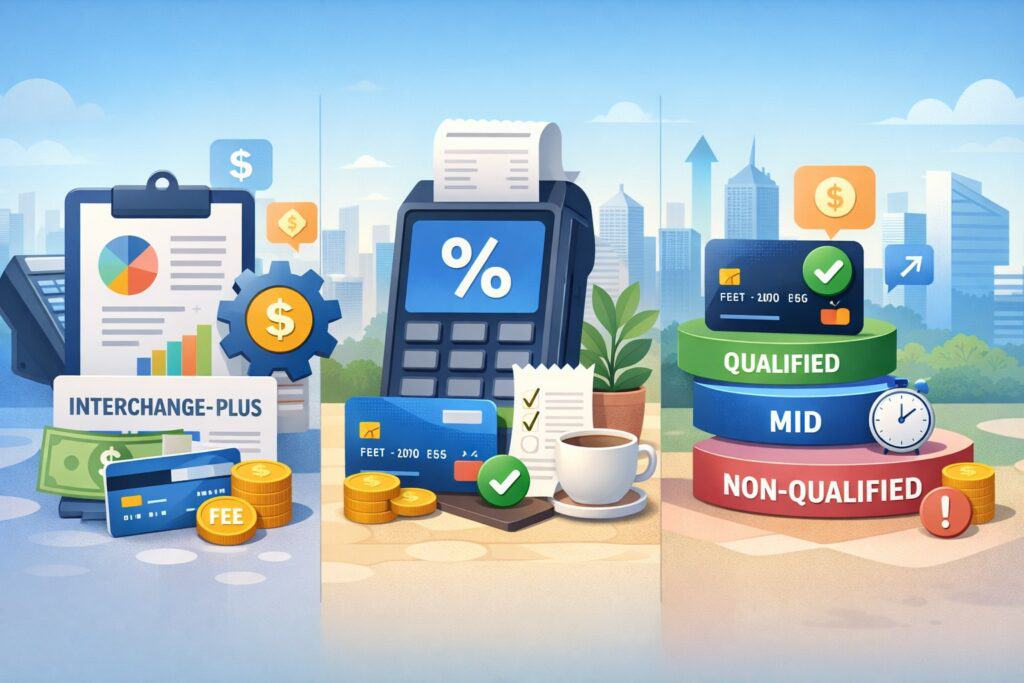
If you want to reduce payment processing costs in restaurants, your pricing model matters as much as your negotiated rate. Many restaurants are on a plan that’s easy to sell but hard to audit.
Interchange-plus (often best for transparency)
With interchange-plus, you pay true interchange + network fees, plus a fixed markup (like X% + Y cents). This structure makes it easier to see what’s controllable.
If you improve your acceptance method, reduce downgrades, and steer your mix, you’ll actually see the savings. Interchange-plus is usually the most “auditable” approach for reducing payment processing costs in restaurants long-term.
Flat rate (simple, sometimes expensive at scale)
Flat rate is predictable and easy for small operators, pop-ups, and new concepts. But as volume grows, flat pricing can become a tax—especially when your actual interchange should be lower than the flat rate.
A flat rate can still reduce payment processing costs in restaurants if your current statement is chaotic or filled with add-on fees, but it’s often a temporary step.
Tiered pricing (common, often the least transparent)
Tiered plans bundle transactions into “qualified/mid/non-qualified” buckets. This can obscure downgrades and make it harder to reduce payment processing costs in restaurants because the cause of higher fees is hidden.
Some operators overpay for years because they can’t tie operational fixes to statement improvements.
Negotiate Like a High-Volume Buyer (Even If You’re One Location)
Restaurants often assume negotiation only works for large chains. Not true. You can reduce payment processing costs in restaurants with negotiation if you walk in with the right data and target the right levers.
Start by requesting (or exporting) 3–6 months of detailed statements and POS reports. Then negotiate in this order:
- Processor markup (percentage and per-item). This is the most direct lever because interchange is not fully negotiable. Getting even a small reduction here compounds every day.
- Ancillary fees. Statement fees, PCI program fees, batch fees, gateway fees, “non-compliance” fees, and monthly minimums often add up more than you think.
- Equipment and support pricing. Leases and inflated support bundles keep payment processing costs in restaurants high even if the processing rate looks “good.”
- Refund and chargeback handling fees. Restaurants with high online volume should negotiate these carefully.
Bring facts: your average ticket, your monthly volume, your channel mix, and your chargeback rate. If your processor won’t provide interchange details, that’s a negotiation signal by itself.
Also watch the broader market. Interchange levels and merchant flexibility are frequently debated, and there have been ongoing legal and settlement discussions related to network rules and fees.
Recent reporting has described proposed settlements that would trim interchange levels modestly and adjust rules that affect merchant acceptance flexibility. Even if those outcomes change over time, the takeaway is stable: competitive pressure exists, and you should negotiate from a position of informed confidence.
Eliminate “Silent Fees” on Your Merchant Statement
Payment processing costs in restaurants are often inflated by fees that aren’t directly tied to transactions. These charges are common, and many are negotiable or avoidable.
Common silent fees to audit
- PCI program and non-compliance fees: If you’re using a validated, PCI-friendly POS and completing the required SAQ, you should not be paying recurring penalties. PCI DSS v4.0 updates make compliance more important, but penalties should not be treated as inevitable.
- Gateway and tokenization fees: You may be paying for multiple gateways (POS + online ordering + loyalty). Consolidation can reduce payment processing costs in restaurants.
- Batch fees: If you close batches multiple times daily or forget to close, you can trigger extra costs or downgrades.
- “Service” bundles: Support plans sometimes duplicate what your POS vendor already covers.
- AVS/CVV fees and fraud tool add-ons: These can be worth it, but only if they lower disputes and improve approvals more than they cost.
- Minimums and monthly program fees: Small merchants get hit hardest here. These fees distort your effective rate.
A clean statement reduces payment processing costs in restaurants immediately because you remove waste. It also makes it easier to compare providers—apples to apples—so you don’t get distracted by a teaser rate while hidden fees remain.
Reduce Chargebacks and Fraud (Because Disputes Are Processing Costs Too)
Payment processing costs in restaurants include more than rates. Every chargeback costs you time, product, and fees—and too many chargebacks can lead to monitoring programs, higher reserves, or even account instability.
Restaurants see disputes from:
- “I don’t recognize this charge” after online orders or bar tabs
- Delivery issues (especially if the platform blames the restaurant)
- No-shows and cancellation disputes for reservations
- Tip disputes or altered tips
- Friendly fraud (customer received the food but disputes anyway)0
To reduce payment processing costs in restaurants through fewer disputes:
- Use clear descriptor naming. Make sure your business name and location show up clearly on statements.
- Send digital receipts for online orders and keep proof of fulfillment (time stamps, order confirmation, delivery confirmation when available).
- Tighten refund policies and communicate them. Confusion drives disputes.
- Control stored cards. Use tokenization and trusted providers to reduce exposure.
- Train staff on tip adjustments. Mis-keys create preventable disputes.
The hidden win: better fraud controls can improve authorization rates. Higher approvals mean fewer re-tries and fewer “forced” manual entries—both of which reduce payment processing costs in restaurants.
Use Smart Menu Pricing and Payment Incentives Without Alienating Guests
Restaurants often fear that any payment steering will damage the guest experience. But there are ways to influence behavior gently, while keeping trust high.
Encourage lower-cost payment behavior ethically
- Offer a cash discount policy (where permitted) that is transparent and consistent.
- Promote debit usage for small tickets where it makes sense.
- Bundle low-ticket items (e.g., add-ons) to raise average ticket and reduce fixed-per-transaction impact.
- Add minimums carefully (only if allowed and aligned with your brand).
Surcharging and dual pricing considerations
Rules and laws vary, and you must follow card network requirements and local regulations. Major networks outline disclosure requirements and surcharge caps (often cited as a maximum of 4% in network rules).
Some operators use “dual pricing” (a posted cash price and a higher card price). Others use a service fee model. Whatever approach you choose, your goal is to reduce payment processing costs in restaurants without creating surprise at checkout.
If you implement any fee strategy:
- Post signage clearly at entry and at the point of sale.
- Train staff on how to explain it in one sentence.
- Monitor reviews and repeat visits for any backlash.
Done carefully, pricing strategy can reduce payment processing costs in restaurants while keeping guest experience intact.
Optimize Your POS and Payment Flow for “Best Qualification”
One of the most overlooked ways to reduce payment processing costs in restaurants is to tune your POS and workflow so transactions qualify for the best possible categories.
Batch timing and tip adjustment hygiene
Many restaurant payments are authorized first, then adjusted for tips later. If your system batches late, or if adjustments happen outside optimal windows, you may increase downgrades or risk indicators. Ensure:
- Batches close daily, consistently.
- Tip adjustments follow clear policies and are completed promptly.
- Staff permissions reduce “oops” edits.
Data fields and restaurant-specific settings
Depending on your setup, your POS may send different data for bar tabs, pre-auth, incremental auth, and card-on-file. Misconfigured settings can inflate payment processing costs in restaurants. Ask your provider to confirm:
- Proper restaurant MCC configuration
- Correct handling of pre-auth/incremental authorization
- Accurate tax and tip fields where applicable
- Correct e-commerce indicators for online orders
Delivery and online ordering integrations
If your online ordering tool routes payments through a separate gateway, you may be paying layered fees. Consolidating ordering and payment flows—while keeping security strong—can reduce payment processing costs in restaurants and improve reporting.
Cut Hardware, Software, and Compliance Costs With Modern Acceptance Methods
Payment processing costs in restaurants include the total ecosystem: terminals, tablets, gateways, software add-ons, and compliance.
Hardware strategy
- Avoid long equipment leases. They often lock you into high total costs.
- Standardize devices across locations to reduce support and replacement costs.
- Consider modern acceptance options like phone-based acceptance for line-busting or pop-up stations if your provider supports it and it meets security requirements. Adoption trends for “tap-to-phone” have been highlighted as growing quickly.
Reduce PCI scope
PCI compliance is easier and cheaper when you minimize where card data touches your environment. Tokenization and hosted payment pages can reduce scope. Many compliance resources stress the importance of meeting PCI DSS v4.0 requirements and timelines.
Reducing PCI scope doesn’t just lower compliance stress—it can reduce payment processing costs in restaurants by preventing fees, audits, and incident exposure.
Build a Monthly “Cost Control” Routine That Keeps Fees Low
Payment processing costs in restaurants creep up when nobody is assigned to them. The best operators treat payments like prime cost: review, adjust, repeat.
Create a monthly routine:
- Week 1: Statement audit
- Identify new fees or increases.
- Compare the effective rate to last month.
- Flag chargeback and refund fee spikes.
- Identify new fees or increases.
- Week 2: Operations check
- Track keyed entry rate.
- Validate batch closure consistency.
- Review tip adjustment errors.
- Track keyed entry rate.
- Week 3: Channel mix review
- Compare online vs in-person share.
- Identify delivery-platform fee overlap.
- Check approval rates by channel.
- Compare online vs in-person share.
- Week 4: Vendor performance
- Review downtime, support tickets, and device failures.
- Negotiate or remove unused add-ons.
- Review downtime, support tickets, and device failures.
This routine keeps payment processing costs in restaurants from becoming “set it and forget it” overhead—and turns it into a controllable line item.
Future Predictions: What Will Change Payment Costs Over the Next 12–36 Months
Payment processing costs in restaurants won’t stay static. Several forces are shaping what you’ll pay and how you’ll manage it.
More contactless and tokenized payments
As contactless grows and tokenization becomes more standard, restaurants may see improved authorization rates and reduced fraud in some channels.
Network and issuer initiatives around tokenization and streamlined provisioning have been promoted as improving security and approval outcomes. Over time, this can help reduce payment processing costs in restaurants indirectly by lowering disputes and re-tries.
Continued scrutiny of interchange and network rules
Merchant pressure over “swipe fees” continues, including ongoing legal and policy discussions. Recent coverage describes proposed settlement frameworks that could slightly lower fees and adjust merchant flexibility in accepting certain card types. Even small basis-point changes matter at restaurant scale—especially for high-volume operators.
Security requirements will keep tightening
PCI DSS v4.0 has already raised the bar, and future updates will likely continue emphasizing modern threats like client-side attacks and stronger controls. Operators who reduce scope and standardize secure flows will be best positioned to reduce payment processing costs in restaurants while staying compliant.
More real-time bank payments for some use cases
While cards will remain dominant for guest payments in many restaurant contexts, more bank-based options and instant transfer rails may expand for catering, B2B, and high-ticket prepayments.
That could create new opportunities to reduce payment processing costs in restaurants for specific payment scenarios—especially where cards are the most expensive option.
FAQs
Q.1: What is the fastest way to reduce payment processing costs in restaurants?
Answer: The fastest way to reduce payment processing costs in restaurants is usually a statement audit plus operational fixes—not a processor switch on day one.
Many restaurants can lower costs quickly by eliminating avoidable fees (unused gateways, duplicate monthly charges, inflated PCI program fees, equipment leases) and reducing “manual entry” behavior that triggers higher-cost transaction categories.
Start by calculating payment processing costs in restaurants across the last 60–90 days using two numbers: total fees paid and total number of transactions.
If your fees per transaction are high, you likely have too many fixed add-on charges or a pricing plan that penalizes small tickets. If your effective rate is climbing, your mix may be shifting toward online orders or premium rewards cards.
Then attack controllables: ensure daily batching, reduce keyed entry, and clean up refund and chargeback patterns. After that, renegotiate markup and ancillary fees. When you negotiate with clean data, it’s easier to reduce payment processing costs in restaurants because you can prove your transaction quality and risk profile.
Q.2: Should restaurants choose interchange-plus pricing to reduce payment processing costs in restaurants?
Answer: Interchange-plus is often the best option to reduce payment processing costs in restaurants because it’s transparent. You see interchange, network fees, and your processor markup separately.
That transparency matters because restaurants can actually change their cost drivers through acceptance behavior, data quality, and mix management.
Flat-rate pricing can be useful for small or new operators who value simplicity, but it may become expensive as volume grows.
Tiered pricing can hide the reasons your costs rise, making it harder to reduce payment processing costs in restaurants through targeted fixes. If you can’t connect operational improvements to statement outcomes, you’re stuck guessing.
Interchange-plus also helps you evaluate new offers. Instead of comparing a teaser “2.29%” headline, you compare a real markup and per-transaction cost. Over time, that’s how many operators reduce payment processing costs in restaurants sustainably—because they’re improving controllables while paying a fair, visible markup.
Q.3: Are cash discounts, dual pricing, or surcharges good strategies to reduce payment processing costs in restaurants?
Answer: They can reduce payment processing costs in restaurants, but only when implemented transparently and in compliance with applicable rules. The biggest risk with surcharges and pricing programs is guest surprise. If customers feel tricked, your brand pays for it through reviews, repeat visits, and staff conflict at checkout.
Network rules also matter. Major card networks publish guidelines around disclosure and caps for credit card surcharges, and merchants must follow those requirements and any local restrictions. If you use dual pricing (a posted cash price and a higher card price), the key is clarity: signage, menu communication, and staff scripting.
Many restaurants reduce payment processing costs in restaurants successfully with a simple approach: offer a clear cash discount, keep the experience friendly, and avoid aggressive policies that feel punitive. The best strategy is the one that protects both margin and guest trust.
Q.4: How do online ordering and delivery increase payment processing costs in restaurants?
Answer: Online ordering and delivery increase payment processing costs in restaurants because card-not-present transactions generally carry more risk and often higher overall fees. Fraud rates are higher online than in-person, disputes are more common, and the data signals that help authorization quality can be weaker if systems are poorly integrated.
Delivery marketplaces can add another layer: you may pay platform commissions, marketing fees, and also face complex payment flows where you don’t control the processing stack.
If your online ordering system uses a separate gateway from your in-store POS, you may be paying duplicate monthly fees and separate per-transaction charges—raising payment processing costs in restaurants without obvious visibility.
To reduce payment processing costs in restaurants for online channels, focus on tokenization, clean integrations, strong proof of fulfillment, and a clear refund policy. Reducing chargebacks in online ordering often creates more savings than shaving a few basis points off your processor markup.
Q.5: Can debit routing and debit mix really lower payment processing costs in restaurants?
Answer: Debit mix can meaningfully lower payment processing costs in restaurants, especially for quick-service and counter-service concepts.
Regulated debit interchange for large issuers is capped under the Durbin framework at 21 cents + 0.05% (plus a possible 1-cent adjustment). On higher tickets, that structure can be cheaper than many credit interchange categories.
That said, you can’t force debit use—but you can encourage it through friendly messaging, cash discount programs, or simply ensuring your terminals and staff make debit acceptance easy (tap, chip, PIN where relevant).
Also remember that not all debit is regulated, and routing rules and network paths can affect outcomes. Your provider should be able to report debit volume and effective debit cost.
Over time, increasing debit share—even modestly—can reduce payment processing costs in restaurants because it changes the underlying mix, which often matters more than rate negotiation alone.
Q.6: What should restaurants ask a processor to show before switching providers?
Answer: Before switching, ask for details that directly explain payment processing costs in restaurants. You want:
- A clear breakdown of pricing model (interchange-plus, flat, tiered)
- Processor markup and per-item fees in writing
- A complete schedule of monthly, annual, and incidental fees
- Gateway and tokenization costs (especially if you have online ordering)
- Chargeback and refund fees
- Equipment costs (purchase vs lease) and support terms
- Interchange qualification or category reporting access
Also ask whether your setup supports reducing PCI scope and aligning with PCI DSS v4.0 requirements, since compliance timelines and controls can affect your total cost.
If a provider avoids transparency, that’s a red flag. The goal isn’t just to “get a lower rate.” The goal is to reduce payment processing costs in restaurants and keep them low as your mix and channels evolve.
Conclusion
To reduce payment processing costs in restaurants, don’t start with a rate. Start with visibility. Payment processing costs in restaurants are driven by transaction method, channel mix, card types, data quality, disputes, and hidden statement fees.
When you benchmark correctly and fix operational leaks—keyed entry, batching habits, misconfigured POS settings—you often unlock savings before you renegotiate anything.
Next, choose a pricing model you can audit, remove silent fees, and negotiate markup and add-ons with clean data. Then reduce disputes with tighter fulfillment proof and clearer policies. Finally, keep payment processing costs in restaurants under control with a monthly routine—because costs drift when no one owns them.
Looking ahead, contactless growth, tokenization, evolving security requirements, and ongoing scrutiny of fee structures will keep changing the landscape.
Operators who build a system (not a one-time “rate hunt”) will be the ones who consistently reduce payment processing costs in restaurants—while keeping checkout fast, staff confident, and guests happy.