Restaurant payment processing fees can feel like one of the most frustrating parts of running a food service business. Cards keep orders moving, guests expect fast payment options, and digital ordering has become part of everyday operations, yet many owners still struggle to understand exactly where the money goes after each transaction.
That confusion matters because restaurants process a steady flow of card payments in an industry where margins are often under pressure. A few tenths of a percentage point may not seem like much at first, but across thousands of transactions, those charges can add up quickly.
When fees are misunderstood, operators may overpay, miss warning signs on statements, or choose systems that look simple on the surface but cost more over time.
This guide breaks down restaurant payment processing fees in a way that is useful for owners, managers, and operators making real decisions.
You will learn what these fees are, why they exist, how restaurant payment processing pricing works, which line items deserve attention, how restaurant POS payment fees fit into the bigger picture, and what practical steps can help you compare providers more intelligently.
The goal is not to make payment processing sound complicated. The goal is to make it easier to understand what you are paying for and how to manage those costs with more confidence.
What restaurant payment processing fees really are
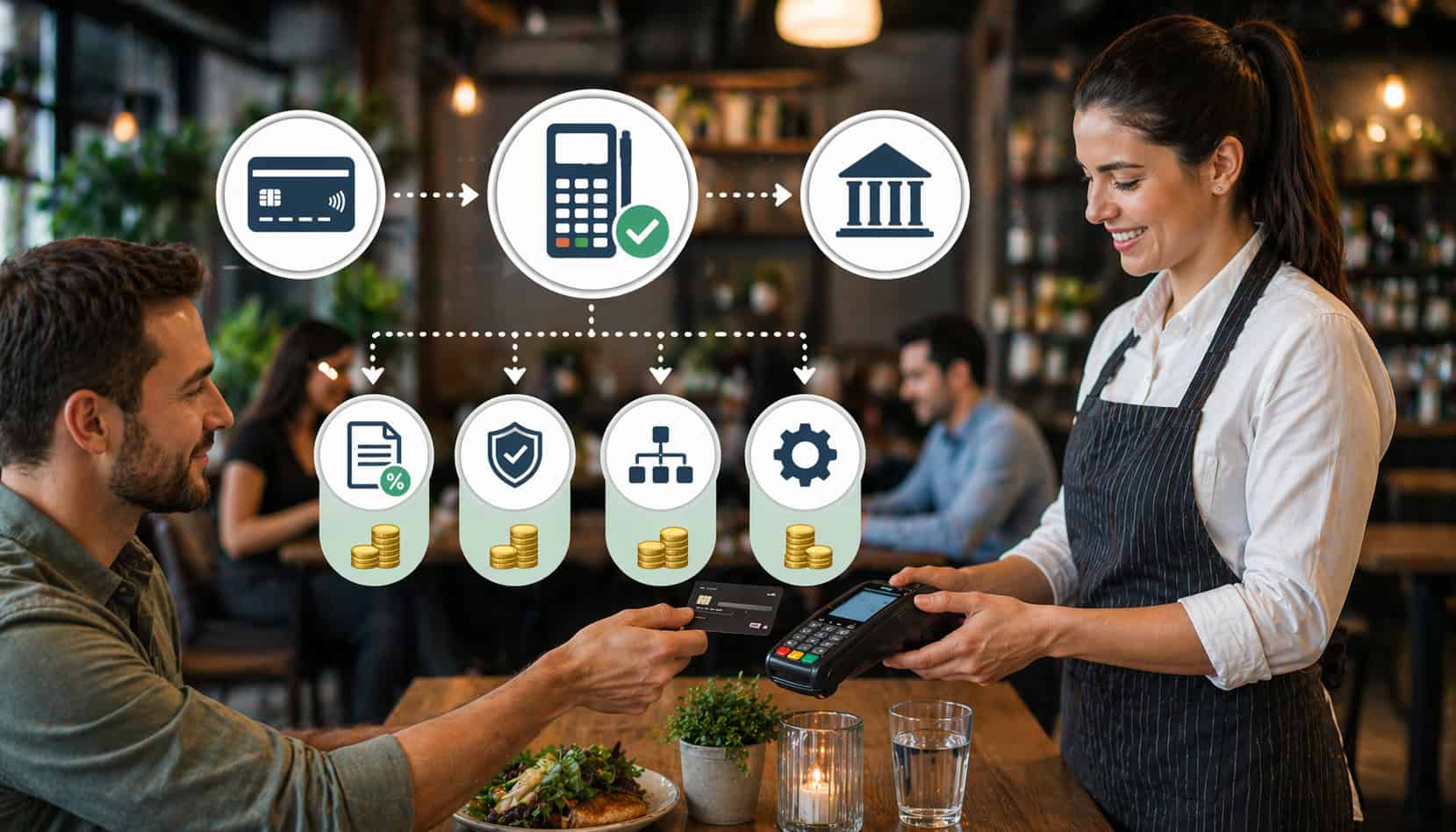
Restaurant payment processing fees are the charges a business pays to accept card and digital payments. Every time a guest taps a card, inserts a chip, pays through an online ordering page, or uses a mobile wallet, multiple parties are involved behind the scenes.
The payment has to be authorized, routed, settled, funded to the merchant, and recorded inside the restaurant’s systems.
That process is why restaurant merchant fees exist in the first place. The bank that issued the card, the card network, the processor, and sometimes the technology platform or gateway all play a role.
The restaurant pays for access to that payment ecosystem, along with fraud tools, hardware support, software connectivity, and statement reporting.
For many operators, the hard part is not accepting that there is a cost. It is understanding which part of the bill comes from which service. Some fees are unavoidable because they are built into card acceptance. Others depend on the provider, the pricing model, the POS setup, or how transactions are entered.
In restaurants, that cost structure can get more complex than it is in some other businesses. Tips, tip adjustments, split tickets, online ordering, delivery, keyed-in transactions, and integrated restaurant software all affect how debit and credit card fees for restaurants are calculated.
A café with mostly in-person, low-ticket transactions may see a very different pattern than a full-service dining room or a restaurant that relies heavily on digital orders.
Why restaurants pay these fees in the first place
Card payments create convenience for guests, but they also create cost and risk for everyone involved in the transaction. Issuing banks take on credit and fraud exposure. Card networks maintain the rails that move transaction data.
Processors and acquiring partners handle authorization, settlement, reporting, funding, and support. Technology vendors may connect the POS, gateway, online ordering tools, and back-office systems.
Restaurants are paying for more than a swipe. They are paying for the ability to accept the payment securely, move it through the network, and receive funds in a usable, trackable form. That includes fraud screening, encryption, chargeback handling, terminal certification, and in many cases integrated reporting inside the POS.
This is also why the same restaurant card processing rates do not apply to every transaction. A chip card presented at the counter usually carries a different risk profile than an online payment entered on a website.
A regulated debit card can price differently from a premium rewards credit card. A manually keyed phone order can cost more than a tapped in-person payment because it carries higher fraud risk.
If you view payment acceptance as both a utility and an operating system input, the fee structure makes more sense. The challenge is not that restaurants should expect zero cost. The challenge is making sure the price matches the service and that the statement is understandable.
Why restaurants often find merchant fees confusing
Many operators first encounter payment processing through a bundled quote, a POS package, or a short sales conversation.
The pricing may be presented as simple, but the actual statement later includes assessments, interchange, authorization charges, monthly platform fees, gateway charges, PCI items, equipment costs, and sometimes unrelated software fees. That gap between the sales pitch and the monthly statement is where confusion starts.
Restaurant payment processing pricing can also be hard to compare because providers use different formats. One company may advertise a flat rate. Another quotes interchange-plus. Another rolls fees into a software bundle. Another lowers the headline rate but adds monthly minimums, batch fees, or support fees that raise the effective cost.
Then there is the issue of timing. In restaurants, tip adjustments are common. An authorization may be created first and finalized later with the gratuity included. Online orders can move through separate systems.
Third-party ordering channels may introduce their own payment path or platform fee. By the time the statement arrives, the operator sees a stack of charges without clear context.
That is why understanding restaurant payment processing fees is less about memorizing jargon and more about learning the structure. Once you know the major fee categories, you can read your statement more clearly, ask better questions, and spot pricing that does not fit your business.
The main parts of restaurant merchant fees
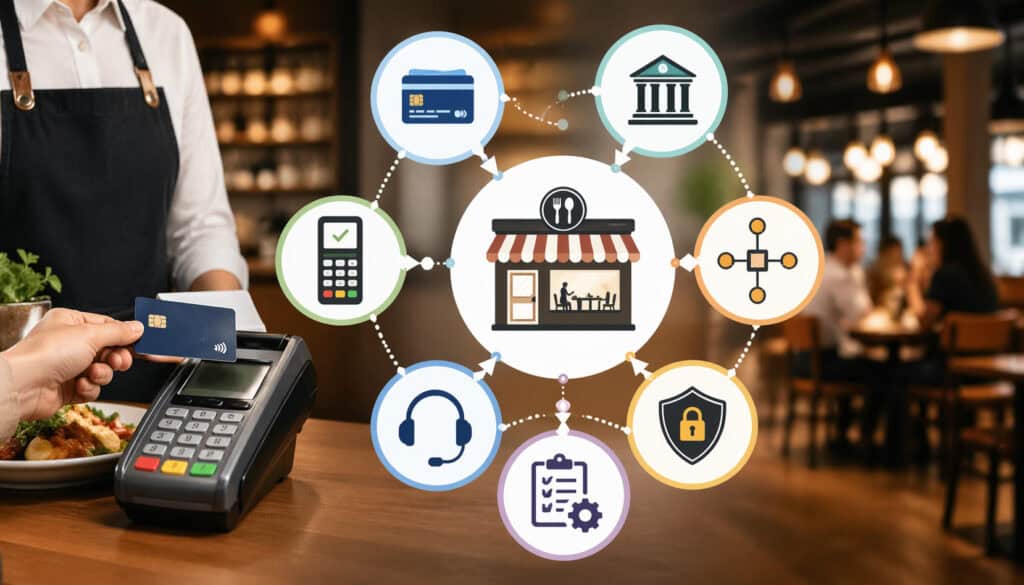
Most restaurant merchant fees fall into a few core buckets. Some are directly tied to the card transaction itself, while others are tied to the account, the equipment, the software environment, or certain events such as chargebacks. Understanding the difference is the first step toward making sense of your monthly bill.
At the broadest level, payment processing costs restaurants pay usually include card-based costs and provider-based costs. Card-based costs are driven by the payment method used. Provider-based costs come from the processor, gateway, POS company, or platform you work with. Together, these form the total cost of accepting cards.
Here is a simple breakdown:
| Fee category | What it usually covers | Who typically sets it |
| Interchange | Base fee tied to the card type and transaction method | Card-issuing side |
| Assessments | Network-level charges on card volume | Card networks |
| Processor markup | Provider’s margin on top of base costs | Processor or acquiring provider |
| Gateway fees | Online routing or payment gateway services | Gateway or processor |
| POS/software fees | Integrated payment software, platform access, or bundled tech | POS or platform provider |
| Equipment fees | Terminal purchase, rental, support, or lease charges | Hardware or processing provider |
| PCI-related charges | Compliance tools, scanning, or non-compliance penalties | Processor or compliance vendor |
| Incidental fees | Chargebacks, retrievals, batch fees, monthly minimums, statement fees | Processor or platform provider |
A healthy pricing review looks at the whole table, not just one line item. Many restaurants focus on the percentage rate and forget to review the fixed monthly costs and event-based charges that can quietly raise the effective cost.
Interchange and assessments
Interchange is often the largest part of credit card processing fees restaurants pay. It is the base cost associated with the card used and the way the transaction is processed. Different card categories can carry different interchange levels, and that means one guest’s basic debit card may cost less to accept than another guest’s premium rewards credit card.
Assessments are separate network-level charges that also apply to card transactions. They are generally much smaller than interchange, but they still contribute to the total cost. Operators sometimes lump interchange and assessments together because both are outside the processor’s direct control, but it helps to remember that they are not the same thing.
In a restaurant setting, the transaction method matters. Card-present payments are usually more favorable than card-not-present transactions because the risk of fraud is generally lower when the card is physically presented and read through a chip or contactless terminal. That is one reason online ordering and manually entered payments often cost more.
Average ticket size matters too. In some restaurant environments, a small-ticket structure can behave differently than a high-ticket full-service check. The fee is not always just a pure percentage.
Per-transaction costs also matter, which means a coffee shop processing many low-dollar orders can feel pricing pressure differently than a steakhouse with fewer, larger tickets.
Processor markup, gateway charges, and software-related fees
Processor markup is the part of the price your provider adds on top of the underlying transaction costs. This is where much of the provider-to-provider variation shows up.
Two processors may handle similar restaurant volume but package their pricing very differently, which is why restaurant payment processing pricing can look inconsistent from one quote to another.
Some providers add a straightforward markup. Others build their margin into a flat-rate or tiered model. In restaurant environments, markup can also be blended together with gateway access, POS payment integration, reporting tools, or online ordering connectivity.
Gateway fees are more common when a restaurant accepts digital payments through an online ordering site, app, or manually integrated commerce flow. The gateway is the technology layer that securely transmits the payment information for authorization.
In some bundled restaurant systems, gateway costs are easy to miss because they are folded into a platform or service fee rather than listed separately.
Software-related charges are another area to watch. A restaurant may think it is comparing payment processors, but in practice it is comparing a package that includes payment acceptance, POS software, reporting tools, menu management, online ordering, and sometimes loyalty or guest data features.
Equipment, PCI, and incidental fees
Equipment fees sound simple, but they can be one of the most expensive parts of a bad arrangement. Some restaurants buy terminals outright. Others rent them. Others lease hardware under terms that cost far more than the equipment is worth. If a provider is vague about the total hardware obligation, slow down and get the numbers in writing.
PCI-related fees can include compliance services, scanning tools, or annual program charges. In some cases, the real surprise is the PCI non-compliance fee charged when the merchant does not complete a required validation step. Operators who thought they were paying for processing alone may suddenly see monthly penalties they did not expect.
Incidental fees cover a wide range of charges: chargeback fees, retrieval fees, batch fees, statement fees, monthly minimums, account maintenance charges, address verification fees, and more. Any one of these may seem small on its own. Together, they can noticeably raise payment processing costs restaurants pay over time.
For restaurants with integrated online ordering, additional platform or support charges may appear on a separate invoice rather than on the merchant statement itself. That separation can make the processing rate look lower than the real all-in cost.
Common pricing models used in restaurants

When restaurant owners compare providers, they are often comparing pricing models as much as providers. That distinction matters because the same business could look expensive or affordable depending on how the fees are packaged and presented.
The most common models in restaurants are flat-rate pricing, interchange-plus pricing, tiered pricing, and subscription-style pricing. None of these is automatically right or wrong. The best fit depends on transaction mix, order channels, average ticket size, reporting needs, and how much transparency the operator wants.
Some restaurants prioritize simplicity. Others want detailed cost visibility. Some want software and payments under one roof, even if that makes comparison harder. Others are willing to separate vendors for more control. A pricing model should support the way the restaurant actually operates, not just the way a sales sheet looks.
One of the biggest mistakes operators make is assuming the lowest advertised rate means the lowest total cost. In restaurant payment fees explained properly, the pricing model matters because it affects how costs show up across card types, transaction methods, and monthly line items.
Flat-rate pricing
Flat-rate pricing is the easiest model to understand at first glance. The processor charges one standard rate for a category of transactions, such as in-person payments, and another rate for online or keyed-in transactions. This simplicity is one reason flat-rate models are popular with smaller businesses and operators who want predictable pricing without studying interchange tables.
For some restaurants, flat-rate pricing can work well. A small café or quick-service operation with modest volume may value simplicity over granular optimization. Staff training is easier, statement reading is usually more straightforward, and there is less mystery around why one card cost more than another.
The drawback is that simplicity can come at a premium. If a restaurant processes a meaningful amount of lower-cost debit volume or has enough scale to benefit from more transparent pricing, a flat-rate model may result in paying more than necessary.
The operator is effectively paying the same headline rate whether the underlying transaction cost was low or high.
Flat-rate can also hide detail. If your statement shows one bundled rate, it may be harder to understand what portion is driven by card costs and what portion is processor margin. That is not always a problem, but it does reduce visibility when you want to negotiate or benchmark your fees.
Interchange-plus pricing
Interchange-plus pricing is often considered one of the clearest ways to understand restaurant card processing rates. Under this model, the merchant pays the underlying interchange and assessment costs, plus a separate markup from the processor. That makes it easier to see what part of the total cost is tied to the card transaction and what part is the provider’s pricing.
For restaurants that want transparency, interchange-plus can be appealing. It helps operators analyze effective rate, compare providers more intelligently, and understand how card mix affects total cost. A full-service restaurant with steady volume, a mix of debit and credit transactions, and a desire to monitor payment detail may benefit from this structure.
The tradeoff is complexity. Statements can be longer and harder to read at first. Costs may fluctuate month to month depending on the type of cards used and how transactions were processed. If an owner wants a single predictable number every month, interchange-plus may feel less comfortable even if it is more transparent.
This model is often a better fit for operators who review statements carefully and want visibility into the relationship between transaction mix and total cost. It is not automatically cheaper, but it usually makes the cost structure easier to audit.
Tiered and subscription-style pricing
Tiered pricing groups transactions into categories such as qualified, mid-qualified, and non-qualified. On paper, this may look manageable. In practice, it can be one of the more confusing models because the operator may not always know why one transaction landed in a more expensive tier than another.
For restaurants, tiered pricing can create frustration when many transactions end up in the less favorable buckets. Rewards cards, keyed transactions, or certain online payments may be priced differently without much transparency. An advertised rate may apply only to the narrowest category, while a larger share of actual restaurant volume settles at higher rates.
Subscription-style pricing works differently. Instead of relying mainly on percentage markup, the provider may charge a monthly subscription and then apply a smaller per-transaction markup. This can be attractive for restaurants with enough volume to justify the fixed monthly cost. It can also create clearer separation between software/service value and transaction pricing.
The downside is that subscription-style pricing does not automatically guarantee savings. Restaurants still need to evaluate all fixed fees, software charges, and incidental costs. A low per-transaction markup can look attractive until the platform and service fees are added back in.
Why payment processing costs vary so much by restaurant type
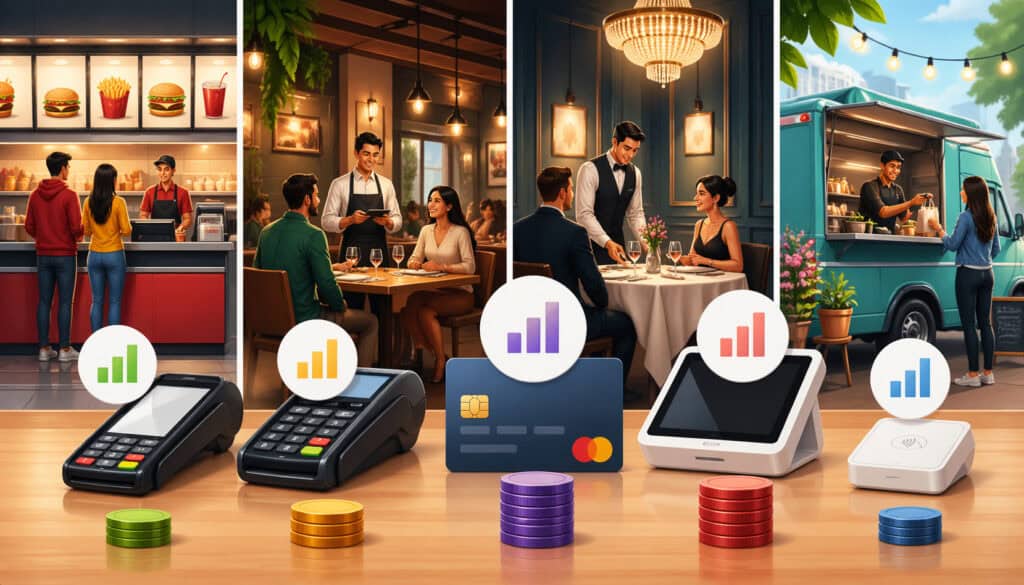
Many operators assume restaurant payment processing fees should fall into one simple range. In reality, payment processing costs restaurants pay can vary widely because restaurants do not all accept payments the same way.
A neighborhood café, a quick-service restaurant, a full-service dining room, and a restaurant built around online ordering all generate transactions differently. The payment environment affects risk, workflow, and system structure. Those differences influence costs.
The biggest cost drivers are not always obvious. Card-present versus card-not-present transactions matter. Debit versus premium credit matters. Tip adjustments matter. Average ticket size matters. Monthly volume matters. Whether the POS and processor are tightly integrated matters. Whether online ordering is routed through your own system or another platform matters too.
This is why restaurant payment fees explained in a meaningful way should always be tied back to actual operations. The “best” pricing for one concept may not be the best pricing for another.
Card-present vs. card-not-present, dine-in vs. online ordering, and keyed transactions
Card-present transactions generally have a more favorable risk profile because the guest physically presents the card and the payment is captured through a secure reader.
Dine-in, counter-service, and most traditional in-person environments fall into this category. When staff use EMV chip readers or contactless terminals correctly, these payments are usually processed more efficiently from a risk standpoint.
Card-not-present transactions are different. Online ordering, phone orders entered manually, and certain remote payments create more fraud exposure because the physical card is not present.
That usually means higher restaurant card processing rates for those transactions. A restaurant that shifts more sales toward web ordering can see its payment profile change even if total sales stay steady.
Keyed-in payments are especially important to watch. When staff manually enter a card number instead of using a card reader, the transaction may carry a higher cost and greater chargeback risk. This often happens with call-in orders, damaged cards, or poorly integrated ordering workflows.
Debit vs. rewards cards, ticket size, tips, and monthly volume
Debit and credit card processing costs are not the same. In many restaurant environments, debit can be less expensive than premium or rewards-heavy credit transactions. That does not mean every debit transaction is cheap or every credit transaction is expensive, but card mix has a real effect on total processing expense.
Rewards cards matter because premium rewards programs often come with higher underlying costs. Restaurants in affluent markets or concepts with larger checks may see more of these cards and therefore a higher effective rate even if the quoted pricing model did not change.
Average ticket size matters because many pricing structures include both percentage-based and per-transaction components. A café running many small tickets may feel the weight of per-transaction charges more heavily than a full-service concept with larger checks. On the other hand, a large average ticket can magnify the percentage-based portion of the fees.
Tips also play a role in full-service environments. The way tip adjustments are handled inside the payment flow can influence statement timing and sometimes line-item interpretation. While tips are a standard part of restaurant processing, operators should still confirm that the system handles them cleanly and transparently.
Monthly processing volume matters because higher volume businesses may have more leverage when comparing pricing structures. That does not always mean a large operator gets the best deal automatically, but it does mean fee comparison should account for scale.
How debit and credit card fees for restaurants differ
Restaurant owners often ask whether debit really costs less than credit. The honest answer is that it often can, but not every statement makes that easy to see. Much depends on the pricing model, card mix, and how transparent the provider is in reporting.
Debit transactions usually carry a different cost profile than credit transactions because the funding and risk structure is different.
Many restaurant operators find that basic debit usage can lower blended costs compared with a customer base that skews heavily toward premium rewards cards. But that benefit can be obscured when a flat-rate or blended model treats many transactions the same on the surface.
Credit card processing fees restaurants pay are often more sensitive to card category. Standard cards, business cards, travel cards, and premium rewards cards do not always behave alike from a cost standpoint.
If your concept attracts business diners, travelers, or customers who favor high-reward cards, your effective rate may climb even if your provider’s markup stays the same.
Debit also tends to show its value more clearly under transparent pricing models. Under flat-rate pricing, lower-cost debit transactions may not reduce your visible rate because the provider is charging the same standard amount for that category. Under interchange-plus, the difference may show more clearly in the detail.
This does not mean restaurants should try to steer guests awkwardly away from one payment type or create a poor checkout experience. It means operators should understand how the mix of debit and credit affects total cost, especially if they are trying to reconcile quoted pricing with actual results.
A practical way to think about card mix
If you want a more useful way to evaluate debit and credit card fees for restaurants, stop asking only, “What is my rate?” and start asking, “What kinds of cards are my guests actually using?” That question leads to better decisions.
A breakfast café may process many small debit transactions from repeat local customers. A white-tablecloth dinner concept may see more premium rewards cards and larger tickets. A quick-service lunch spot in a business district may have a different card mix at noon than during weekend family traffic. A delivery-heavy concept may see more card-not-present credit volume.
Once you understand the mix, your monthly statement starts to tell a clearer story. If most guests pay with premium rewards cards, the issue may not be a hidden processor markup. If most guests pay online, the card-not-present environment may be contributing more than expected. If many phone orders are keyed in, the workflow may be driving costs upward.
This is why effective rate is so important. It helps you evaluate the total cost of accepting payments across your real transaction mix, rather than relying on one advertised rate that may not reflect how your restaurant actually operates.
Hidden and often-overlooked fees that create frustration
The biggest surprises in restaurant payment processing pricing often come from fees that are not part of the headline rate. These are the charges that operators notice only after a few months, when statements start arriving and the real monthly cost becomes visible.
Some of these fees are legitimate operating charges. Others are negotiable. Others are signs that a provider’s pricing is less transparent than it first appeared. Either way, they deserve attention because they affect your effective cost.
Common examples include monthly minimums, statement fees, batch fees, PCI non-compliance charges, chargeback fees, gateway fees, hardware leases, account maintenance charges, support fees, and platform or software add-ons.
In bundled restaurant systems, some of these may appear outside the merchant statement entirely, which makes total-cost comparison even harder.
A restaurant can easily fixate on the percentage rate and miss the reality that smaller recurring fees are quietly raising the overall cost every month.
The line items that deserve the closest review
Monthly minimums are an older but still important fee type. They require the merchant to generate a minimum level of processing revenue for the provider each month. If the business falls short, an extra charge appears. Seasonal restaurants and businesses with uneven volume should watch this carefully.
Statement fees and batch fees may sound minor, but over time they add up. Batch fees matter especially in businesses that close batches frequently or operate multiple terminals and locations. Gateway fees are common when online ordering or ecommerce-style payments are involved.
PCI non-compliance charges are among the most frustrating because they often show up when an operator misses a required compliance step. In many cases, the restaurant could have avoided the charge entirely by completing a questionnaire or validation process on time. That is why PCI items should never be ignored as “small print.”
Chargeback fees matter because restaurants can face disputes from online orders, remote payments, or service-related issues. Even if the disputed amount is small, the fee attached to the dispute can add to the pain.
Hardware leases deserve extra caution. A lease may look manageable in monthly terms but become expensive across the full agreement. Buying equipment outright is often clearer than entering a long hardware commitment with vague terms.
Why bundled platforms can hide true costs
Bundled systems are popular because they reduce setup complexity. One provider may offer POS software, payment processing, online ordering, reporting, and support in one package. Operationally, that can be convenient. Financially, it can make comparison harder.
When restaurant POS payment fees are bundled, the operator may struggle to tell where the payment cost ends and the platform cost begins.
Is the higher monthly fee paying for stronger software? Is the processing rate lower because the platform fee is higher? Is a gateway charge included or billed separately? Are online ordering fees part of the processing invoice or another invoice altogether?
These are not arguments against bundled systems. In some restaurants, a well-integrated platform saves time, reduces keying errors, and improves reconciliation. That can create real value even if the raw processing rate is not the lowest available. The issue is transparency.
Before comparing providers, separate the costs into categories: transaction fees, monthly account fees, software fees, hardware fees, online ordering fees, and any third-party service fees. Only then can you judge whether a bundled offer is actually competitive.
How restaurant POS systems and payment processors interact
In many restaurants, the POS system and payment processor feel like one thing because they work together at checkout. But they are not always the same thing.
The POS is the operating platform that manages orders, checks, menu items, reporting, employee permissions, and often online ordering. The payment processor is the service that moves card transactions through the payment system.
Sometimes those functions come from one vendor family. Sometimes the POS integrates with a separate processing partner. Sometimes the relationship is flexible. Sometimes it is locked down. This matters because the structure affects pricing, support, and the ease of switching providers later.
Integrated payments can be valuable in restaurant environments. They reduce manual entry, keep ticket totals aligned, improve reporting, and help staff move faster. That matters in busy service windows. It can also help with tip handling, end-of-day reconciliation, and order-level tracking.
The challenge is that integrated systems can make merchant account fees for restaurants harder to isolate. When the payment processor is closely tied to the POS environment, the operator may not know whether the true cost is competitive or whether the convenience is coming with a premium.
Why bundled POS and payments make comparison harder
A restaurant considering new payments may think it is shopping for lower rates, only to find that the POS agreement limits processor choice. Some systems require the use of a preferred processor.
Others allow outside processors but charge extra integration or support fees. Others offer a discount only if the merchant stays inside the platform’s preferred payment setup.
That means restaurant payment processing fees cannot be reviewed in isolation. The POS relationship matters. Switching processors may affect online ordering, reporting, handheld devices, kitchen workflows, gift card tools, or back-office exports.
In some cases, even if an outside processor offers a better transaction rate, the total operational tradeoff may not be worth it.
This is also why restaurant owners should understand the software bundle structure. If the provider combines POS software, payments, and online ordering, ask for separate pricing components. If they cannot clearly explain the parts, cost comparison becomes guesswork.
How to read your merchant statement and spot red flags
A merchant statement should help you understand what happened during the month. Too often, it does the opposite. The language is dense, fees are grouped unclearly, and line items appear without useful explanation. Still, reviewing the statement monthly is one of the best ways to control restaurant merchant fees over time.
Start with the basics. Look at total processing volume, total fees paid, and the effective rate. Effective rate is usually calculated by dividing total fees by total processed volume. This gives you a practical measure of what card acceptance actually cost for the month, regardless of how the pricing was advertised.
Then go deeper. Review whether the charges break out interchange, assessments, processor markup, and monthly account fees clearly. If the statement is bundled, try to identify fixed fees separately from transaction-based fees.
Compare month to month. If volume stayed similar but total fees jumped, there may have been a change in card mix, channel mix, or extra account charges.
A clear statement review can uncover problems early. It can also help you decide whether the issue is pricing, process, or transaction mix.
Red flags restaurant owners should not ignore
Watch for vague labels such as “miscellaneous fee,” “service fee,” or “adjustment” without explanation. These may have a valid reason, but they should still be understandable. If your provider cannot explain them clearly, that is a problem.
Look for PCI non-compliance fees, duplicate monthly charges, unexpected gateway fees, or recurring equipment costs you thought had ended. Watch for an effective rate that drifts upward without a clear operational reason. If online ordering increased, there may be a reason. If nothing changed but costs rose, investigate.
Review the number of keyed transactions if your statement or reporting shows it. A jump in manual entry may indicate a workflow issue, damaged terminals, staff workarounds, or a system problem. All of those can raise risk and cost.
Also compare the processing statement with your POS reports and any separate software invoices. In restaurants, fees are often split across multiple documents. Looking at only one can create a false sense of the total cost.
Real-world restaurant scenarios that show how fees behave
Fee structures make more sense when viewed through real operating scenarios. Restaurants do not all process payments the same way, and the same provider can feel affordable in one concept and expensive in another.
A café serving coffee and pastries may run hundreds of low-ticket in-person transactions daily. A quick-service restaurant may process counter orders, kiosk orders, and digital pickup orders in the same shift.
A full-service dining room may rely heavily on tips and larger guest checks. An online-order-heavy concept may send a high share of volume through card-not-present channels.
These operational patterns matter because restaurant payment processing fees respond to actual transaction behavior, not just the headline rate on the agreement.
Common mistakes restaurants make when evaluating payment costs
Most restaurants do not overpay because they are careless. They overpay because payment processing is easy to underestimate. It is often bundled into larger operational decisions, and the marketing language around pricing can make important differences seem smaller than they are.
One of the most common mistakes is focusing only on the advertised rate. A low headline number may apply only under narrow conditions, while the actual effective rate is much higher once card mix, fixed charges, and platform fees are included.
Another common mistake is ignoring effective rate altogether. Operators may know their quoted pricing model but have no idea what card acceptance actually cost last month as a share of sales. Without that number, it is difficult to benchmark performance or compare offers realistically.
Restaurants also make mistakes by reviewing statements too rarely, overlooking how online ordering changes cost structure, accepting hardware lease terms without calculating the total obligation, or assuming the POS and processor are impossible to separate.
Some operators avoid asking questions because the statements feel intimidating. That is understandable, but it leaves money and clarity on the table.
The biggest pricing comparison errors
One major error is comparing providers without using your own recent statements and volume data. Quotes based on generic restaurant examples are less useful than analysis based on your actual ticket size, monthly volume, payment channels, and card mix.
Another error is treating all bundled systems as directly comparable. One provider may include stronger reporting, support, or online ordering tools, while another keeps those costs separate. If you only compare the processing rate, you may reward the quote that hides more of the cost elsewhere.
Many restaurants also fail to account for how operations affect price. A concept with growing online ordering, frequent keyed phone orders, or a large premium-card customer base may not fit the assumptions in a simple quote. The mismatch shows up later in the statement.
Finally, some operators think reviewing fees means chasing the absolute lowest rate. That can be shortsighted. The better goal is a fair, understandable, sustainable cost structure that supports guest experience and clean operations.
How restaurants can control payment costs without hurting guest experience
The good news is that controlling restaurant payment processing fees does not have to mean making checkout awkward or limiting payment choice. In most cases, the best improvements come from cleaner operations, better visibility, and stronger comparison methods.
Start by making sure in-person transactions are truly card-present and captured through secure, modern hardware. Avoid unnecessary keyed entry. Train staff on correct terminal use and make sure damaged devices are replaced quickly. Small workflow issues can quietly raise costs and risk.
Review your online ordering flow. If digital orders have grown, ask whether the system structure still makes sense. Are you paying separate gateway, platform, and software charges that no longer fit the business? Are manual interventions causing avoidable keyed transactions? Are payment and POS systems integrated cleanly enough to reduce errors and reconciliation work?
Use statements as a management tool, not just a bill to approve. Track effective rate monthly. Watch changes in card-not-present share, average ticket size, and fixed monthly charges. If a provider cannot explain your fees clearly, that is a signal in itself.
Practical steps that often make the biggest difference
- Calculate your effective rate every month.
- Separate fixed monthly fees from transaction-based fees.
- Review the share of card-present versus card-not-present volume.
- Reduce keyed-in transactions where possible.
- Confirm PCI requirements are complete to avoid non-compliance charges.
- Reassess hardware arrangements, especially long leases.
- Compare bundled system costs against unbundled alternatives using your real statements.
- Ask providers to price your actual recent volume, not a sample business.
- Review online ordering and payment integration together, not as separate cost centers.
- Train managers to recognize unusual statement changes.
A step-by-step checklist to review restaurant payment processing pricing
If restaurant payment fees have felt too confusing to evaluate, use this checklist as a practical review process. It helps turn a vague pricing conversation into something concrete and comparable.
Restaurant payment fee review checklist
| Step | What to review | Why it matters |
| 1 | Pull 3–6 recent merchant statements | Gives a realistic picture of volume, fee mix, and trends |
| 2 | Calculate the effective rate for each month | Shows your true cost, not just the advertised pricing |
| 3 | Separate transaction fees from monthly fixed fees | Prevents low headline rates from hiding recurring charges |
| 4 | Identify card-present vs. card-not-present volume | Explains why online-heavy businesses may pay more |
| 5 | Review keyed-in transaction count | Helps spot avoidable higher-cost workflows |
| 6 | Check for PCI, gateway, batch, statement, and monthly minimum fees | Finds common hidden or overlooked charges |
| 7 | Review hardware terms | Prevents expensive lease surprises |
| 8 | Compare software, POS, and payment charges separately | Clarifies bundled pricing |
| 9 | Ask for pricing based on your actual recent processing mix | Produces more useful quotes |
| 10 | Compare total monthly cost, not just rate | Leads to better long-term decisions |
How to use this checklist when comparing providers
First, gather your current data before requesting new quotes. A provider should be able to explain how your card-present volume, online ordering volume, average ticket, monthly sales volume, and card mix influence pricing. If the proposal ignores those details, it may not reflect your actual business.
Second, ask every provider to show the full monthly picture. That includes transaction costs, monthly fees, gateway fees, PCI items, support charges, and software or platform costs. If the restaurant uses bundled technology, ask for the components to be listed separately even if they are sold together.
Third, compare the offers using your own effective-rate framework. Do not rely only on a quoted percentage. Build a side-by-side estimate using your recent real volume. That is how you turn restaurant payment processing pricing into something understandable.
Finally, weigh operational fit alongside cost. A lower rate loses value if it creates slower checkout, reporting gaps, online ordering problems, or extra manual reconciliation work. Payment pricing should support the restaurant, not complicate it.
Frequently Asked Questions
What is a normal range for restaurant payment processing fees?
There is no single standard rate for every restaurant because total costs depend on the pricing model, card mix, order channels, fixed account fees, and the broader POS and software setup. A restaurant with mostly in-person debit transactions may have a different cost profile than one with heavy online ordering and premium rewards card usage. The most useful number to review is the effective rate, which reflects what card acceptance actually cost based on real monthly activity.
Why do online orders usually cost more to process than in-person payments?
Online orders are usually card-not-present transactions, which generally carry more risk than card-present payments. Because the physical card is not being read in person, these transactions often come with higher processing costs. In many cases, online ordering also adds gateway fees, platform charges, or software-related costs that make the total expense higher than a typical in-store payment.
Are debit card transactions cheaper than credit card transactions for restaurants?
They often can be, but the answer depends on the type of card and the pricing structure used by the processor. In transparent pricing models, the difference between debit and credit is usually easier to see. In flat-rate or bundled pricing setups, that difference may be less obvious because the rates are blended together, even when the underlying transaction costs are not the same.
What is the difference between the quoted rate and the effective rate?
The quoted rate is the pricing structure a processor advertises or offers during the sales process. The effective rate is what the restaurant actually pays after all transaction charges and relevant account fees are divided by total processed volume. Effective rate is usually the better number to review because it reflects real-world payment activity rather than marketing language.
Why is a restaurant merchant statement often hard to understand?
Merchant statements often combine interchange, network assessments, processor markup, monthly account fees, gateway charges, and incidental fees in one document. Restaurants may also have extra complexity from tips, online ordering, integrated POS systems, and multiple payment channels. Reviewing statements monthly and separating fixed charges from transaction-based costs can make the statement much easier to understand.
Should restaurants choose bundled POS and payment systems?
Bundled systems can be useful when they improve checkout flow, reduce manual entry, and simplify support. However, they can also make true cost comparison harder because payment fees and software fees are often packaged together. The key is transparency. Restaurant owners should ask for the charges to be broken out clearly so they can compare the full cost rather than only the visible rate.
Can a restaurant lower payment processing costs without affecting guest experience?
Yes. Many restaurants can lower costs by improving operations instead of limiting payment choices. Reducing keyed-in transactions, keeping in-person payments truly card-present, completing PCI requirements on time, reviewing monthly statements carefully, and checking how online ordering affects the cost structure can all help control payment expenses without creating friction for guests.
Final thoughts
Restaurant payment processing fees are not just a back-office detail. They are part of the day-to-day economics of running a restaurant. Because card acceptance touches nearly every order, even small misunderstandings can turn into meaningful cost over time.
The most useful way to approach restaurant payment processing fees is with structure. Know the main fee categories. Understand the pricing model.
Separate transaction costs from fixed monthly charges. Review your effective rate regularly. Pay attention to how online ordering, card mix, tip handling, and POS integration shape the real cost of accepting payments.
Most of all, remember that restaurant payment fees explained well should leave you with more clarity, not more confusion. You do not need to become a payments specialist to make better decisions.
You just need a practical framework for reading statements, asking sharper questions, and comparing providers based on how your restaurant actually operates. When you do that, merchant costs become easier to manage and far less mysterious.