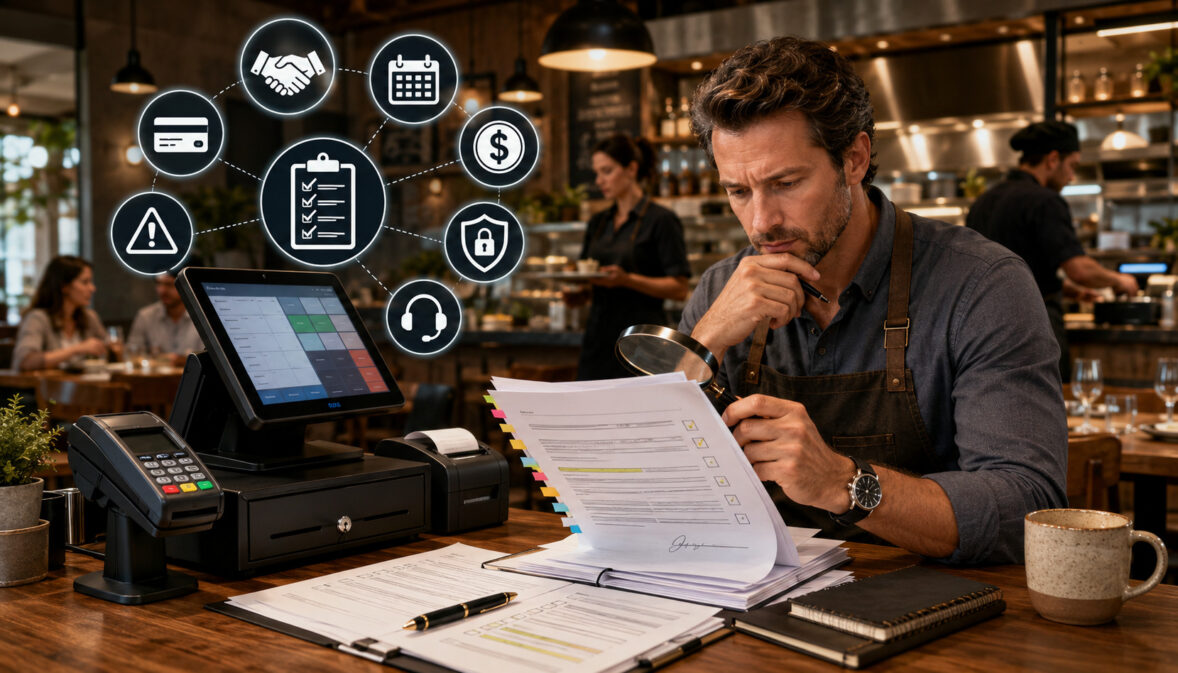
A restaurant point-of-sale system affects far more than checkout. It can control how orders move to the kitchen, how payments are accepted, how employees access the system, how sales are reported, and how customer and transaction records are stored.
For that reason, restaurant POS contracts deserve the same careful review as other important operational agreements. A contract may determine the length of the commitment, the total monthly cost, hardware ownership, payment processing requirements, support availability, data access, renewal rules, and the process for leaving the service.
These issues matter in every food-service environment. A café may prioritize low-ticket transaction costs and fast equipment replacement. A bar may need dependable late-night support and offline payment options.
A food truck may care about mobile connectivity, compact hardware, and seasonal contract flexibility. A full-service restaurant may focus on tableside ordering, tip handling, kitchen routing, and integration reliability.
The sales presentation may explain what a POS platform can do, but the written agreement establishes what each party is obligated to provide.
Reviewing restaurant POS contract terms before signing can help an operator identify unclear pricing, unexpected commitments, operational limitations, and responsibilities that may not have been emphasized during a demonstration.
This guide provides general educational information rather than legal, accounting, payment compliance, cybersecurity, tax, or financial advice. Restaurant owners should involve qualified professionals whenever contract language, processing terms, security responsibilities, or financial obligations require specialized review.
What Are Restaurant POS Contracts?
Restaurant POS contracts are written agreements between a restaurant and one or more providers involved in supplying its point-of-sale environment. Depending on the arrangement, the restaurant may sign separate agreements with a software provider, hardware supplier, payment processor, installer, support provider, payment gateway, or integration partner.
In other situations, several services are bundled into a single restaurant POS vendor agreement. The restaurant may receive software, equipment, payment processing, onboarding, training, and support under one package. Bundling can simplify vendor management, but it may also make individual fees and obligations harder to separate.
A POS contract for restaurants may include a primary service agreement along with pricing schedules, hardware orders, processing applications, privacy policies, support policies, product-specific terms, and addenda. Owners should review the complete set of documents rather than treating the signature page as the entire agreement.
What a POS Contract Usually Covers
A typical restaurant POS service agreement addresses software access, permitted users, devices, implementation, support, updates, integrations, hardware, data handling, pricing, and termination.
When payments are integrated, a separate restaurant POS payment processing agreement may cover processing rates, per-transaction charges, settlement timing, chargebacks, refunds, compliance-related fees, payment equipment, and merchant account responsibilities.
Other documents may define:
- Installation and onboarding services
- Menu programming responsibilities
- Staff training
- Hardware warranties
- Equipment replacement
- Data export options
- Support response times
- Software maintenance
- Auto-renewal
- Cancellation notice
- Liability limits
- Dispute resolution
Each document should be read together because a pricing sheet or order form may modify the general restaurant POS terms and conditions.
Why Owners Should Read the Contract Carefully
A demonstration is designed to show the system’s features. A proposal summarizes pricing and expected services. The contract, however, defines the obligations that apply after the restaurant signs.
Important details may appear in footnotes, linked policies, product schedules, or separate processing documents.
For example, a proposal may describe hardware as “included,” while the restaurant POS hardware agreement classifies it as rented equipment that must be returned. A salesperson may discuss flexible cancellation, while the contract requires notice within a specific renewal window.
Owners should ask for important promises to be included in the written agreement. Verbal explanations, emails, and presentation slides may be useful, but they should not be assumed to override signed contract terms.
Restaurant POS Contract Terms at a Glance
The following table can serve as an initial restaurant POS contract checklist. It does not replace a detailed review, but it helps operators identify the terms most likely to affect cost, flexibility, and daily operations.
| Contract Area | What to Review | Why It Matters | Priority |
| Contract length | Start date, end date, minimum term and renewal | Affects flexibility and long-term commitment | High |
| Pricing | Monthly fees, setup charges, device fees and add-ons | Determines the total operating cost | High |
| Hardware | Purchase, lease, rental, warranty and replacement | Determines ownership and repair responsibilities | High |
| Payments | Processing rates, transaction charges and settlement | Affects the cost and timing of card acceptance | High |
| Cancellation | Notice period, termination fees and final invoices | Determines how the restaurant can exit | High |
| Auto-renewal | Renewal timing and notice requirements | May extend the contract automatically | High |
| Support | Hours, channels, response targets and exclusions | Affects recovery during service disruptions | High |
| Data rights | Access, export, retention and migration | Protects access to business records | High |
| Integrations | Included connections, fees and support responsibility | Affects workflows between business systems | Medium/High |
| Liability terms | Responsibility, limitations and indemnification | May shift significant risk | High |
How to Use the Table
Use the table during vendor demonstrations, proposal comparisons, restaurant POS contract negotiation, and professional review. Mark each term as clear, unclear, acceptable, or requiring revision.
The table is most useful when the restaurant records the vendor’s answer next to the related contract section. If a representative says support is available at all times, identify where the restaurant POS support agreement confirms that availability. If a quoted monthly fee includes several modules, identify which modules are listed on the order form.
Operators can also assign responsibility for reviewing different areas. A manager may assess workflow and training terms, while an accountant reviews recurring charges and a payment professional examines transaction pricing.
Why Every Restaurant May Have Different Contract Priorities
Contract priorities should reflect the restaurant’s operating model. A counter-service café processing hundreds of small transactions may focus on per-transaction charges. A full-service operation may care more about handheld reliability, table management, tip adjustments, and late-night support.
A food truck may need portable equipment, cellular connectivity, short commitments, and dependable offline functions. A bar may require support during evenings, weekends, and holidays. A multi-location operator may prioritize centralized reporting, location pricing, user permissions, data consolidation, and the ability to add or remove sites.
The goal is not to find one universally perfect contract. It is to identify terms that fit the restaurant’s service style, transaction profile, staffing, locations, growth plans, and tolerance for long-term commitments.
Term One: Contract Length and Commitment
Restaurant POS contract length determines how long the restaurant must maintain the service or continue paying contracted charges. Agreements may be month-to-month, annual, or multi-year. Some include an initial term followed by automatic annual renewals.
Owners should identify the effective date, billing start date, implementation date, initial term, expiration date, and renewal date. These dates may not be the same. Billing may begin when the agreement is signed, when hardware ships, or when the account is activated rather than when the restaurant starts using the system.
Short-Term vs. Long-Term Agreements
A short-term restaurant POS subscription agreement may offer greater flexibility when a concept is new, seasonal, relocating, or testing a platform. However, short agreements may carry higher monthly pricing, equipment charges, or limited discounts.
Longer agreements may provide price stability, implementation concessions, or reduced hardware costs. The tradeoff is that the restaurant may have fewer exit options if its operating needs change.
Neither structure is automatically better. Owners should compare the potential savings against the financial and operational consequences of remaining committed for the full term.
Questions to Ask About Commitment
Ask the vendor:
- What is the minimum commitment?
- When does the contract officially begin?
- When does billing begin?
- Is there a trial or pilot period?
- What happens when the initial term expires?
- Can the contract be transferred to a new location?
- What happens if the restaurant closes?
- Can individual locations be removed?
- Does adding equipment restart or extend the term?
Term Two: Pricing and Monthly Fees
Restaurant POS pricing terms should explain the full cost of software, hardware, support, implementation, payments, and optional services. A single advertised monthly rate rarely answers every cost question.
The restaurant may be charged by location, terminal, handheld, employee, module, order channel, or transaction. Certain functions may be available only in higher software tiers.
Subscription Pricing Details
The restaurant POS software contract should identify what is included in the base subscription. Owners should confirm whether the price includes reporting, menu management, kitchen routing, online ordering, gift cards, loyalty tools, inventory features, remote access, and multiple user roles.
Ask whether the subscription price can increase during the initial term and what notice will be provided before a pricing change. Also determine whether taxes, gateway charges, support plans, or third-party subscriptions are billed separately.
Hidden or Overlooked Fees
Restaurant POS contract fees that are sometimes overlooked include:
- Implementation charges
- Menu-entry fees
- Data migration charges
- Training fees
- Additional terminal fees
- Integration subscriptions
- Premium reporting fees
- Support upgrades
- Replacement equipment shipping
- Payment gateway charges
- Location activation fees
- Account closure fees
A helpful review separates one-time costs, recurring fixed costs, transaction-based costs, and event-based charges. The internal guide to restaurant payment processing fees provides additional context on processing markups, gateway charges, equipment costs, and incidental fees.
Term Three: Hardware Purchase, Lease, or Rental Terms
A restaurant POS hardware agreement may cover terminals, tablets, handhelds, card readers, cash drawers, receipt printers, kitchen printers, kitchen display screens, routers, stands, docks, and accessories.
Owners should identify whether each item is purchased, leased, rented, financed, loaned, or supplied conditionally as part of another service.
Hardware Ownership
Purchased equipment generally becomes the restaurant’s property after payment, subject to the agreement. Leased or rented equipment usually remains the provider’s property and may have to be returned.
Equipment described as “free” or “included” may still be connected to a minimum processing commitment or early termination charge. Owners should calculate the total cost across the full hardware term rather than evaluating only the monthly amount.
The contract should also explain whether the equipment can be used with another software platform or payment processor.
Warranty and Replacement Terms
Review the length and scope of the warranty. Determine whether it covers manufacturing defects, accidental damage, liquid exposure, normal wear, power problems, and connectivity failures.
Ask:
- Who performs troubleshooting?
- Who pays for shipping?
- Is an advance replacement available?
- How quickly is replacement equipment sent?
- Is temporary equipment provided?
- Are replacement devices new or refurbished?
- Does replacing hardware create a new commitment?
Equipment planning should also account for spare card readers, printers, cables, and power supplies.
Term Four: Payment Processing Terms
A restaurant POS payment processing agreement can have a greater long-term financial effect than the software subscription. Processing costs may include percentage rates, per-transaction charges, authorization fees, batch fees, monthly minimums, gateway fees, chargeback fees, refund charges, compliance-related fees, and equipment costs.
Owners should review the processing application, program guide, pricing schedule, and merchant terms—not only the POS order form.
Integrated Payments and Contract Bundling
Integrated payments allow the POS and payment system to exchange transaction information directly. This can reduce manual entry and simplify reconciliation, but the restaurant should determine whether the POS requires a particular processor.
Some agreements connect continued software access, hardware discounts, or support benefits to the use of designated processing services. The restaurant should understand what happens to the POS subscription if it changes processors.
For additional operational context, see this guide to restaurant POS systems with integrated payments.
Understanding Transaction Costs
Transaction costs should be evaluated using the restaurant’s actual monthly volume, average ticket, card mix, order channels, and number of transactions.
A percentage alone does not show the full cost. A café with many low-value purchases may be affected heavily by per-transaction charges, while a higher-ticket restaurant may be more sensitive to percentage markups.
Request a sample cost analysis based on recent statements. Ask how in-person, online, contactless, keyed, debit, credit, refund, and chargeback transactions are priced.
Term Five: Cancellation and Early Termination Terms
Restaurant POS cancellation terms establish how the agreement can be ended and what financial or operational obligations continue afterward.
The contract may require notice a certain number of days before expiration. It may also require notice to be delivered through a particular method, such as certified mail, a designated email address, or an online account process.
Early Termination Fees
An early termination fee may be a fixed amount, the remaining subscription balance, a hardware buyout, a processing-related charge, or a combination of these.
Owners should ask whether fees apply when the restaurant closes, relocates, sells, changes ownership, experiences repeated service failures, or cannot complete implementation.
The restaurant should also determine whether terminating the software automatically terminates processing, hardware, integrations, and other linked services.
Exit Process Questions
Before signing, ask:
- Who must receive cancellation notice?
- What form must the notice take?
- How far in advance is notice required?
- How is receipt confirmed?
- What final charges may apply?
- When does software access end?
- How long will data remain available?
- Which equipment must be returned?
- Who pays return shipping?
- When will deposits or reserves be released?
A clear exit plan is useful even when the restaurant expects a successful long-term relationship.
Term Six: Auto-Renewal and Renewal Notice
Auto-renewal provisions extend a contract unless the restaurant cancels within the specified notice window. A one-year agreement may renew for another full year if notice is not submitted on time.
Renewal language should identify the length of each renewal term, the cancellation window, the permitted notice method, and whether pricing may change.
Why Auto-Renewal Matters
A restaurant may decide to switch systems near the end of the initial term but discover that the cancellation deadline passed several weeks earlier. It may then remain responsible for another renewal period.
Rules affecting automatic renewal and cancellation can depend on the agreement and applicable law. Federal business guidance discusses the importance of clear terms and cancellation practices in negative-option arrangements, but owners should obtain qualified legal review for their specific situation.
How to Track Renewal Dates
Store the signed agreement in a central contract folder and record:
- Initial expiration date
- Renewal term
- Earliest review date
- Cancellation deadline
- Required notice method
- Vendor notice address
- Internal decision owner
Set multiple reminders well before the notice deadline. Waiting until the final week may leave too little time to review alternatives, export data, arrange new hardware, and train staff.
Term Seven: Implementation and Onboarding Terms
Restaurant POS implementation terms should define what the vendor will configure and what the restaurant must provide.
Implementation can involve menu entry, modifier creation, taxes, service charges, user permissions, printer routing, kitchen display setup, payment activation, online ordering, gift cards, loyalty tools, integrations, hardware installation, testing, and training.
What Implementation Should Include
The agreement should specify who is responsible for:
- Entering menu items and prices
- Building modifiers
- Configuring taxes and fees
- Installing equipment
- Connecting printers and kitchen screens
- Creating employee permissions
- Testing payments
- Migrating customer or gift card data
- Training staff
- Supporting the launch
The restaurant POS setup guide provides a useful operational overview of menu configuration, hardware installation, network preparation, testing, and staff readiness.
Timeline and Delay Questions
Ask for estimated milestones and identify dependencies. Implementation may be delayed if equipment is backordered, internet service is unavailable, menu information is incomplete, or payment approval is pending.
The contract should explain whether implementation charges are refundable, whether billing begins during a delay, and who pays for additional work caused by incomplete information or scope changes.
Restaurants should avoid scheduling a high-volume launch until ordering, kitchen routing, receipts, reports, payments, refunds, and offline procedures have been tested.
Term Eight: Training and Staff Support Terms
Training affects whether the restaurant can use the POS consistently after launch. The restaurant POS vendor agreement should identify the number, format, and duration of included training sessions.
Training may be remote, recorded, self-guided, on-site, or delivered through a combination of methods.
Role-Based Training Needs
Different employees need different instruction. Servers may need table management, split checks, modifiers, and tip workflows. Bartenders may need tabs, preauthorizations, and quick-item entry. Kitchen employees need kitchen display or printer workflows.
Managers may require permissions, refunds, voids, closeout, reporting, labor controls, menu editing, and user management. Owners may need financial reporting, remote access, audit logs, and multi-location controls.
Training should reflect the restaurant’s actual service model rather than relying only on a general product tour.
Ongoing Training Access
Determine whether training remains available after implementation. New managers and employees may join months later, and menus or workflows may change.
Ask whether recorded tutorials, searchable documentation, practice environments, scheduled classes, and additional trainer sessions are available. Clarify whether extra training is included or billed hourly.
Term Nine: Technical Support and Service Levels
A restaurant POS support agreement should describe support hours, communication channels, escalation procedures, and any applicable service targets.
Support may be offered by phone, chat, email, remote access, or on-site service. Some channels may be available only under premium plans.
Support Availability
Restaurant operating hours often extend beyond standard business hours. Owners should confirm whether support is available during nights, weekends, holidays, and peak periods.
Ask whether after-hours support covers all issues or only complete outages and payment failures. Also determine whether hardware, software, processing, and integrations are supported by the same team.
Response Time and Resolution Expectations
Response time is the time required for the provider to acknowledge a request. Resolution time is how long it takes to correct the issue. These are not the same.
A service level agreement may categorize incidents by severity and assign different targets. Review how the vendor defines a critical issue. A single unavailable terminal may be considered less severe than a systemwide outage, even when that terminal is essential to a small restaurant.
Ask how unresolved cases are escalated and whether service credits are available when contractual targets are missed.
Term Ten: Software Updates and Maintenance
Restaurant POS software contracts usually permit the provider to update the platform. Updates may include security patches, bug fixes, compatibility changes, interface modifications, and new features.
The agreement should explain whether updates are automatic, optional, scheduled, or controlled by the vendor.
Who Controls Updates
Cloud-based platforms may apply updates centrally. Locally installed systems may require manual installation or scheduled maintenance.
Ask whether the restaurant can postpone noncritical updates, how much notice is provided, and whether older hardware or operating systems may become unsupported.
Update Risks and Planning
Updates may affect menus, reports, integrations, printers, card readers, user permissions, or kitchen workflows. Owners should ask whether updates are tested with supported third-party integrations and what recovery options exist if a release creates problems.
Restaurants should also know whether major new features are included in the subscription or sold as separate add-ons.
Term Eleven: Uptime, Downtime, and Offline Mode
The restaurant should understand what the vendor promises regarding system availability and what happens when software, hardware, payment services, local networks, or internet connections fail.
An uptime percentage may exclude scheduled maintenance, third-party outages, local internet failures, hardware problems, and events outside the provider’s control.
Offline Mode Questions
Ask whether the system can perform the following without an internet connection:
- Open and edit orders
- Send tickets to the kitchen
- Print receipts
- Accept card payments
- Store payment authorizations
- Apply tips
- Process refunds
- Sync transactions after service returns
Offline payment acceptance may involve financial and fraud risks. Restaurants should obtain guidance from their payment professional before enabling or changing offline payment settings.
Downtime Responsibility
The contract may treat vendor software failures differently from local network, internet, hardware, processor, or user errors.
Owners should identify who troubleshoots each component and whether the support team coordinates with outside providers. A documented backup procedure should explain how staff take orders, communicate with the kitchen, calculate totals, and record payments during an outage.
Term Twelve: Data Ownership and Data Access
Restaurant POS data ownership is one of the most important long-term contract issues. POS records may include sales totals, transaction histories, menu data, employee activity, customer profiles, gift card balances, loyalty records, inventory information, and operational reports.
The contract should distinguish between restaurant data, payment data, platform-generated analytics, aggregated data, and provider-owned software.
Who Owns the Restaurant’s Data?
Owners should confirm whether they can access and export their business records throughout the contract and after cancellation.
The agreement may grant the vendor permission to process, store, aggregate, or analyze certain data. Restaurants should understand the scope of those rights and whether information may be shared with integration partners or service providers.
Data Export and Migration Terms
Ask:
- Which records can be exported?
- Which file formats are available?
- Are exports self-service?
- Is there a migration fee?
- Are customer and loyalty records included?
- Can gift card balances be transferred?
- How long is data retained after cancellation?
- When will the account become inaccessible?
- Can reports be generated after termination?
Request a sample export before signing. A statement that data is “available” is less useful if the format cannot be imported into another system.
Term Thirteen: Privacy and Security Terms
Privacy and security provisions should explain how the provider handles restaurant, employee, customer, and transaction information. Relevant documents may include a privacy policy, data-processing addendum, security schedule, backup policy, and incident-response terms.
Review access controls, user permissions, authentication options, encryption, backups, logging, remote access, and breach notification responsibilities.
Customer and Payment Data Protection
A restaurant should know what customer information is collected, why it is collected, where it is stored, and which vendors can access it.
Payment security resources for merchants emphasize understanding the complete payment environment, including terminals, connected systems, networks, gateways, and external service providers.
Restaurants can also review this educational guide to PCI compliance for restaurants for additional background on payment workflows and operational responsibilities.
Security Responsibilities Shared by Both Sides
A provider may supply security controls, but the restaurant still manages employee accounts, passwords, permissions, physical devices, network access, and staff behavior.
Federal small-business guidance recommends including security expectations in vendor contracts and planning for controls to be reviewed as threats change.
Owners should involve a qualified cybersecurity advisor when evaluating access controls, backups, incident notification, or technical security commitments.
Term Fourteen: PCI and Payment Compliance Language
Restaurants accepting payment cards may encounter contract language related to payment security standards, validation, questionnaires, scanning, equipment, and secure transaction handling.
The agreement may assign responsibilities to the restaurant, processor, gateway, software provider, and other service providers.
Why PCI Language Matters
Payment security requirements can apply to merchants of every size, although validation and reporting requirements may vary. Restaurants should ask their acquirer or payment professional which requirements apply to their specific payment environment.
A contract may also include fees connected to compliance tools, incomplete validation, security scans, or noncompliance. Owners should understand what service is being provided and which actions remain their responsibility.
Questions to Ask Payment Providers
Ask:
- Which payment-security services are included?
- Are compliance-related fees charged?
- Who provides validation instructions?
- Is tokenization used?
- Is payment data encrypted?
- Can staff access full card information?
- How are security incidents reported?
- Who coordinates breach response?
- Are remote-access tools used?
- Which payment devices are supported?
These questions are educational starting points. A payment professional and cybersecurity advisor should evaluate the restaurant’s actual environment.
Term Fifteen: Integration Terms
Restaurant POS integrations may connect the platform with accounting software, online ordering, delivery services, reservations, loyalty programs, gift cards, inventory tools, payroll exports, marketing platforms, and application programming interfaces.
The contract should identify which integrations are supported and who is responsible when information does not sync correctly.
Included vs. Paid Integrations
An integration shown during a demonstration may require a separate subscription, activation fee, third-party agreement, or higher software tier.
Ask whether fees are charged per location, device, order, employee, or month. Also determine whether the integration is built and maintained by the POS provider or by an outside developer.
Integration Reliability and Support
When an integration fails, each provider may direct the restaurant to the other. The agreement should identify the first point of contact and describe how vendors coordinate troubleshooting.
Ask what happens if an integration is discontinued, materially changed, or no longer supported. Restaurants should avoid assuming that every current integration will remain available for the full contract term.
Term Sixteen: Add-On Features and Future Costs
POS platforms often offer add-ons such as online ordering, loyalty programs, gift cards, inventory management, kitchen displays, advanced reporting, marketing tools, handheld devices, and multi-location dashboards.
The restaurant POS subscription agreement should explain how these additions affect pricing and contract length.
Feature Bundles
Bundles can reduce the number of separate services a restaurant manages. However, the restaurant may pay for features it does not use or may be unable to remove one module without changing the entire package.
Owners should compare bundled pricing with the cost of required features only. They should also ask whether introductory discounts expire.
Future Upgrade Costs
Ask how pricing changes when the restaurant adds:
- A terminal
- A handheld
- A kitchen screen
- A location
- A manager account
- An ordering channel
- A report package
- An integration
- A loyalty program
- Premium support
Determine whether adding a feature creates a new minimum term or changes the renewal date for the full agreement.
Term Seventeen: Hardware Return and End-of-Contract Rules
Leased, rented, or loaned equipment generally must be returned after cancellation. The contract should identify the return deadline, destination, condition requirements, and charges for missing or damaged items.
Return obligations may include terminals, tablets, readers, stands, docks, cables, power adapters, routers, printers, and accessories.
Return Conditions
Owners should document hardware condition when it is received and maintain an equipment inventory. Photographs, serial numbers, shipment records, and signed delivery documents can help resolve later disagreements.
Ask whether normal wear is accepted and whether the restaurant must use a vendor-issued return label. Confirm how delivery is verified.
End-of-Term Hardware Planning
Hardware return rules can affect the switching timeline. A restaurant may need the existing system until the replacement platform is installed, tested, and operational.
Plan for overlapping access when appropriate. Export data, complete final reports, test replacement hardware, and confirm payment readiness before disconnecting or returning the existing system.
Term Eighteen: Warranties and Disclaimers
Warranty provisions explain what the provider promises about software and hardware. Disclaimer provisions describe what the provider does not promise.
Software may be provided subject to limitations involving uninterrupted availability, third-party services, internet access, reporting accuracy, or compatibility.
Hardware Warranty Questions
Ask:
- How long is equipment covered?
- What defects are included?
- Is accidental damage excluded?
- Who pays shipping?
- How quickly is equipment replaced?
- Is on-site service available?
- Is replacement equipment covered by a new warranty?
- Are consumables and accessories covered?
Software Warranty Questions
Review how the contract addresses bugs, reporting errors, service interruptions, and feature changes. Determine what remedy is available if the software does not function as documented.
The available remedy may be limited to support, correction, a service credit, or termination under specific conditions. An attorney should review limitations that appear inconsistent with the restaurant’s operational risk.
Term Nineteen: Liability Limits and Indemnification
Liability limitations and indemnification clauses allocate responsibility when a loss, claim, dispute, or third-party action occurs.
These provisions can be complex and may affect the types of damages that can be recovered, the maximum amount recoverable, and which party must defend certain claims.
Why Liability Terms Need Careful Review
A contract may exclude lost profits, lost data, indirect damages, service interruption losses, or third-party failures. It may also limit liability to fees paid during a defined period.
Restaurants should not assume the vendor will cover every loss caused by an outage, reporting error, security incident, integration failure, or equipment problem.
When to Ask an Attorney
Professional legal review is especially important when:
- Liability is heavily one-sided
- Indemnification duties are broad
- Data or security responsibilities are unclear
- The contract is difficult to terminate
- Multiple related agreements apply
- Significant equipment or processing commitments are involved
- The agreement covers several locations
This article cannot determine whether a particular clause is fair, enforceable, or appropriate for a specific restaurant.
Term Twenty: Dispute Resolution and Governing Law
Dispute provisions establish how disagreements are handled. The contract may require informal notice, management escalation, mediation, arbitration, or court proceedings.
It may also identify governing law, venue, filing deadlines, notice addresses, and rules for recovering costs.
Why Dispute Terms Matter
These terms can affect where a dispute occurs, how much the process costs, whether a jury trial is available, and whether claims can be combined with those of other customers.
Owners should also review whether continued payment is required while a billing or service dispute is unresolved.
Review Before There Is a Problem
Dispute clauses are easiest to evaluate before the relationship begins. After a problem develops, the restaurant may already be bound by the agreed procedure.
Ask an attorney to explain unclear arbitration, venue, indemnification, limitation, or notice provisions before signing.
Restaurant POS Agreement Checklist
Use the following restaurant POS agreement checklist when comparing proposals or preparing for professional review.
| Contract Term | What to Review | Question to Ask | Priority |
| Contract length | Initial term, start date and renewal | How long am I committed? | High |
| Pricing | Monthly, setup, device and add-on fees | What is included in the total cost? | High |
| Hardware | Purchase, lease, warranty and return | Who owns the equipment? | High |
| Payments | Rates, fees, funding and processing requirements | Is designated processing required? | High |
| Cancellation | Notice method and termination charges | How do I exit the agreement? | High |
| Auto-renewal | Renewal period and notice window | When must notice be delivered? | High |
| Support | Hours, channels and response targets | Who helps during active service? | High |
| Data access | Export, format and retention | Can I keep usable copies of my records? | High |
| Integrations | Included connections and support | Who resolves synchronization failures? | Medium/High |
| Liability | Limits, exclusions and indemnification | Should an attorney review these clauses? | High |
How to Use the Checklist
Complete the restaurant POS contract checklist for every proposal. Do not combine answers from different vendors or rely on memory.
Record the contract page, section number, quoted fee, and vendor explanation for each item. Highlight conflicts between the proposal and the agreement.
Use the checklist before a demonstration, before signing, during implementation, before adding major features, and before renewal.
Records to Keep With POS Contracts
Maintain a central file containing:
- Signed service agreements
- Order forms
- Pricing schedules
- Hardware inventories
- Payment processing terms
- Integration agreements
- Training commitments
- Support contacts
- Renewal deadlines
- Cancellation instructions
- Notices and delivery confirmations
- Data export procedures
- Final invoices
- Contract amendments
Limit access to authorized managers while ensuring that more than one responsible person knows where the records are stored.
Common Mistakes Restaurant Owners Make With POS Contracts

A common mistake is focusing only on the monthly software price. The total cost may also include hardware, processing, implementation, integrations, support, training, and eventual switching expenses.
Other mistakes include ignoring renewal language, failing to test data exports, overlooking hardware ownership, and assuming support is available whenever the restaurant is open.
Trusting Verbal Promises Over Written Terms
A representative may sincerely describe a feature, price, or service based on current information. However, personnel, policies, and product capabilities can change.
Ask for important commitments to be added to the contract, order form, or signed addendum. This includes pricing concessions, implementation duties, hardware quantities, support availability, migration assistance, and cancellation arrangements.
Not Comparing Total Cost
Calculate projected costs across the full contract term. Include:
- Software subscriptions
- Hardware payments
- Payment processing
- Setup and implementation
- Training
- Integrations
- Support plans
- Add-ons
- Replacement equipment
- Cancellation obligations
- Data migration and switching
A lower monthly subscription may not represent a lower total cost.
Best Practices for Reviewing Restaurant POS Contracts

A consistent restaurant POS contract review process improves comparison and reduces the chance that an important term will be overlooked.
Recommended practices include:
- Read every contract document before signing.
- Compare the agreement with the proposal.
- Request an itemized fee summary.
- Review payment processing separately.
- Confirm the initial and renewal terms.
- Identify all cancellation requirements.
- Clarify equipment ownership and return obligations.
- Test data export options.
- Review support hours and escalation.
- Confirm implementation responsibilities.
- Identify paid integrations.
- Track notice deadlines.
- Store all documents centrally.
- Place important verbal promises in writing.
- Obtain qualified professional guidance.
Create a Contract Review Routine
Review the agreement at four key points:
- Before signing
- After implementation
- Before adding major services
- Several months before renewal
The post-implementation review should confirm that billing, equipment, software modules, payment pricing, and support match the signed documents.
Involve the Right People Before Signing
The owner may lead the review, but operational managers, finance staff, IT support, payment professionals, and legal counsel can identify different risks.
Managers can evaluate workflow and training. Finance staff can compare total costs. Payment professionals can review processing structures. Cybersecurity advisors can assess access, backup, and incident terms. Attorneys can interpret legal obligations and risk allocation.
Questions to Ask Before Signing a POS Contract for Restaurants
The following questions can be used during demonstrations, proposal reviews, and restaurant POS contract negotiation.
Cost and Payment Questions
- What is the complete monthly cost?
- Which features cost extra?
- Are setup or implementation fees charged?
- Are device or user fees charged?
- Is payment processing required?
- How are in-person and online transactions priced?
- Are batch, gateway, refund, chargeback, or compliance-related fees charged?
- What are the hardware costs?
- Can pricing change during the initial term?
- What cancellation charges may apply?
Operational and Support Questions
- When is live support available?
- What qualifies as an emergency?
- How are outages escalated?
- What works in offline mode?
- Who configures the menu?
- How much training is included?
- How quickly is failed hardware replaced?
- Which integrations are included?
- Who supports integration failures?
- Can all important data be exported?
- How long is data retained after cancellation?
- How are software updates scheduled?
- What happens if an implementation deadline is missed?
Ask the vendor to show where each answer appears in the agreement.
How to Compare Restaurant POS Vendor Agreements

A useful comparison places written terms side by side. Create categories for software, hardware, processing, implementation, support, data, integrations, renewal, cancellation, and liability.
Apply the same operating assumptions to every proposal. Use identical transaction volume, ticket size, terminal count, location count, modules, and support requirements.
Compare Written Terms, Not Just Demos
A demonstration shows how the platform performs under prepared conditions. It may not reveal contract commitments, exclusions, processing requirements, support limitations, or data-export restrictions.
After each demonstration, compare the agreement rather than ranking vendors solely by interface or feature count.
Choose Contract Fit Over Feature Count
The most suitable arrangement should support the restaurant’s actual operations and budget. A long feature list has limited value if the contract creates unpredictable costs, weak support coverage, unsuitable payment terms, or difficult exit conditions.
Consider:
- Service model
- Transaction profile
- Operating hours
- Number of locations
- Hardware needs
- Staff training needs
- Reporting requirements
- Integration dependencies
- Growth plans
- Desired flexibility
Frequently Asked Questions
What should restaurant owners review in POS contracts?
Owners should review contract length, software pricing, payment processing, hardware ownership, implementation, support, data access, integrations, renewal, cancellation, warranties, liability, and dispute provisions. They should also identify every incorporated document and compare the written terms with the proposal.
What are common restaurant POS contract terms?
Common restaurant POS contract terms include monthly subscriptions, device fees, minimum commitments, auto-renewal, cancellation notice, early termination fees, hardware return requirements, payment processing charges, support hours, data rights, software updates, and liability limitations.
The exact combination depends on whether software, equipment, processing, and support are bundled.
How long are restaurant POS contracts usually?
Contract structures vary. Some are month-to-month, while others use annual or multi-year commitments. An initial term may be followed by automatic renewal periods. Owners should verify both the contract duration and the cancellation notice deadline.
What fees should owners look for in a POS contract?
Review software subscriptions, device fees, location fees, setup, implementation, training, processing, gateways, integrations, support upgrades, replacement equipment, chargebacks, refunds, compliance-related programs, cancellation, and data migration. Request both an itemized price list and an estimated total monthly cost.
What should a restaurant POS agreement checklist include?
A restaurant POS contract checklist should include the term, renewal, total pricing, hardware ownership, processing requirements, cancellation, support, implementation, training, data export, privacy, security, integrations, warranties, and legal risk provisions. It should also show where each answer appears in the contract.
Why do payment processing terms matter in POS contracts?
Payment processing fees apply repeatedly as the restaurant accepts transactions. Small differences in percentage rates, per-transaction charges, gateway fees, and monthly costs can become significant over the contract term.
Processing requirements may also affect whether the restaurant can change processors without changing POS systems.
Can a restaurant cancel a POS contract early?
Early cancellation may be possible, but fees, notice requirements, hardware obligations, and continuing payment responsibilities may apply. The answer depends on the signed agreement and applicable law. A qualified attorney should review the restaurant’s specific contract and circumstances.
Conclusion
Restaurant POS contracts affect much more than access to software. They can determine how long the restaurant remains committed, what it pays each month, who owns the hardware, how payments are processed, when support is available, and whether business records remain accessible after cancellation.
Before signing, owners should understand restaurant POS contract length, pricing, processing fees, hardware terms, cancellation requirements, auto-renewal, implementation, training, support, offline capabilities, integrations, data rights, security responsibilities, warranties, liability limits, and dispute provisions.
A strong POS decision is not based only on features. It also depends on clear responsibilities, understandable costs, dependable operational support, usable data access, and contract terms that fit the restaurant’s service model.
Restaurant owners should read the complete agreement, document vendor answers, compare total costs, track renewal deadlines, and seek qualified legal, accounting, payment, cybersecurity, tax, or business guidance before signing or materially changing a contract.