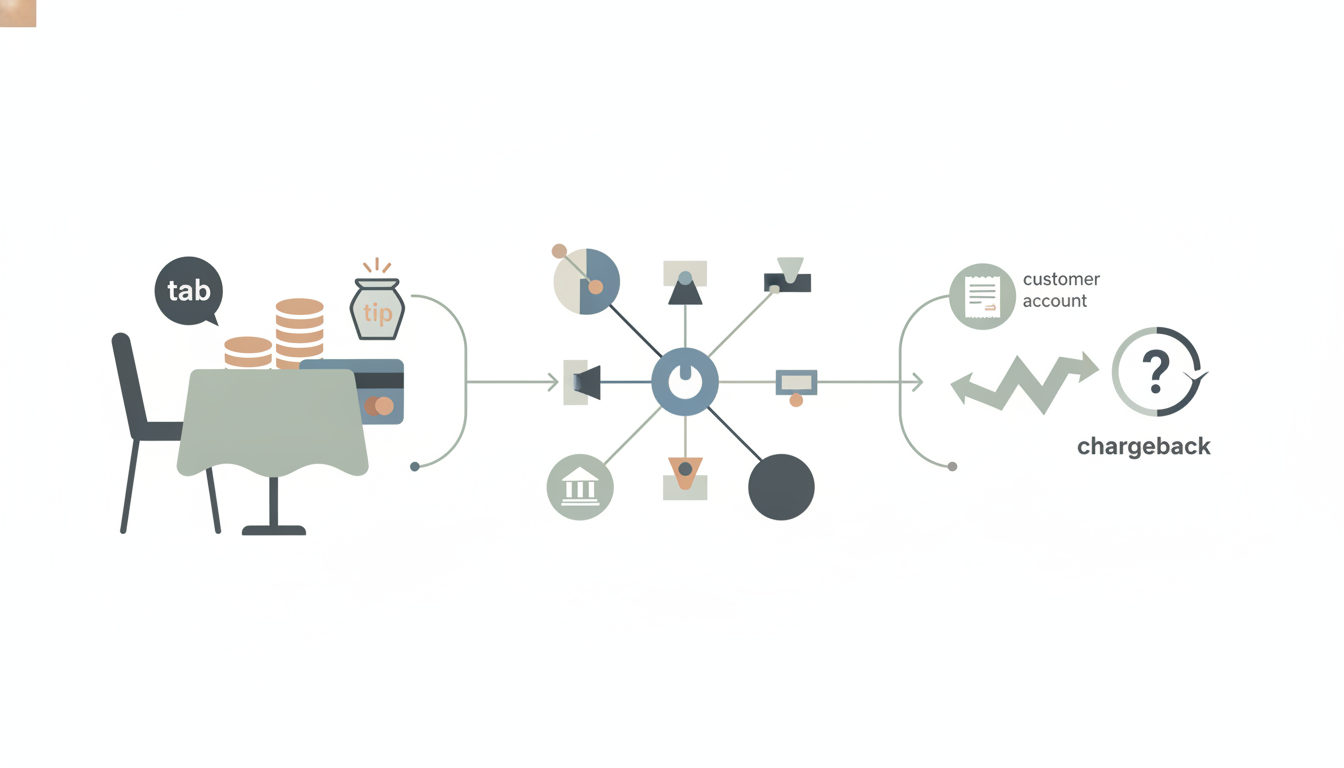
A card tab authorizes at the table, adjusts when the tip is written, batches at your cut-off, then clears and funds as one net deposit.
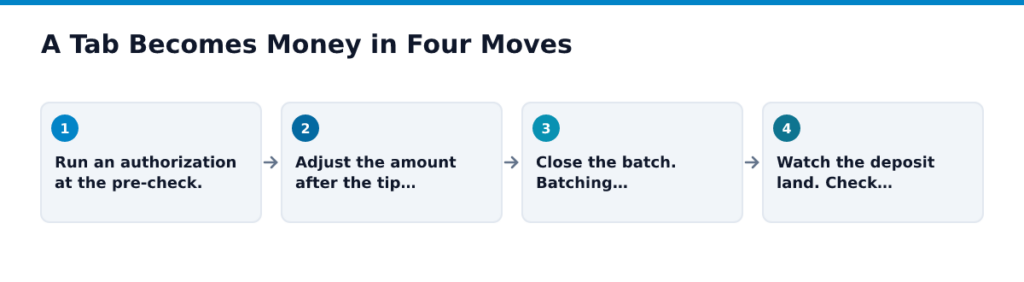
A Tab Becomes Money in Four Moves
Walk this sequence once with your own terminal on a slow afternoon, before you sign anything.
- Run an authorization at the pre-check. The server dips or taps, and your payment gateway sends the request to the issuer, the bank that gave the guest the card. Check that the printed slip shows an approval and a hold amount, because a hold reserves the guest’s credit; no money has moved.
- Adjust the amount after the tip is written. A retail store captures the exact sale once, but you authorize an estimate and then submit a higher final figure. Check that your POS shows a tip-adjustment window and confirm how long it stays open on an unadjusted check.
- Close the batch. Batching is the moment your POS hands the day’s adjusted sales to your acquirer, the bank or processor that holds your merchant account. Check the cut-off time in the settings, then check what happens to a tab closed after it, because that sale rides on tomorrow’s batch and funds a day later.
- Watch the deposit land. Check the deposit against the batch report, not against the day’s sales total.
You’ve done this correctly when you can point to a single dinner check and name its authorized amount, its adjusted amount, the batch it rode in, and the deposit line it landed in. That trail is the backbone of Restaurant Payment Processing: How It Works and What Payment Methods to Use. Next-day funding shortens the wait without lowering the cost of acceptance, so ask whether it’s bundled or billed, and what time the batch has to close to qualify.
The Tip Line Is Where Restaurant Payments Get Strange
When a server runs a card for a $60 check, the authorization usually isn’t for $60. Without that cushion, a generous tip pushes the captured total above the hold, and the transaction either downgrades or needs a second authorization the guest already walked away from.
The tip only becomes real if someone adjusts it before the batch closes. Miss the cut-off and the sale settles at the pre-tip amount, the server is still owed the money, and the restaurant pays that tip out of its own account with no card funding behind it. Recovering it means a fresh transaction the guest never agreed to. Pay-at-table terminals and QR code payment flows sidestep this entirely by capturing the tip at authorization, so there’s nothing left to adjust.
The money itself belongs to the employee. An employer can’t keep tips for any purpose, and managers and supervisors can’t take a share of a tip pool, whether or not the business claims a tip credit (Fact Sheet #15A). Under federal rules, an employer may deduct the card processing fee attributable to the tip portion, provided the deduction doesn’t drop the employee below minimum wage (Fact Sheet #15). Several states are stricter, so check yours before you configure the setting. Large food or beverage establishments also file Form 8027 each year to report receipts, tips, and any allocated tips (About Form 8027, Employer’s Annual Information Return of…).
Match the tip report to the batch report every night. Weekly reconciliation finds the same errors after the payroll run that would have fixed them.
What Comes Out of the Deposit
Between the batch and the bank, the sale passes through three parties who each take a slice, plus whatever your processor bills monthly. Each slice has a name and an owner, and a statement that won’t tell you both is a statement you should be able to demand better than. Here’s the stack, top to bottom.
| Fee | Who receives it | How it’s set | Typical basis | Negotiable |
|---|---|---|---|---|
| Interchange | The bank that issued the guest’s card | Percentage plus a per-item amount | No | |
| Debit interchange (covered issuers) | Issuing bank | Capped by Regulation II; cards must carry at least two unaffiliated networks so you can route Restaurant Payment Processing Fees Explained (12 CFR Part 235) | Per item plus a small percentage | No, but routing choice is yours |
| Batch fee | Processor | Contract | Per settlement batch | Yes |
Only one row moves when you negotiate. That’s why Flat-Rate vs Interchange-Plus Pricing for Restaurants matters: a flat rate folds all four top rows into one number, so you never see the margin you’re paying. Before you compare quotes, read Understanding Merchant Accounts for Restaurants and ask for the markup as a single figure in writing.
Chargebacks: The Reversal That Runs Backward Through the Same Rails
A dispute travels the settlement path in reverse. The guest calls their issuer, the issuer debits the acquirer, and the acquirer debits your merchant account, often weeks after the plates were cleared. The money is simply gone from a later deposit, usually with a line item on the statement naming the case and a filing deadline attached.
Regulation Z sets the consumer side of that clock. A cardholder has to put a billing error in writing to the issuer within 60 days after the creditor sends the first periodic statement showing the charge, and the creditor must acknowledge the notice within 30 days and resolve it within two complete billing cycles, capped at 90 days (§ 1026.13 Billing error resolution). That’s why a Friday night in March can hit your account in May.
Restaurant disputes cluster around a few causes. A descriptor that shows a holding-company name nobody recognizes. A tip keyed higher than what the guest wrote on the slip. A batch sent twice. A delivery order taken over the phone and keyed by hand. We walk through the pattern in more detail in What Causes Chargebacks in Restaurants, and the fraud side in How Contactless Payments Reduce Fraud.
Fix the descriptor to your trade name and city. Retain signed tip slips. Cap and audit tip adjustments so a server can’t turn a $4 tip into $40. Representment claws back a fraction of what those habits would have kept, and it costs a manager an hour per case.
Where Card Data Lives in Your Restaurant
PCI DSS applies to every entity that stores, processes, or transmits cardholder data, which includes your restaurant and the POS terminals on the line (PCI Data Security Standard (PCI DSS)). What doesn’t change is the obligation.
Shrink the footprint before you buy a single control. Point-to-point encryption scrambles the card data inside the reader, so what reaches your POS is a token, a stand-in value that’s useless to a thief and still lets you run a tip adjustment or a refund. A terminal that never hands a real card number to your software takes most of the system out of scope.
Scope creeps back in through paper and inboxes. Watch for these:
- Card numbers written on phone-order tickets and left in a spike by the expo window.
- Catering deposits emailed by a client and sitting in a manager’s mailbox for months.
- Reservation notes with a card on file for no-show protection.
Ask your processor which questionnaire your setup qualifies for and who holds the encryption keys. Our Restaurant POS Security Checklist walks the rest.
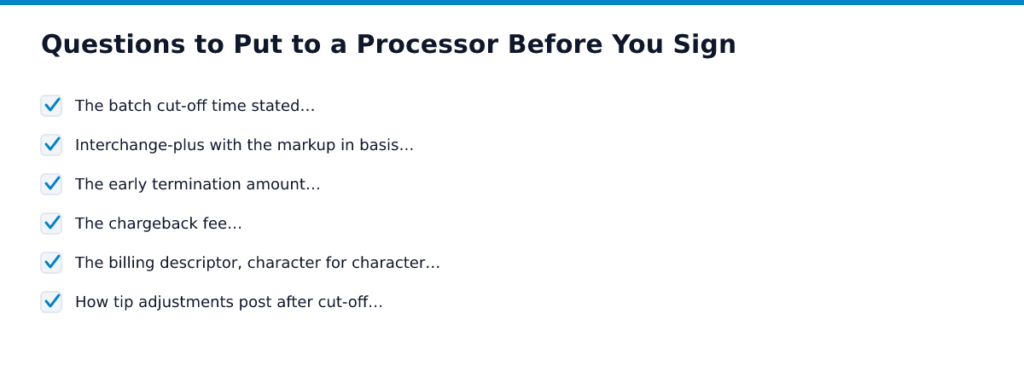
Questions to Put to a Processor Before You Sign
Ask these in writing, in an email you keep, before the equipment ships. A salesperson’s verbal answer isn’t a term, and the answers you get back tell you as much about the processor as the numbers do.
- The batch cut-off time stated in your time zone, and whether next-day funding is included or billed.
- Interchange-plus with the markup in basis points and per-item cents, or a blended rate.
- The early termination amount, and whether the hardware sits on a separate non-cancelable lease.
- The chargeback fee, and whether it’s refunded when you win the dispute.
- The billing descriptor, character for character, as it will print on a statement.
- How tip adjustments post after cut-off, and the authorization pad percentage applied at swipe.
Two of those questions decide your cost; the lease and termination language decide what an exit costs you. Our guide to Restaurant POS Contracts: Terms Owners Should Review covers the clauses behind them, and Common Restaurant POS Buying Mistakes covers what owners sign anyway.
Print the sheet, get the answers dated and signed, then run a live card and a tip adjust on your own terminal before the first shift. Our Restaurant POS Setup Guide for Small Businesses gives you the order to do it in.
Frequently Asked Questions
How much do merchant processors make on a restaurant transaction?
Your processor keeps the margin above interchange and network assessments, and on an interchange-plus contract that margin is a disclosed number, typically quoted as basis points plus a per-transaction amount. What decides your effective cost is the mix underneath it: card-present dine-in swipes on regulated debit price differently from a rewards credit card typed into an online ordering page, and Regulation II caps what an issuer above the asset threshold may charge on debit interchange (12 CFR Part 235). On a flat-rate account you can’t see the split at all, which is the real cost of that pricing model. Ask for the margin as one number in writing and compare it against your last three statements, not against a competitor’s headline rate.
What is the best payment system for a restaurant?
The right system is the one that matches your service model and doesn’t lock the hardware to the processor. A full-service house with tabs, coursing, and tip adjust needs open-check handling and a clean batch cut-off; a counter-service or ghost-kitchen operation needs fast tender and clean online-order routing more than it needs table maps. Check three contract terms before you check features: the termination clause, whether the terminals are leased or purchased, and whether you can switch processors while keeping the software. A system that stores no card data on your premises also shrinks your PCI scope, which cuts what you have to secure and document (PCI Data Security Standard (PCI DSS)).
Why does a pending charge on my card show more than my check total?
Because the restaurant authorized an amount padded above the check to cover a tip that hasn’t been written yet, and that padded authorization is what your bank displays until the final amount clears. Guests who see the padded figure sometimes call the bank instead of the restaurant, which starts a billing-error dispute under Regulation Z rather than a phone call you could have resolved (§ 1026.13 Billing error resolution). Printing a line on the receipt explaining the temporary hold prevents more of those calls than any representment ever recovers.